What Causes a Rainbow? How Rainbows Form
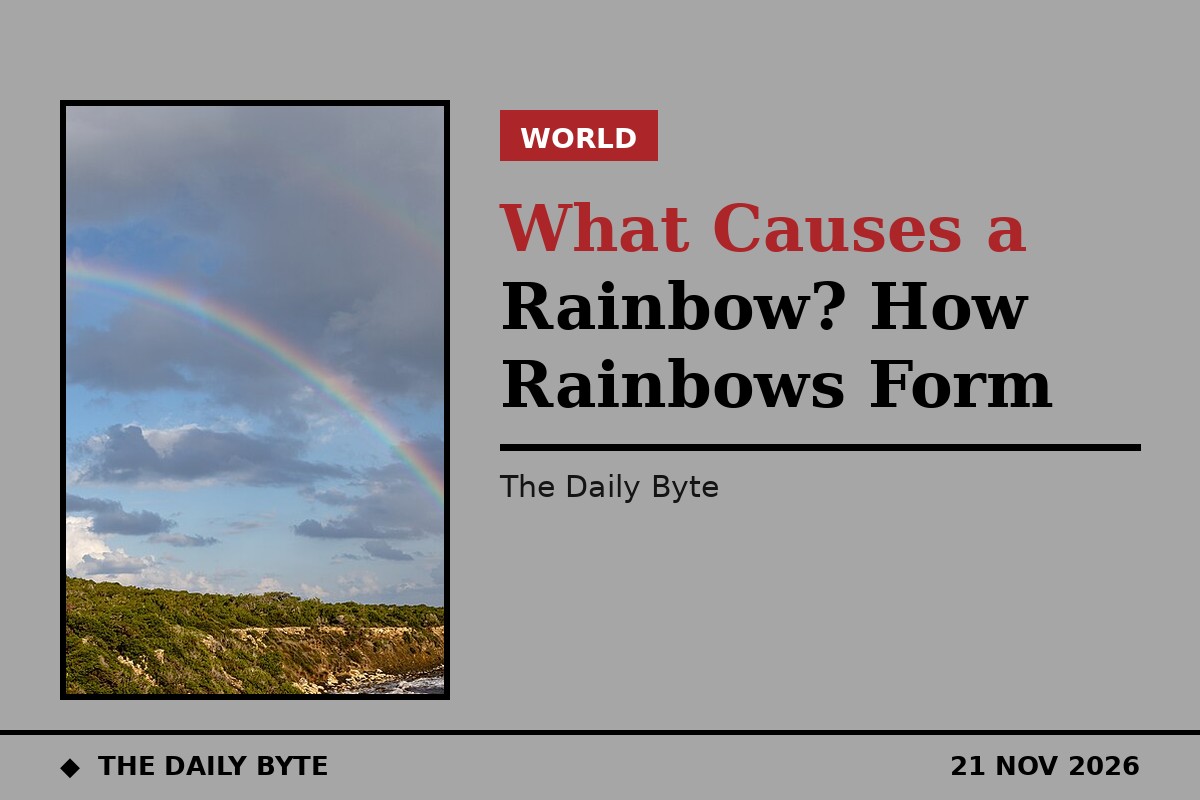
A rainbow is caused by sunlight being split into its colours inside raindrops. When the Sun is low behind you and rain is falling in front of you, each raindrop bends the sunlight entering it, bounces it off the inside back wall of the drop, and bends it again as it leaves. Because each colour bends by a slightly different amount, the white sunlight fans out into a spectrum, and millions of drops working together paint a bow across the sky.
That is the whole trick, and it is also why a rainbow is not a thing you can walk up to. It is an optical effect that depends entirely on where you are standing relative to the Sun and the rain. Move, and the rainbow moves with you. Another person standing a few steps away is, strictly speaking, looking at a different rainbow, made by a different set of raindrops.
Three ingredients: low Sun, rain and the right angle
A rainbow can only appear when three conditions are met at the same time. First, the Sun must be above the horizon and shining, not hidden behind cloud. Second, the Sun has to be fairly low in the sky: if you are standing on level ground, its altitude must be below 42 degrees, which is why rainbows are most common in the morning and late afternoon, and never appear around midday in summer. Third, the air in the part of the sky opposite the Sun must be full of water droplets, usually falling rain.
The geometry matters because a rainbow always appears in the sky directly opposite the Sun. Turn your back to the Sun and the bow will arch across the sky in front of you, centred on the point directly opposite the Sun, known as the antisolar point. Your own shadow points towards it. That is also why the most spectacular rainbows appear when half the sky is still dark with rain cloud while the Sun shines on you from behind: the bow stands out against the darkened sky.
What happens inside a raindrop
Three separate processes do the work inside each drop: refraction, reflection and dispersion. Refraction is the bending of light as it passes from one medium into another, in this case from air into water, where it travels more slowly. When a ray of sunlight enters a raindrop at an angle, its direction changes. Inside the drop, the light strikes the curved back wall and most of it is reflected, like light off the inside of a mirror. Then it is refracted a second time as it leaves the drop and returns to the air.
Dispersion is what produces the colours. Sunlight looks white, but it is really a mixture of all the colours of the visible spectrum. Each colour has a different wavelength, and each wavelength is refracted by a slightly different amount when it enters and leaves the drop. Red light, with the longest visible wavelength, bends least; violet, with the shortest, bends most. So the white beam that enters the drop leaves it fanned out into its separate colours, just as a glass prism splits white light.
The geometry of the drop fixes the angles at which the light can come back to your eye. For a primary rainbow, the coloured light leaves the drops at between about 40 and 42 degrees from the direction of the incoming sunlight: red at about 42 degrees, violet at about 40 degrees. Only the drops sitting at those angles from the line between your eye and the antisolar point send their light to you, and that is what draws the bow.
Why the colours are always in the same order
Every droplet reflects all the colours of the sunlight back towards you, but because each colour leaves the drop at a slightly different angle, only one colour from each individual drop reaches your eye. The drops higher in the sky are at the angle that sends you red light, so the top of the bow is red. Drops a little lower send you orange, then yellow, green, blue, indigo and violet at the bottom. The order never changes, because it is set by the wavelengths of light themselves.
The familiar sequence is remembered with the name Roy G. Biv: red, orange, yellow, green, blue, indigo, violet. In reality the spectrum is continuous rather than seven neat stripes, and the boundaries between the colours blur into one another. What you see as bands is your eye dividing a smooth gradient. The English scientist Isaac Newton, whose prism experiments in the 1660s first showed that white light is made of colours, is the reason the rainbow is traditionally described as having seven colours.
Why a rainbow is curved
A rainbow is really a full circle, not an arc. The coloured light comes back to your eye from every drop that sits at 40 to 42 degrees from the antisolar point, and those drops form a complete ring around that point. From the ground, the lower half of the circle is cut off by the horizon, because the raindrops below it have already hit the ground. What you see is the upper half of the circle, which looks like an arch.
From a high vantage point, or from an aeroplane, the full circle can sometimes be seen, with the plane’s shadow sitting in the middle of the ring. The higher you climb, the more of the circle comes into view. The shape is a direct consequence of the fixed 42-degree angle: it is the same physics, seen from a different place.
Double rainbows and Alexander’s band
Sometimes a second, fainter bow appears outside the first. A double rainbow forms when sunlight is reflected twice inside each raindrop instead of once before it leaves. The extra bounce sends the light out at a wider angle, about 50 to 53 degrees from the antisolar point, so the secondary bow sits roughly 10 degrees outside the primary one. It is fainter because some light is lost at each reflection, and its colours run in reverse order, with red on the inside and violet on the outside.
Between the two bows, the sky often looks noticeably darker than the sky inside the primary bow. This dark band has a name: Alexander’s band, after Alexander of Aphrodisias, the Greek philosopher who described it around 1,800 years ago. It exists because the geometry of the drops means no sunlight can be redirected at angles between about 42 and 50 degrees, so the drops in that ring send no light to your eye at all. The sky inside the primary bow, by contrast, looks brighter than the sky outside it, because drops there scatter some light back at every angle below 42 degrees.
Why you can never reach the end of a rainbow
Irish legend says a pot of gold waits at the end of the rainbow, but the physics rules it out. A rainbow has no fixed position in the landscape: it is an image formed by light reaching your eyes from a particular direction, and it moves as you move. Walk towards it and it recedes at the same pace. A person standing where your rainbow appears to touch the ground sees a different rainbow, further back, if the weather allows at all.
That also means you have probably stood at the end of somebody else’s rainbow many times without knowing it. If you can see another person standing at the foot of the bow you are looking at, you are standing at the foot of the bow they are looking at. No gold has ever been reported.
Moonbows and other relatives
The same physics works with moonlight. On a strongly moonlit night, with rain falling opposite the Moon, a faint rainbow can appear, called a moonbow or lunar rainbow. Because moonlight is far dimmer than sunlight, and because human eyes see colour poorly in dim light, moonbows usually look white or pale grey rather than coloured, although a long camera exposure can reveal the colours.
Rainbows can also form in spray from waterfalls and fountains, and even from a garden hose on a sunny day, wherever sunlight meets a curtain of fine water droplets. A related effect, the fogbow, appears in fog rather than rain: the droplets are so small that the colours blur together and the bow looks white. And very occasionally, faint extra bands can be seen just inside the primary bow. These supernumerary bows are caused by light waves interfering with one another inside the smallest drops.
Frequently asked questions
Why can’t I see a rainbow at midday? The Sun must be lower than 42 degrees above the horizon for the bow to clear the ground. Around noon in summer, the Sun is higher than that in most of the world, so the rainbow’s circle sits below the horizon and cannot be seen.
Can two people see the same rainbow? Not exactly. Each observer’s rainbow is made by the drops at 42 degrees from their own antisolar point, so the drops doing the work are different for each person. Two people standing together see bows in almost the same place, but they are not the same bow.
Why are rainbows rarer in winter? They are not rarer everywhere, but they need rain and low Sun together. In winter the Sun stays low all day, which helps, but much winter precipitation falls as snow, and snowflakes do not split light the way round raindrops do.
Is a rainbow a real object? It is a real optical phenomenon, but it has no substance and no fixed location. It is light, redirected by water, seen from one particular viewpoint — which is why it vanishes the moment the Sun goes behind a cloud or the rain stops.


