What Causes Sunburn? UV Damage Explained
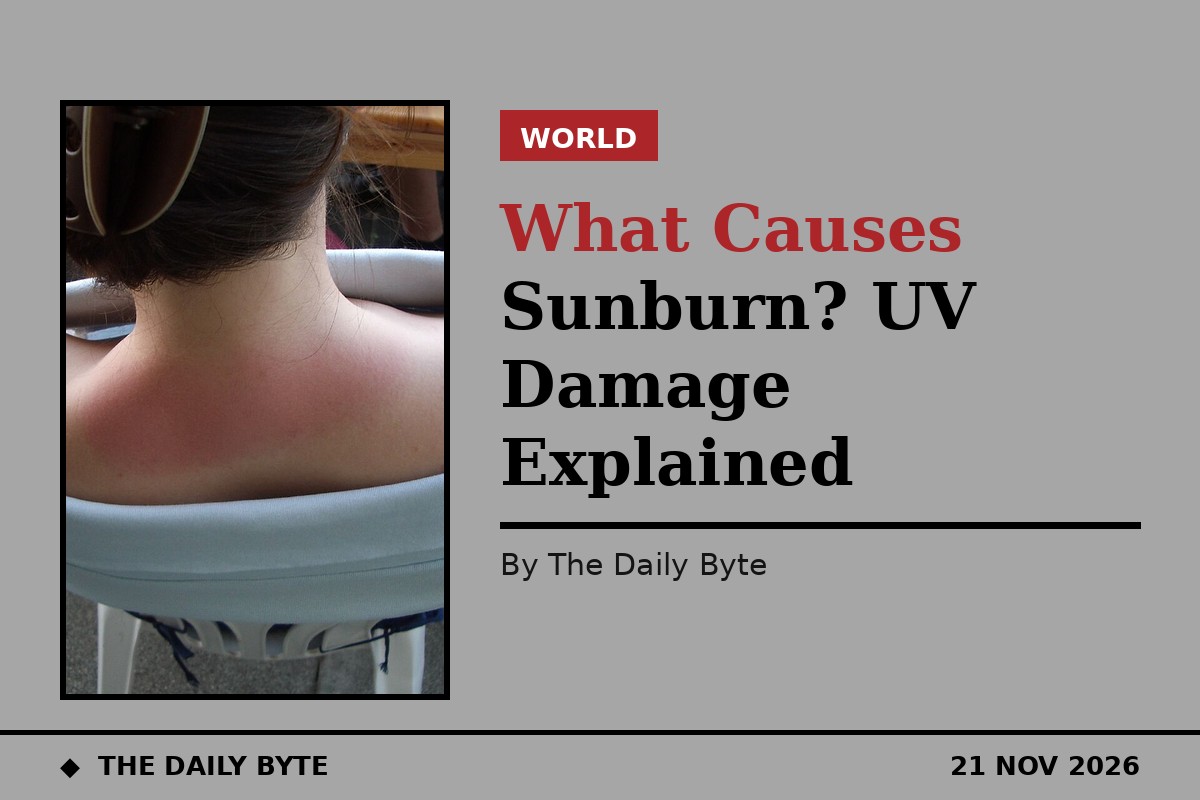
Sunburn is caused by ultraviolet radiation from the sun, principally the shorter-wavelength UVB rays, damaging the DNA in the cells of the outer skin and triggering an inflammatory reaction. The redness, heat, pain and peeling are not the burn itself: they are the body responding to that damage, clearing out injured cells and trying to protect itself from the next exposure. Sunburn is, in other words, a visible sign of a radiation injury, and it appears hours after the damage was done.
This explainer sets out which part of sunlight does the damage, what happens inside a skin cell when UV hits it, why the pain arrives late, why some people burn and others tan, and what actually prevents sunburn.
Which part of sunlight burns the skin?
Sunlight contains ultraviolet radiation, the invisible part of the spectrum beyond violet light, in three bands. UVA has wavelengths of 315 to 400 nanometres and penetrates deep into the skin. UVB has wavelengths of 280 to 315 nanometres and is mostly absorbed in the epidermis, the outer layer of the skin. UVC, below 280 nanometres, is the most energetic of the three, but it is filtered out by the ozone layer and does not reach the ground in any meaningful amount.
UVB is the principal cause of sunburn, because each UVB photon carries more energy than a UVA photon and because UVB is absorbed directly by DNA. UVA still matters: it makes up about 95 per cent of the ultraviolet light reaching the surface, it penetrates deeper, and it damages DNA indirectly by generating reactive oxygen species, the unstable molecules that injure cells. Both bands contribute to ageing of the skin and to skin cancer, but when the question is what makes skin go red and sore after a day in the sun, the answer is mostly UVB.
Two common beliefs about sunlight are wrong. The first is that you cannot burn on a cloudy day. Much of the ultraviolet light passes through light cloud, and it also reflects off sand, water, snow and concrete, so the dose can be high even when the sun feels weak. The second is that heat causes sunburn. It does not: the burning rays are invisible, and you can be badly burned on a cool, breezy day, or at altitude, where the air is thinner and less ultraviolet light is filtered out. The temperature of the air tells you nothing about the strength of the ultraviolet radiation.
What UV does inside a skin cell
When a UVB photon strikes a skin cell, it can be absorbed directly by the DNA in the cell nucleus. The energy distorts the DNA molecule, joining two neighbouring bases together into a structure called a cyclobutane pyrimidine dimer, most commonly a thymine dimer. That is a physical kink in the genetic code. The cell has repair systems that can cut out and replace the damaged section, and most of the time they succeed. When the damage is too great, the cell gives up: it undergoes apoptosis, a programmed self-destruction, rather than risk passing on corrupted DNA.
Those dying cells are the sunburn cells seen under the microscope: keratinocytes, the main cells of the epidermis, with shrunken, dark nuclei. At the same time, the damaged cells release chemical alarm signals, including the cytokines interleukin-6 and tumour necrosis factor alpha, and prostaglandins, the same family of chemicals that cause pain and swelling in other kinds of injury. Mast cells in the skin release histamine and other mediators within an hour of exposure. Together these signals dilate the blood vessels in the skin, which produces the redness, and sensitise the nerve endings, which produces the pain.
That sequence explains the delay. The DNA damage happens while you are in the sun, but the inflammatory response takes hours to build. Redness usually appears within three to four hours of exposure, peaks around twelve to twenty-four hours later, and then fades over several days. Peeling follows as the damaged top layer of skin is shed and replaced. A severe burn can blister, which is a second-degree burn: fluid collects between the damaged layers of skin, and the blisters should be left alone, because breaking them opens a route for infection.
Why do some people burn and others tan?
The difference is melanin, the pigment made by cells called melanocytes in the base of the epidermis. There are two kinds. Eumelanin is brown-black and strongly protective: it absorbs ultraviolet light and dissipates the energy as heat, shielding the DNA in the cell nucleus. Pheomelanin is red-yellow and offers much less protection; it can even generate reactive oxygen species when exposed to UVA. People with more eumelanin, which is to say people with darker skin, burn less readily. People with fair skin, blond or red hair and freckles tend to make more pheomelanin and less eumelanin, and they burn more easily.
Exposure to ultraviolet light triggers the skin to make more melanin, which is what a tan is. It happens in two phases. Immediate pigment darkening occurs during exposure itself, as existing melanin is oxidised and redistributed, and it can fade quickly. Delayed tanning takes twenty-four to seventy-two hours, as new melanin is synthesised and transferred to the surrounding skin cells. Repeated exposure also thickens the epidermis, which blocks more ultraviolet light. All of this is the skin defending itself, and it is worth saying plainly: a tan is a sign that damage has already happened, not a sign of health. A tan provides only a small amount of protection, roughly equivalent to a sun protection factor of about three, and it is no substitute for sunscreen and shade.
The long-term consequence of repeated damage is the serious one. When DNA repair fails, mutations can accumulate in genes that control cell growth, including proto-oncogenes and tumour-suppressor genes, and that raises the risk of skin cancer: melanoma, basal cell carcinoma and squamous cell carcinoma. DermNet, the New Zealand dermatology resource, reports that a single blistering sunburn at least doubles the risk of developing melanoma. That is why sunburn in childhood matters so much: the skin remembers the dose, even when the redness has long faded.
What actually prevents sunburn?
The most effective protection is also the simplest: stay out of strong sun in the middle of the day, when ultraviolet radiation is at its peak, and seek shade. Clothing is more reliable than any cream: a long-sleeved shirt, a wide-brimmed hat and sunglasses protect the parts they cover without needing to be reapplied. Sunscreen is the back-up for the skin that remains exposed, not a licence to stay out longer.
On sunscreen, three facts matter. First, the sun protection factor, or SPF, measures protection against UVB: SPF 30 filters about 97 per cent of UVB, and SPF 50 about 98 per cent, so the gain from higher numbers is small and no sunscreen blocks everything. Second, a sunscreen must protect against UVA as well, so look for a broad-spectrum product. Third, most people apply far too little, and it must be reapplied every two hours and after swimming, sweating or towelling off, because it rubs and washes away. The ultraviolet index, published in weather forecasts, is the practical guide to the day: at an index of three or above, protection is needed, and at eight or above it is essential.
Vitamin D complicates the advice, because the skin makes vitamin D from the same ultraviolet light that causes sunburn. The balance is that only brief exposure is needed for vitamin D, and a burn is never required to make it. Short periods in the sun with the face and arms uncovered are enough in summer, and in winter in the UK the sun is too weak to make vitamin D at all, which is why the government advises a supplement in the darker months. Getting sunburnt in pursuit of vitamin D is counterproductive.
What to do if you are already burnt
Cool the skin with a cool shower or bath, or with damp cloths, and drink plenty of water, because sunburn draws fluid to the skin. Moisturise with a plain after-sun lotion or moisturiser, and take a painkiller such as ibuprofen or paracetamol if the pain needs it. Wear loose clothing over the burnt area and stay out of the sun until it has healed. Do not pop blisters, and do not cover the burn with butter, toothpaste or other home remedies, which can trap heat and irritate the skin.
Get medical advice if the burn blisters badly, if the skin is very swollen, if you develop a fever, chills or dizziness, or if a child under a year old is burnt. Those are signs of a more serious injury or of heat illness, and they should not be managed at home. For most sunburns, though, the treatment is time: the inflammation settles over a few days, the damaged skin peels, and the redness fades, leaving the skin to repair itself as best it can.
Frequently asked questions
Can you get sunburnt on a cloudy day? Yes. Much of the ultraviolet radiation passes through light cloud, and it also reflects off sand, water and snow, so the dose can still be high enough to burn. The sun does not need to feel hot for its ultraviolet rays to damage the skin.
Does a tan protect you from sunburn? Only slightly. A tan provides protection roughly equivalent to SPF 3, which is far too little to prevent burning on a strong-sun day. A tan is evidence of damage, not a shield against it.
Why does sunburn hurt hours after you come inside? Because the pain comes from the inflammatory response to DNA damage, not from the light itself. The damage happens in the sun, but the release of cytokines and prostaglandins, and the dilation of blood vessels, take hours to build to their peak.
Is sunburn the same as a heat burn? No. Sunburn is a radiation burn caused by ultraviolet light damaging DNA. The skin is not heated to a high temperature. That is why you can be badly sunburnt on a cool day, and why cooling the skin afterwards relieves the symptoms without undoing the damage.
Does one sunburn cause skin cancer? One sunburn does not make cancer inevitable, but it raises the risk. A single blistering sunburn at least doubles the risk of melanoma, and the risk grows with the total ultraviolet dose over a lifetime. Repeated sunburns, especially in childhood, are the pattern most strongly linked to skin cancer.


