What Happens When a Company Goes Into Administration?
When a company goes into administration, it has not necessarily shut down. It has entered a formal legal process in which a licensed insolvency practitioner — the administrator — takes control of the business from its directors, and creditors are temporarily stopped from taking legal action to recover what they are owed. The aim is to rescue the business if possible, or, failing that, to get the best available result for the people it owes money to.
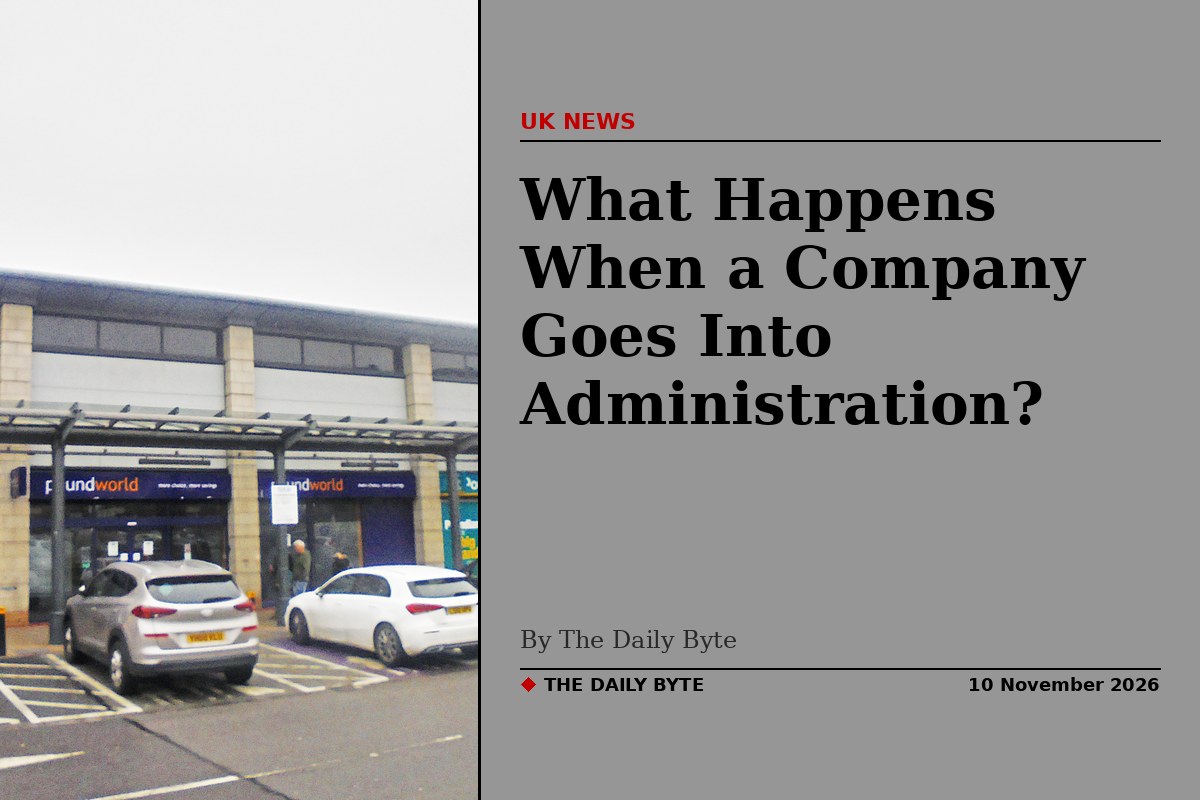
Administration is one of the most common phrases in British business news, and one of the least understood. It is in the headlines again because Poundland, the discount retailer with around 600 stores, faces a deadline on Thursday 12 November 2026, when its notice of intention to appoint administrators expires. This explainer sets out what administration means, how it works, what happens to staff and customers, and what could happen next for Poundland.
What does going into administration mean?
Administration is a formal insolvency procedure under the Insolvency Act 1986. A company can be put into administration if it is in debt and cannot pay the money it owes, or is likely to become unable to do so. Once the process starts, the directors must hand over control of the company and everything it owns — its assets — to the administrator, who must be a professional insolvency practitioner.
The company is then protected by a legal moratorium, often described as a breathing space. During administration, creditors cannot start or continue legal action against the company without the administrator's consent or the court's permission, landlords cannot simply take back premises, and nobody can apply to wind the company up. That protection is the point: it gives the administrator time to work out the best way forward without the business being picked apart by individual creditors.
Administration does not mean the company has closed. A company in administration can keep trading, and many do, while the administrator looks for a buyer or a rescue deal. But the directors no longer run it, and the administrator can cancel or renegotiate contracts and make employees redundant.
How does a company enter administration?
There are several routes into administration. The directors can appoint an administrator themselves, usually after taking professional advice that the company is insolvent or about to become so. A lender holding a qualifying floating charge over the company's assets can also appoint one, and creditors can apply to the court for an administration order.
There is also a preliminary step that has become common in high-profile cases: the notice of intention to appoint administrators. Filing this notice gives the company a short period of protection from creditors — usually ten working days — while it tries to agree a rescue. Poundland's board filed such a notice on Thursday 29 October 2026, which is why its protection runs out on Thursday 12 November. Filing the notice is not the same as going into administration, but it is a clear sign that administration is close unless a deal is found.
What does the administrator do?
The administrator's job is set out in law, and the aims follow a strict order. The first aim is to rescue the company as a going concern — that is, to save the business itself so it can keep trading. If that is not reasonably practicable, the second aim is to achieve a better result for creditors as a whole than they would get if the company were wound up straight away. If neither of those is possible, the third aim is to realise property to pay secured or preferential creditors.
Within eight weeks of being appointed, the administrator must write a statement of proposals explaining what they plan to do, and send it to creditors, employees and Companies House. The administrator also writes to creditors and Companies House to say they have been appointed, and publishes a notice of the appointment in The Gazette, the official public record.
In practice, rescuing the company itself is uncommon. More often, the business — or the parts of it worth having — is sold to a new owner, while the old company is left holding the debts and is later dissolved or liquidated. Sometimes the sale is negotiated before the administrator is formally appointed and completed immediately afterwards, an arrangement known as a pre-pack administration. Administrators must report the full facts of a pre-pack to creditors within seven days of the transaction.
Administration is a live process with a time limit. It ends automatically after 12 months unless the administrator asks the court or creditors for an extension. It can also end sooner if the purpose of the administration has been achieved, for example if a Company Voluntary Arrangement has been agreed with creditors.
What happens to employees in administration?
Employees often keep working while the administrator looks for a buyer, because a trading business is worth more than a closed one. But there is no guarantee: the administrator can make staff redundant, and if the business is broken up, some stores or sites may close while others are sold on.
If the business is sold as a going concern, employees' rights may transfer to the new owner under the TUPE regulations, which protect employment terms when a business changes hands. If staff are made redundant and the company cannot pay what they are owed, they can apply to the Government's Redundancy Payments Service for statutory redundancy pay, notice pay, holiday pay and some unpaid wages, up to statutory limits. Employees' claims for wages and holiday pay also rank as preferential debts, which means they are paid ahead of most other unsecured creditors.
That is why administration cases involving large employers attract so much attention. Poundland employs more than 10,000 people across around 600 stores, and its founder has warned that a collapse could put 12,000 jobs at risk, with tens of thousands more roles in the wider supply chain affected.
What happens to customers, gift cards and orders?
For customers, the practical effects depend on what the administrator decides. Shops in administration usually keep trading, at least at first, so customers can still buy goods. But administrators may stop honouring gift cards and vouchers for a period, because gift card holders are generally unsecured creditors — people the company owes money to, but who rank near the back of the queue for payment.
Customers who paid by credit card have stronger protection. Under Section 75 of the Consumer Credit Act, the card provider can be liable for purchases of between £100 and £30,000 if the goods are not delivered or are faulty and the retailer cannot put things right. Customers who paid by debit card may be able to claim through their bank's chargeback scheme instead. Anyone with an outstanding order from a company in administration should keep their receipts and check the administrator's announcements before assuming the order will be fulfilled.
Who gets paid first?
When an administrator sells a business or its assets, the money raised is distributed in a set order laid down by law. Broadly, creditors with fixed charges over specific assets, such as a property, are paid first, followed by the costs of the administration itself. Then come preferential creditors — mainly employees' claims for wages and holiday pay up to a limit, followed by HMRC for certain taxes the company collected on the Government's behalf, such as VAT and PAYE.
After that, creditors with floating charges are paid, then unsecured creditors, such as suppliers and customers with gift cards. Suppliers are usually unsecured creditors, which means they may get back only a small proportion of what they are owed, and sometimes nothing at all. Shareholders are last in line, and in an administration they usually receive nothing.
Why is Poundland in the news?
Poundland is the latest big-name retailer to reach the brink of administration, and its case shows how a business can be profitable on paper yet still run out of cash. Managing director Barry Williams told staff that the company swung from an EBITDA loss of £68.1 million in the year to September 2025 to a profit of £18.1 million in the year to September 2026 — an £86 million turnaround, although the figures have yet to be audited. Like-for-like sales rose seven per cent in the first period of the new financial year.
Despite that improvement, Poundland has been unable to buy new stock since 27 October, after its owner, Gordon Brothers, restricted its access to credit facilities and cash generated through trading. As of 3 November, management was reportedly unable to access around £25 million in cash, even as the balance continued to grow through store sales. Gordon Brothers, which bought Poundland from Pepco Group for a nominal £1 in June 2025, has said the business was in distress when it was acquired and remains challenged.
Advisory firm AlixPartners has been lined up as administrator in waiting, and has asked for proposals from potential liquidators for Poundland's stores and stock in case a deal to sell the business as a going concern fails. Executives from Gordon Brothers are due to appear before the Business and Trade Committee on Wednesday 11 November, and the notice of intention to appoint administrators expires on Thursday 12 November. Insiders have said an extension of the deadline now looks increasingly likely, but if no solvent sale is agreed, Poundland could be broken up, with parts of the business sold separately.
Poundland is not alone: 102 companies in England and Wales entered administration in September 2026, on the seasonally adjusted count published by the Insolvency Service on 20 October 2026. Administration remains a regular feature of the British economy, even when the wider headlines are about growth.
Frequently asked questions
Is administration the same as liquidation? No. Administration aims to rescue the business or get a better result for creditors than liquidation would. Liquidation means the company is wound up, its assets are sold, and it ceases to exist. A company can end up in liquidation after administration, but administration itself is a rescue process first.
Does going into administration mean all the shops will close? Not necessarily. Administrators often keep shops trading while they look for a buyer, and a sale as a going concern can save many or all of the stores. But closures are common where parts of the business cannot be sold, and administrators may close loss-making sites quickly to stop the losses.
Can a company come out of administration? Yes. If a Company Voluntary Arrangement is agreed with creditors, or the business is rescued, the company can be handed back to its directors and the administration ends. This is uncommon for large retailers, where a sale of the business is the more usual outcome.
What is a Company Voluntary Arrangement? A Company Voluntary Arrangement, or CVA, is a formal agreement between a company and its creditors to pay back some or all of what is owed over time, usually in return for the company being allowed to keep trading. Administrators can propose a CVA as one of the ways of rescuing a business.
How long does administration last? Administration ends automatically after 12 months unless the administrator asks the court or creditors for an extension. It can end sooner if the administrator's purpose has been achieved.
Should I use a gift card from a company in administration? Use it as soon as possible. Administrators can stop honouring gift cards, and gift card holders rank as unsecured creditors, so the value may be lost if the company is wound up. Check the administrator's announcements for the latest position.
Administration is a process, not a verdict. For Poundland, the days up to 12 November will decide whether a rescue deal saves the chain as a going concern, whether the deadline is extended while talks continue, or whether administrators from AlixPartners take over and the business is sold in parts. Whatever happens, the rules set out above — the moratorium, the administrator's aims in order, and the fixed order in which creditors are paid — will shape the outcome for staff, suppliers and shoppers alike.