What Is a Ballistic Missile?
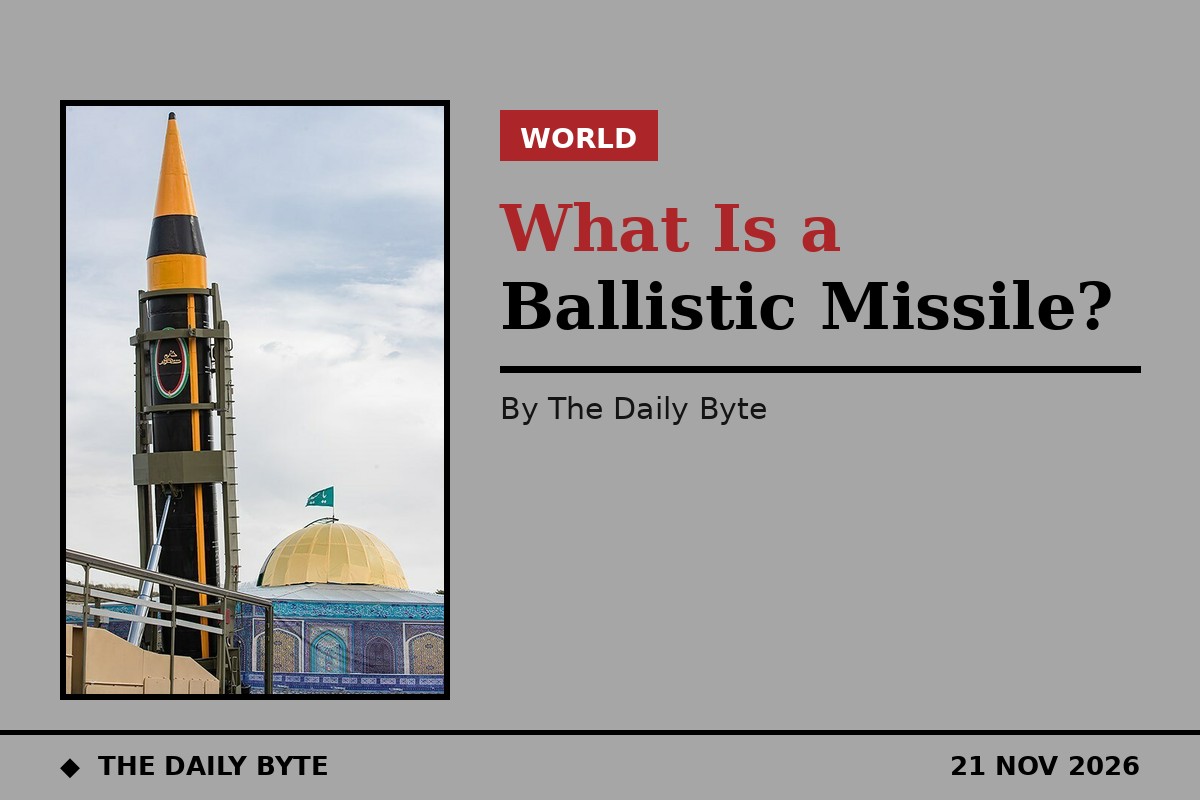
A ballistic missile follows a ballistic trajectory: a rocket motor fires briefly at the start of the flight, throwing the missile up into a high arc, and then the engine cuts out and the missile coasts, unpowered, for most of its journey, falling back to Earth under gravity. It is, in essence, a rocket that throws its warhead along a curved path and lets physics do the rest.
That simple idea makes them some of the most feared weapons in the world: they fly far, they fly fast, and they give defenders very little time to react. An intercontinental missile can cross 10,000 kilometres in about 30 to 35 minutes.
How does a ballistic missile fly?
A ballistic missile's flight has three phases. The boost phase is the powered part: the rocket engines ignite, the missile climbs steeply, and for an intercontinental missile this lasts a few minutes. It is the easiest phase to spot, because the burning rocket produces a bright heat signature satellites can see, but it is also the shortest.
Then comes the midcourse phase, the longest part of the flight. The engine has shut down, the missile is coasting on a sub-orbital path, and for a long-range missile much of this phase takes place above the atmosphere, at altitudes of up to about 4,500 kilometres. Because the path is governed by gravity, it is broadly predictable once tracked, but the missile moves so fast that hitting it is another matter entirely.
Finally there is the terminal phase. The warhead re-enters the atmosphere and plunges towards the target at hypersonic speed, above Mach 5, and for intercontinental missiles at speeds that can exceed Mach 20. The re-entry vehicle needs a heat shield to survive the friction, and the whole terminal phase may last only a minute or less.
How are ballistic missiles categorised?
Ballistic missiles are usually grouped by range, although different countries use slightly different boundaries:
Tactical ballistic missiles fly less than 300 kilometres. Short-range ballistic missiles, known as SRBMs, fly from 300 to 1,000 kilometres. Medium-range ballistic missiles, or MRBMs, cover 1,000 to 3,500 kilometres. Intermediate-range ballistic missiles, IRBMs, cover 3,500 to 5,500 kilometres. And intercontinental ballistic missiles, ICBMs, fly further than 5,500 kilometres, far enough to cross oceans and continents.
They can be launched from fixed silos, mobile launchers on trucks, ships, submarines and, in some cases, aircraft. Mobile launchers are harder to find before launch, which is why countries that rely on these missiles invest heavily in them. Some modern designs are quasi-ballistic: they follow a shallow, largely ballistic path while staying guided and able to manoeuvre, which makes them harder to predict and intercept.
Ballistic missile vs cruise missile: what is the difference?
The two weapons are often confused, but they fly in almost opposite ways. A ballistic missile is powered only at the start and then coasts on a high arc, often leaving the atmosphere. A cruise missile is powered for its whole flight by a jet engine, flies inside the atmosphere, and usually stays low, following the terrain to avoid radar.
That difference shapes everything else. A ballistic missile is much faster, typically Mach 5 to Mach 25, and reaches a target 1,000 kilometres away in five to ten minutes. A cruise missile is slower, usually subsonic to around Mach 3, and the same journey takes an hour or more. But the cruise missile is far more accurate, steering with GPS and terrain matching to within metres, and harder to detect because it flies low. The ballistic missile is easier to spot on radar, because it flies high, but far harder to stop, because it arrives so fast.
Modern attacks use both types at once, which is exactly the problem defenders face in Ukraine: cruise missiles force defenders to look down, while ballistic missiles arrive from above at high speed and need entirely different interceptors.
Why are ballistic missiles so hard to intercept?
Stopping a ballistic missile usually means colliding with it directly, at several kilometres per second, with almost no margin for error. It has been compared to hitting a bullet with another bullet, except the target travels several times the speed of sound and the engagement may last only minutes.
The numbers from Ukraine show how hard it is. On the night of 2 to 3 November 2026, Ukrainian air force data cited by the Institute for the Study of War put the interception rate for ballistic and anti-ship missiles at 17.65 percent, against 83.05 percent for cruise missiles in the same barrage: ballistic missiles are easier to detect but harder to stop, while cruise missiles are harder to detect but easier to stop once found.
Specialised systems exist to do the job, each covering a different part of the arc: Patriot PAC-3 batteries, the American THAAD system, Israel's Arrow system and the naval SM-3 interceptor. No single system covers the whole flight, which is why countries build layered defences, and why salvos, decoys and manoeuvring warheads can still overwhelm them.
Ballistic missiles in the news
Ballistic missiles are a regular feature of the war in Ukraine. Russia's Iskander-M, a road-mobile short-range missile with a claimed range of up to 500 kilometres, has been one of its main precision weapons since 2022, and Ukraine's American-supplied ATACMS, with a range of about 300 kilometres, is its counterpart. An open-source log of the night of 20 to 21 November 2026 listed three Iskander-M and related ballistic missiles among the weapons Russia fired at Ukraine, alongside 148 Shahed-type drones and cruise missiles, and reported Iskander-M strikes on Kyiv's CHPP-5 power plant.
The same weapons shape crises far beyond Ukraine. Iran's ballistic missile programme, including missiles it says can reach 4,500 kilometres, is a central factor in the standoff in the Gulf, and the shooting down of American drones over the Strait of Hormuz on 21 November is part of the same confrontation. Ballistic missiles can carry conventional or nuclear warheads, which is why arguments about them are never only about the missiles, but about what they might carry.
Frequently asked questions
Can a ballistic missile carry a nuclear warhead? Yes. They can carry conventional or nuclear warheads, and the largest intercontinental missiles can carry several independently targeted warheads, known as MIRVs, on a single missile.
How fast is a ballistic missile? It depends on range, but they typically re-enter the atmosphere at hypersonic speed, above Mach 5, and intercontinental missiles can exceed Mach 20. An ICBM can strike a target 10,000 kilometres away in about 30 to 35 minutes.
Can ballistic missiles be shot down? Yes, but it is difficult. Systems such as Patriot PAC-3, THAAD, Arrow and SM-3 are designed to intercept them, yet salvos, decoys and manoeuvring warheads make defence unreliable, as the Ukrainian figures show.
What is the difference between a ballistic missile and a rocket? All ballistic missiles are rockets, but not all rockets are ballistic missiles. A space rocket and a ballistic missile share the same basic technology, but one puts a payload into orbit and the other delivers a warhead along a ballistic arc.
Sources: the flight phases and range categories of ballistic missiles; the comparison with cruise missiles; Ukrainian interception data for 2 to 3 November 2026 via the Institute for the Study of War; and the open-source log of the attacks of 20 to 21 November 2026. The ballistic missile is old technology, but nothing has yet replaced it as a way of delivering a warhead quickly over a very long distance.


