What Is a Black Hole? Event Horizon Explained
A black hole is a region of space where gravity has become so strong that nothing can escape it, not even light. That single fact explains almost everything else about black holes: why they are black, why they have a point of no return, and why they are so hard to study. A black hole is not a hole in the everyday sense, and it is not a cosmic vacuum cleaner. It is what is left when a huge amount of mass is squeezed into a tiny volume, until the pull of its gravity overwhelms every other force.
The idea sounds like science fiction, but it follows directly from Albert Einstein's general theory of relativity, published in 1915. Within a year, the German physicist Karl Schwarzschild had worked out a solution to Einstein's equations describing the gravity around a perfectly round, non-spinning mass. That solution contained a surprise: squeeze a mass tightly enough, and a boundary appears beyond which escape becomes impossible. The name "black hole" itself came much later. It was popularised by the American physicist John Archibald Wheeler, starting in the late 1960s, and it stuck because it is accurate. These objects are black because light cannot climb out of them, and they are holes in the sense that anything that falls in does not come back.
The short answer: gravity wins completely
Every object pulls on every other object with gravity. On Earth that pull is gentle enough to live with. Around a black hole it is not. The key idea is escape velocity: the speed something must reach to break free of a body's gravity and never fall back. A rocket leaving Earth needs about 11 kilometres per second. For a black hole, the escape velocity is greater than the speed of light, about 300,000 kilometres per second. Since nothing in the universe can travel faster than light, nothing inside a black hole can ever get out.
That is why astronomers describe a black hole by its mass and by the size of the region from which escape is impossible. The Sun, if it could be squeezed into a ball only about 3 kilometres across, would become a black hole. Earth would need to be crushed to a radius of about one centimetre, smaller than a grape. The Sun cannot actually do this, and neither can Earth: only the most massive stars end their lives in this way. But the thought experiment shows what a black hole really is. It is not about a special kind of matter. It is about density. Pack enough mass into a small enough space and a black hole is what you get.
The event horizon: the point of no return
Every black hole has two basic parts. The first is the event horizon, the boundary that marks the point of no return. The event horizon is not a physical surface. You could not touch it, stand on it, or see it directly. It is a spherical boundary around the black hole, and its radius is called the Schwarzschild radius, after Karl Schwarzschild. Cross it, and every path you could take leads further inwards. Stay outside it, and you can still escape, provided you have enough speed.
How big is an event horizon? It depends only on the mass inside it. Double the mass and the radius doubles. A black hole with the mass of the Sun would have an event horizon about 3 kilometres in radius. A black hole with ten times the Sun's mass would have one about 30 kilometres across. The supermassive black hole at the centre of our galaxy has an event horizon millions of kilometres wide, yet that is still small on the scale of a galaxy. Far away from a black hole, its gravity behaves exactly like the gravity of a star of the same mass. It is only close up that things become extreme.
Strange things happen near the event horizon. Time itself appears to slow down there, as seen by a distant observer. Light climbing away from near the horizon loses energy and shifts towards the red end of the spectrum. These are predictions of general relativity, and they have been confirmed by observations of objects orbiting close to black holes. Inside the horizon, the mathematics of relativity says that space and time effectively swap roles, so that moving towards the centre becomes as unavoidable as moving towards tomorrow. This is why physicists say that, once inside, falling to the centre is not a choice but a direction in time.
The singularity at the centre
The second basic part of a black hole is the singularity at its centre, where all of its mass is concentrated. According to general relativity, the singularity is a point of vanishing size and effectively infinite density, where the known laws of physics break down. That is a sign that our current theories are incomplete rather than a description of a real physical object. Physicists expect that a future theory combining gravity with quantum mechanics will describe what actually sits at the centre, but no such theory is confirmed yet. What matters for now is that the singularity is hidden from the rest of the universe by the event horizon. Nothing that happens there can send a signal back out.
Between the singularity and the event horizon there is no surface, no floor and no air. There is only empty space curved so steeply that all roads lead inwards. This is also why the popular image of a black hole as a whirlpool or a plug hole is only partly helpful. A whirlpool pulls things down because water is flowing. A black hole pulls things in because of the shape of spacetime itself around it. Mass tells spacetime how to curve, and curved spacetime tells matter how to move. Around a black hole, spacetime is curved so extremely that the natural path for anything is to fall in.
How a black hole forms
Most black holes begin as stars. A star shines because the heat and pressure in its core push outwards, balancing the inward pull of its own gravity. For billions of years the two forces hold each other in check. When a very massive star, born with around 20 times the mass of the Sun or more, runs out of fuel, that balance fails. The core collapses under its own weight in a fraction of a second, triggering a supernova explosion that blows the star's outer layers into space. If the remaining core is heavy enough, nothing can stop the collapse. It falls past the point where it would become a neutron star, past every known limit, until it becomes a black hole.
Smaller stars meet gentler ends. A star like our Sun will end its life as a white dwarf, a dense ember about the size of Earth. A heavier star may leave behind a neutron star, a ball of matter only about 20 kilometres across that packs more mass than the Sun. Only the heaviest stellar cores cross the final line and become black holes. This is why astronomers sort black holes by mass. Stellar-mass black holes, the remains of dead massive stars, weigh from a few times the mass of the Sun to dozens of times the Sun's mass. They are scattered throughout galaxies, including our own.
The three sizes of black hole
Stellar-mass black holes are the smallest kind, but they are far from the whole story. At the other end of the scale sit supermassive black holes, weighing hundreds of thousands to billions of times the mass of the Sun. Almost every large galaxy has one at its centre, including our own Milky Way. How supermassive black holes grew so large, and how some of them already existed less than a billion years after the universe began, is one of the biggest open questions in astronomy. They probably grew by swallowing gas and stars and by merging with other black holes, but the details are still being worked out.
Between the two groups should sit intermediate-mass black holes, weighing roughly 100 to 10,000 times the mass of the Sun. Astronomers have found a number of candidates, but these middleweight black holes have proved hard to confirm. They are the missing link that would show how small black holes grow into giant ones. A fourth type, primordial black holes, is purely hypothetical. These would have formed in the first moments after the Big Bang from dense patches of the early universe. No definitive proof of their existence has been found, and they remain an idea that observations have yet to confirm or rule out.
How we know black holes exist
Since a black hole gives off no light of its own, astronomers have to find them by their effects on their surroundings. The classic method is to watch a visible star orbiting an unseen companion. If the companion is too heavy to be a normal star or a neutron star, and it gives off no light, a black hole is the explanation. Astronomers have identified many stellar black hole candidates in binary star systems using exactly this method.
The strongest evidence comes from the centre of our own galaxy. There, stars orbit an unseen object called Sagittarius A*, about 26,000 light-years from Earth, that weighs about 4.3 million times as much as the Sun. The stars whip around it at enormous speeds, following tight orbits that only make sense if that much mass is packed into a region smaller than our Solar System. No other known object fits the evidence. Decades of tracking those stars, including work that won a share of the 2020 Nobel Prize in Physics, turned Sagittarius A* from a candidate into a confirmed supermassive black hole.
Black holes also betray themselves when they feed. Gas falling towards a black hole does not drop straight in. It spirals around it, forming a glowing disc called an accretion disc, heated to enormous temperatures by friction as it circles faster and faster. That disc can shine brighter than whole galaxies, and it can launch jets of particles from the black hole's poles at close to the speed of light. These jets can stretch for tens of thousands of light-years. Paradoxically, as one astronomer put it, black holes, which let no light escape, are among the brightest objects in the universe. That is because the light comes not from the black hole itself, but from the doomed matter swirling around it.
The first photograph of a black hole
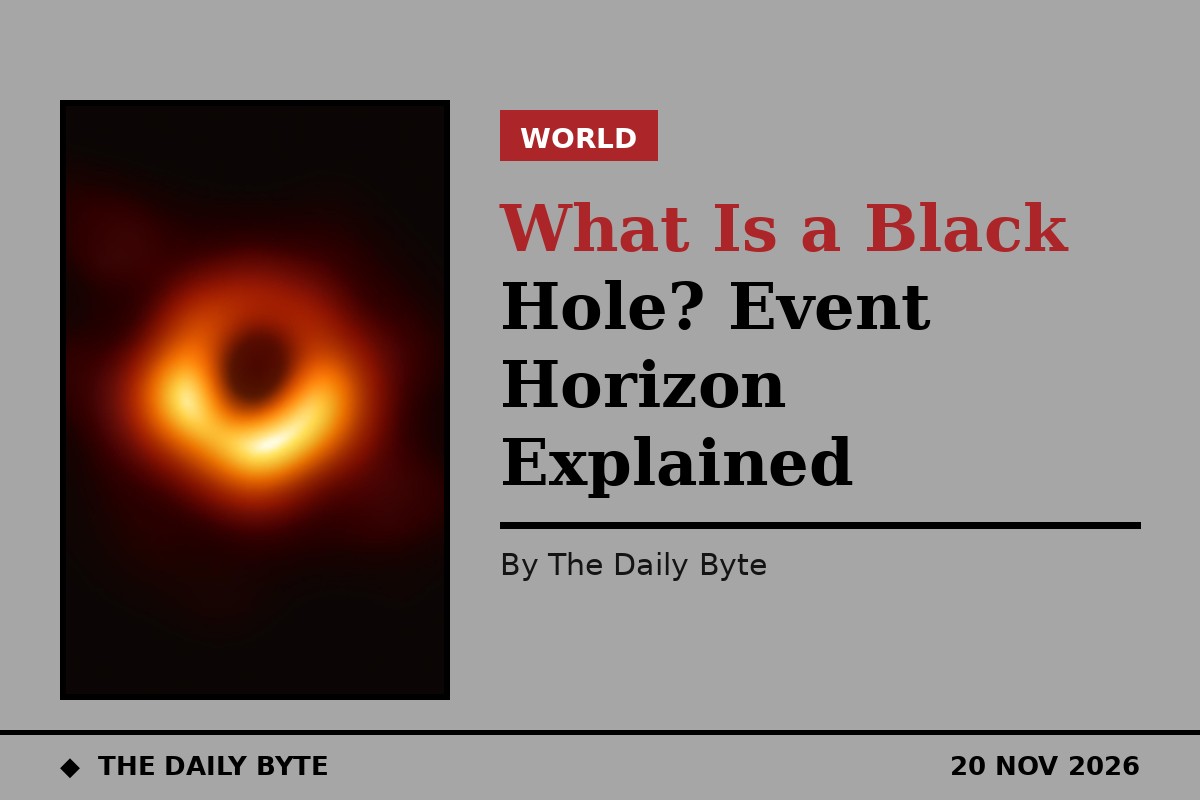
For decades the black hole was a theoretical object, confirmed only indirectly. That changed on 10 April 2019, when the Event Horizon Telescope collaboration released the first ever image of a black hole's shadow. The target was the supermassive black hole at the centre of the galaxy Messier 87, known as M87*, about 55 million light-years away. It weighs about 6.5 billion times as much as the Sun, and its event horizon is about 1.5 light-days across, or roughly 40 billion kilometres, about the size of our Solar System.
The image shows a dark circle surrounded by a lopsided ring of orange light. The dark centre is not the event horizon itself but the black hole's shadow, the region of glowing gas darkened by the black hole's gravity. The bright ring is light from the accretion disc, bent around the black hole by its gravity, with one side brighter because the gas there is moving towards us. The picture was made by linking eight radio telescopes around the world into a single Earth-sized telescope, a technique called very long baseline interferometry, and combining their data with atomic clocks and supercomputers. The data were collected in April 2017, and it took two years to turn them into an image. In May 2022 the same collaboration released an image of Sagittarius A*, the black hole at the centre of our own galaxy. The two images together confirmed that Einstein's theory of gravity holds even in the most extreme places in the universe.
What would happen if you fell in?
Falling into a black hole is a one-way trip, but what the trip feels like depends on the size of the black hole. The danger comes from tidal forces: the difference in gravity between your head and your feet. Near a stellar-mass black hole, that difference is enormous. You would be stretched lengthways and squeezed sideways, a process astronomers grimly call spaghettification, long before you reached the event horizon. Near a supermassive black hole, the event horizon is so large that the tidal forces at the boundary are comparatively gentle. In theory, you could cross the horizon of a supermassive black hole without immediately noticing anything special. You would not be able to send a message back out, though, and the singularity would still be waiting for you.
There is one more strange effect. To someone watching from far away, you would appear to slow down as you approached the horizon, your light growing redder and dimmer, never quite seen to cross it. To you, the crossing would happen in finite time. Both descriptions are correct. They describe the same event from different points of view, and the difference is a real feature of relativity, not a trick of the light.
Myths, Hawking radiation and the end of black holes
A common myth is that black holes suck everything in like a vacuum cleaner. They do not. From a safe distance, a black hole's gravity is no stronger than that of a star of the same mass. If the Sun were replaced by a black hole of exactly the same mass, the planets would keep orbiting exactly as they do now, although the Solar System would grow very cold without sunlight. It is only when you get close that a black hole becomes dangerous, because its gravity strengthens so steeply with decreasing distance.
Another surprise is that black holes may not last for ever. In 1974 Stephen Hawking predicted that black holes slowly leak a faint trickle of particles, now called Hawking radiation, and so very slowly lose mass. For a stellar-mass black hole the effect is so tiny that it would take far longer than the current age of the universe to evaporate. But in principle, black holes are not eternal. They grow by feeding and they shrink, almost imperceptibly, by radiating. The glow is far too faint to detect around a real black hole today, so Hawking radiation remains a prediction rather than an observation.
Black holes matter because they are the universe's most extreme laboratories. They test general relativity where gravity is strongest, they shape the galaxies around them by heating gas and shutting down star formation, and they mark the boundary of what our current physics can explain. The first photograph of a black hole answered a question that had stood for a century, and it opened new ones: how did the giants at the hearts of galaxies grow so fast, what happens inside the horizon, and what theory will finally describe the singularity? A black hole is a place where gravity wins completely, and where our understanding of the universe is still catching up.


