What Is a Carbon Credit?
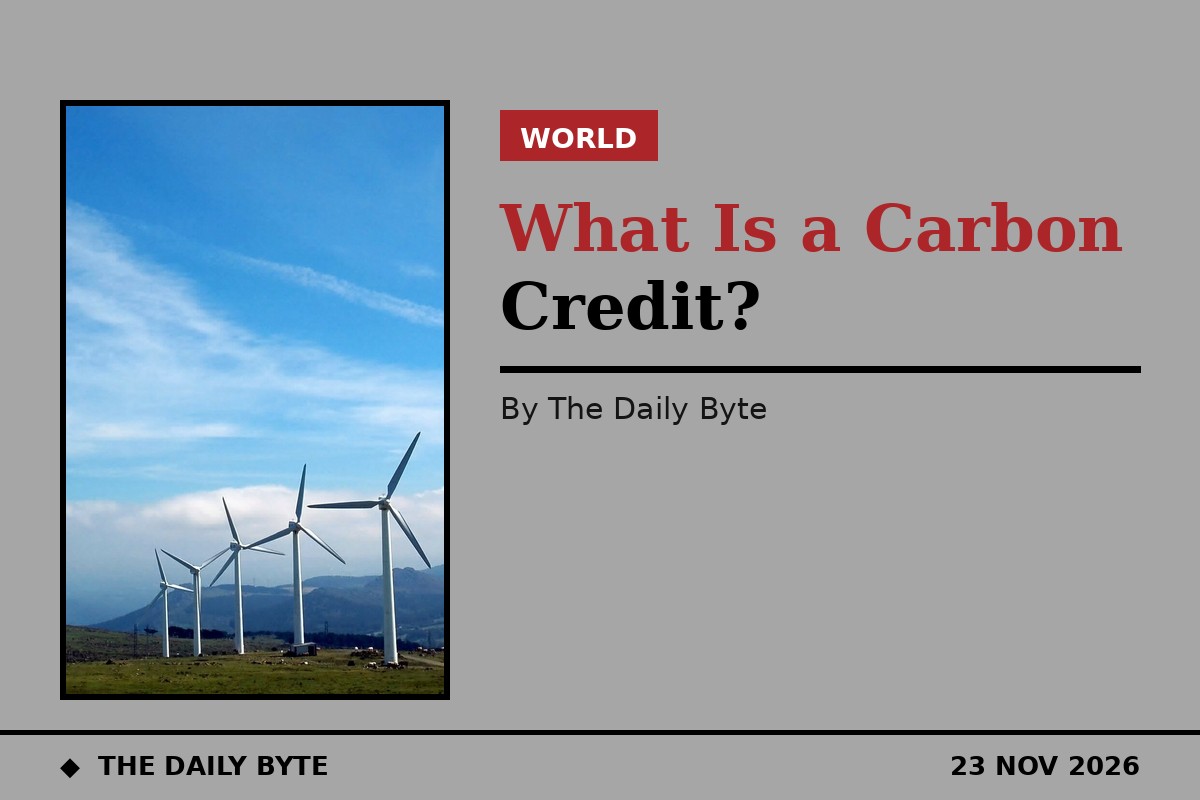
A carbon credit is a tradeable certificate that stands for one tonne of carbon dioxide, or its equivalent in other greenhouse gases, that has been avoided, reduced or removed from the atmosphere. When a project cuts emissions by one tonne, it can create one credit. When a company or a country buys that credit, it is paying for that tonne of reduction rather than making the cut itself. The idea is simple. The arguments about whether it works in practice are not.
Carbon credits were back in the headlines in November 2026, when the COP31 climate summit in Antalya, Türkiye, ended on 22 November without an overarching deal, but still adopted new decisions on carbon markets under Article 6 of the Paris Agreement. With governments unable to agree on a wider climate pact, the machinery for trading credits kept moving anyway: 17 governments endorsed a playbook for scaling up high-integrity carbon credit trading, and the UN trade body UNCTAD launched a Global Carbon Market Network on 12 November. This explainer sets out what a carbon credit actually is, how one is made, who buys them, and where the system can go wrong.
How does a carbon credit work?
A carbon credit begins life as a project. A wind farm is built where a coal plant would otherwise have run. A programme hands out efficient cookstoves that burn less wood. A company restores a mangrove forest that pulls carbon out of the air. Each project measures what it achieves against a baseline — an estimate of the emissions that would have happened without it — and the difference, if it is real and measurable, becomes credits.
Before any credit can be sold, the project must be checked. Under the main standards, an independent auditor, known as a validation and verification body, examines the project design, visits the site and confirms the numbers. Only then does a registry issue the credits, each with a unique serial number so it can be tracked. The credits can then be bought and sold, sometimes several times. When a buyer finally uses a credit to match its own emissions, the credit is “retired” in the registry: it is permanently removed from circulation so that nobody else can claim the same tonne.
That last step matters. A credit that is never retired has not offset anything. It is simply a certificate sitting in an account. The whole system depends on the chain holding together: a real project, an honest baseline, independent checking, a trustworthy registry and final retirement.
What are the two kinds of carbon credit?
Credits fall into two broad families, and the distinction matters because they do very different things. Avoidance and reduction credits come from projects that stop emissions happening in the first place: a solar plant that displaces coal power, a scheme that stops methane leaking from a landfill, or cookstoves that burn less fuel. Removal credits come from projects that take carbon dioxide that is already in the air and store it, for example by planting trees, restoring wetlands, or capturing carbon directly from the atmosphere and burying it underground.
| Type | What it does | Examples |
|---|---|---|
| Avoidance / reduction | Stops a tonne of emissions from happening | Wind and solar power, efficient cookstoves, methane capture |
| Removal | Takes a tonne of CO2 out of the air and stores it | Reforestation, mangrove restoration, direct air capture |
Removal credits are generally scarcer and more expensive than avoidance credits, because pulling carbon out of the air is harder than not emitting it. They also raise a different question: how long will the carbon stay stored? A tonne locked in a tree is only a climate benefit for as long as the tree stands. If the forest burns or is cut down, the carbon returns to the atmosphere. This problem is known as permanence, and it is one of the main reasons forest credits are the most contested part of the market.
Compliance markets and voluntary markets
Carbon credits change hands in two different kinds of market. In a compliance market, the law requires it. The best-known example is the European Union Emissions Trading System, which caps emissions from power stations, heavy industry and aviation in Europe. Companies covered by the scheme must hold enough allowances to cover their emissions, and they can trade those allowances with each other. The price is set by supply and demand within a legally fixed cap, so the total amount of pollution is limited by design.
In a voluntary market, nobody is forced to buy. Companies, airlines and sometimes individuals buy credits by choice, usually to support a claim about their climate impact — for example, that a flight or a product is “carbon neutral”, or that the company is on the way to net zero. The voluntary market is where most of the argument sits. There is no single global regulator, so quality depends on the standard that issued the credit. The two largest registries in the voluntary market are Verra, whose Verified Carbon Standard is the biggest crediting programme in the world, and Gold Standard, a non-profit founded by WWF in 2003. Both have been approved by the UN aviation body ICAO for use under its CORSIA offsetting scheme for international flights.
The difference between the two markets is also the difference between a permit and a promise. A compliance allowance is a legal obligation inside a capped system. A voluntary credit is a claim about a project somewhere else in the world, and its value depends entirely on whether that claim is true.
What is Article 6 of the Paris Agreement?
Article 6 of the Paris Agreement is the part of the 2015 climate deal that governs international carbon trading. It was designed to let countries cooperate: a country that can cut emissions cheaply can sell the extra reductions to a country where cuts are expensive, so the same money achieves more. The rulebook for how this works was adopted at COP26 in Glasgow in 2021, the details were finalised at COP29 in Baku in 2024, and COP30 in Belém in 2025 marked the shift from negotiating the rules to actually running the system.
Article 6 has two trading routes, and they work very differently. Article 6.2 covers cooperative approaches: two or more countries strike a bilateral deal and trade units called Internationally Transferred Mitigation Outcomes, or ITMOs. As of 15 December 2025, 108 such bilateral agreements between 64 different countries had been signed. Article 6.4 creates a centralised, United Nations-supervised market called the Paris Agreement Crediting Mechanism. Projects register with a UN Supervisory Body, follow UN-approved methods, and earn credits known as A6.4ERs. It is the successor to the Clean Development Mechanism set up under the 1997 Kyoto Protocol, and as of 15 January 2026 more than 1,000 former CDM projects were in the pipeline to move across to the new mechanism.
| Article 6.2 | Article 6.4 | |
|---|---|---|
| How it works | Countries trade directly under bilateral deals | Central UN-supervised market and registry |
| Credit name | ITMOs (Internationally Transferred Mitigation Outcomes) | A6.4ERs (Article 6.4 Emission Reductions) |
| Who sets the rules | The countries involved, within a UN framework | The UN Article 6.4 Supervisory Body |
| Scale so far | 108 bilateral agreements between 64 countries | Over 1,000 ex-CDM projects in the pipeline |
The single most important safeguard in both routes is the “corresponding adjustment”. When a country sells a credit, it must add that tonne back to its own emissions count, and the buyer subtracts it. Without that adjustment, the same tonne would be counted twice — once by the seller and once by the buyer — and the atmosphere would see no benefit at all. Double counting was one of the biggest flaws of the old Kyoto-era system, and Article 6 was written specifically to close it. The Legal 500’s guide to Article 6 sets out the two mechanisms, the three forms of host-country authorisation agreed at COP29, and the figures quoted here.
Who buys carbon credits, and why?
Three groups of buyers dominate the market. The first is governments. Under the Paris Agreement, each country has a climate target called a nationally determined contribution, and Article 6 lets a country buy ITMOs from abroad to help meet it, rather than making every cut at home. The second is airlines. Under ICAO’s CORSIA scheme, airlines on international routes between the 129 participating countries must offset emissions above 85% of their 2019 level, using credits from approved standards. Demand is large: analysts at MSCI estimate the first phase of CORSIA, running from 2024 to 2026, will need up to 137 million tonnes of CO2e, and the second phase, from 2027 to 2035, up to 1,299 million tonnes. Core Markets’ briefing on Article 6 and CORSIA explains the scheme and the registries approved for it.
The third group is companies buying voluntarily, usually to back a net-zero or carbon-neutral claim. The European Union’s provisional agreement on a 2040 climate target — a 90% cut in emissions, with member states allowed to use international carbon credits for up to 5% of their emissions — has added fresh demand from governments too. Supply is expected to grow sharply to meet it: BloombergNEF projects that carbon credit supply will rise from 243 million tonnes in 2024 to 2.6 billion tonnes in 2030 and 4.8 billion tonnes in 2050.
What makes a carbon credit good — or worthless?
A credible credit has to pass four tests. The first is additionality: the reduction must not have happened anyway. A wind farm that was already profitable without credit revenue does not become additional because someone buys its credits. The second is permanence: the carbon must stay out of the atmosphere, which is straightforward for a tonne of CO2 pumped underground and far harder for a tonne stored in a forest. The third is accurate measurement: the baseline, the project’s emissions and the claimed saving must be checked by an independent auditor, not just asserted by the seller. The fourth is no double counting: the same tonne must not be claimed by the project host country, the buyer’s country and a company all at once.
When those tests fail, the credit is worth little more than paper. Independent research has repeatedly found that some credits, particularly older forest-protection credits, delivered far less climate benefit than claimed, because the baselines were inflated or the forests were never truly at risk. That record is why the Integrity Council for the Voluntary Carbon Market drew up its ten Core Carbon Principles, and why buyers now pay a premium for credits that carry the Council’s label. The lesson of the last decade is that a cheap credit is often a cheap credit for a reason.
What happened to carbon credits at COP31?
COP31, held in Antalya from 9 November, ran two days over time and became the longest climate summit on record. It ended on Sunday 22 November 2026 with no overarching agreement: the proposed “Antalya Pact” was abandoned after the European Union, the UK, Norway, Panama, Vanuatu, the Marshall Islands and the least developed countries refused to sign a text that made no mention of fossil fuels. It was the first COP since Copenhagen in 2009 to close without a cover decision. Saur Energy’s report on the collapse records the breakdown and what survived it.
What survived was the technical work, including on carbon markets. Negotiators adopted decisions on Article 6, alongside decisions on adaptation, the just transition, climate finance, loss and damage, technology and the Green Climate Fund. Away from the main text, 17 governments endorsed a policy playbook for scaling up high-integrity carbon credit trading, UNCTAD launched a Global Carbon Market Network on 12 November, and the UK, Norway and Canada announced a $10 billion initiative for climate projects in emerging markets. The politics of the summit failed, but the plumbing of the carbon market carried on being built. Columbia University’s Center on Global Energy Policy explains how Article 6.2 and 6.4 are meant to work together, and why the corresponding adjustment is the cornerstone of the whole system.
That is the position as COP31 closed: a market with agreed rules, growing demand from governments and airlines, and a credibility problem it has not yet fully solved. Whether a carbon credit is a genuine tonne of avoided warming or an expensive piece of paper depends on the project behind it — and on whether anyone is checking.
Frequently asked questions
What is one carbon credit worth?
One credit represents one tonne of carbon dioxide equivalent (CO2e) avoided, reduced or removed. Its price is not fixed: it varies widely by project type, quality and market, with removal credits generally costing more than avoidance credits.
Is a carbon credit the same as a carbon offset?
No. A credit is the unit — the certificate for one tonne. An offset is what happens when a buyer retires that credit to compensate for its own emissions. A credit that is never retired has offset nothing.
Does buying carbon credits erase a company’s emissions?
No. Buying credits does not reduce the buyer’s own emissions at all. It pays for a reduction elsewhere. Critics argue that heavy reliance on credits lets polluters delay cutting their own emissions, which is why standards increasingly require companies to cut first and offset only what remains.
What is the difference between Article 6.2 and Article 6.4?
Article 6.2 covers bilateral deals between countries, trading ITMOs under rules the countries agree between themselves. Article 6.4 is a centralised UN market, the Paris Agreement Crediting Mechanism, where projects follow UN-approved methods and earn A6.4ERs under a Supervisory Body.
Did COP31 agree anything on carbon markets?
Yes. Although the summit failed to agree an overarching “Antalya Pact”, negotiators did adopt decisions on Article 6 carbon markets, and 17 governments endorsed a playbook for scaling up high-integrity credit trading.


