What is a ceasefire and how does it work?
A ceasefire is an agreement between warring parties to stop fighting for a set period, or indefinitely. It silences the guns and suspends military operations, but it does not end the war itself and it is not a peace treaty. The legal state of war continues, and the fighting can resume if the agreement breaks down.
Ceasefires are in the news almost every week, from Gaza to Ukraine to Sudan, and the word is often used loosely. In practice, ceasefires vary enormously: some last for a few hours so aid can get through, others hold for decades. This guide explains what a ceasefire is, how it differs from a truce and an armistice, what a ceasefire agreement usually contains, who checks whether it is being kept, and why so many of them fail.
What a ceasefire actually is
There is no single settled definition of a ceasefire in international law. At its broadest, the term covers any arrangement in which at least one conflict party commits to halting violence from a specified point in time, temporarily or permanently. That is the working definition used by researchers at the Peace Research Institute Oslo (PRIO), whose 2026 policy brief on ceasefire monitoring notes that the vocabulary is used far more loosely in practice than the textbook sequence of truce, then ceasefire, then armistice, then peace agreement suggests.
A ceasefire is usually a written agreement, negotiated between the parties or brokered by a third party such as the United Nations, a regional organisation or a mediator state. It can also be declared unilaterally by one side, although a one-sided declaration only becomes a real ceasefire if the other side stops shooting too. A ceasefire can cover a whole conflict or only one area, last for a fixed period or remain open-ended, and be highly detailed or little more than a handshake commitment to stop firing.
The single most important thing to understand is what a ceasefire is not. It is not peace. A peace treaty settles the political questions behind a war: borders, government, the status of territory and the rights of the people who live there. A ceasefire settles none of that. It deals only with the fighting, and it is usually meant as a step towards negotiations rather than the end of them.
Ceasefire, truce and armistice: the differences
The three words are often used as if they mean the same thing. They do not, and the differences matter.
A truce is the most informal and limited of the three. Truces are usually arranged locally between field commanders to achieve a specific short-term goal, such as evacuating wounded soldiers from a battlefield or recovering the dead. The First Geneva Convention of 1949 actually requires parties to arrange a truce or suspension of fire whenever circumstances allow so that wounded fighters can be removed and transported to safety. Truces tend to last hours or days and signal nothing about a willingness to negotiate a broader deal.
A ceasefire is more structured than a truce. It is typically negotiated at a higher level, spells out a geographic scope, a timeline and rules about what military activities are prohibited, and often includes monitoring arrangements to verify compliance. Ceasefires can last for a defined period or remain open-ended.
An armistice is the most formal arrangement short of a peace treaty. The Hague Regulations of 1907 define it as an agreement that suspends military operations by mutual agreement of the warring parties. A general armistice suspends hostilities everywhere; a local armistice applies only to a specific area. The most famous example is still in force today: the armistice that halted the Korean War in 1953 has never become a peace treaty, so North and South Korea remain technically at war more than 70 years later.
Before a full ceasefire is reached, conflict parties and mediators often go through an initial "cessation of hostilities" agreement. This contains some elements of a ceasefire but is usually less formal, and it is a common first step on the way to a fuller deal. That is the sequence described in a 2016 reading pack on ceasefires commissioned by the UK government's Department for International Development.
How a ceasefire is agreed
Ceasefires are usually negotiated, and the negotiations are often harder than they look. The parties must agree on when the fighting stops, where it stops, and what exactly is forbidden. Most agreements set a specific hour as the moment of entry into force, and because each side tries to gain as much ground as possible until then, fighting often intensifies in the final hours before a ceasefire begins.
Mediators play a central role. The United Nations Department of Political and Peacebuilding Affairs has published guidance on the mediation of ceasefires, and UN envoys have brokered ceasefires in conflicts from Yemen to Libya. Regional organisations, neighbouring states and humanitarian organisations can also act as mediators. The International Committee of the Red Cross (ICRC) is frequently involved where humanitarian access is the priority, because international humanitarian law requires parties to allow the rapid and unimpeded passage of relief supplies to civilians in need.
The reasons for declaring a ceasefire are rarely purely humanitarian. The UN's own guidance is blunt about this: the principal aim of a ceasefire is usually military and strategic, not humanitarian. A ceasefire can give an exhausted army time to regroup, allow a government to consolidate control of territory, or create the political space for negotiations. The same ceasefire can serve several purposes at once: letting aid in, enabling a prisoner exchange, and opening the door to talks.
What a ceasefire agreement usually contains
A serious ceasefire agreement is a practical document, not a statement of principle. The strongest agreements, according to research by the political scientist Virginia Page Fortna in her 2004 book Peace Time, clearly define the ceasefire line, create demilitarised zones, and provide for third-party monitoring and joint commissions. Those mechanisms do not require the parties to trust each other; they make sure violations are detected quickly and dealt with before they escalate.
Most agreements cover the same ground. They set the exact time the ceasefire starts and whether it has an end date. They define the ceasefire line: where each side's forces are, and where they must stay. They ban specific activities, such as firing weapons, moving troops forward, building new fortifications, flying drones over the other side's positions, or laying mines. They set out how humanitarian aid will move, how prisoners will be exchanged, and how the dead will be recovered and returned. And they create a way to deal with alleged violations, usually a joint commission with representatives of both sides and a neutral chair, plus a monitoring mission on the ground.
Weaker agreements skip much of this. A vague commitment to "stop fighting" with no defined line, no monitoring and no procedure for complaints is far more likely to collapse, because each side can claim the other broke it first and there is no agreed way to find out what actually happened.
Who monitors a ceasefire, and what happens when it breaks
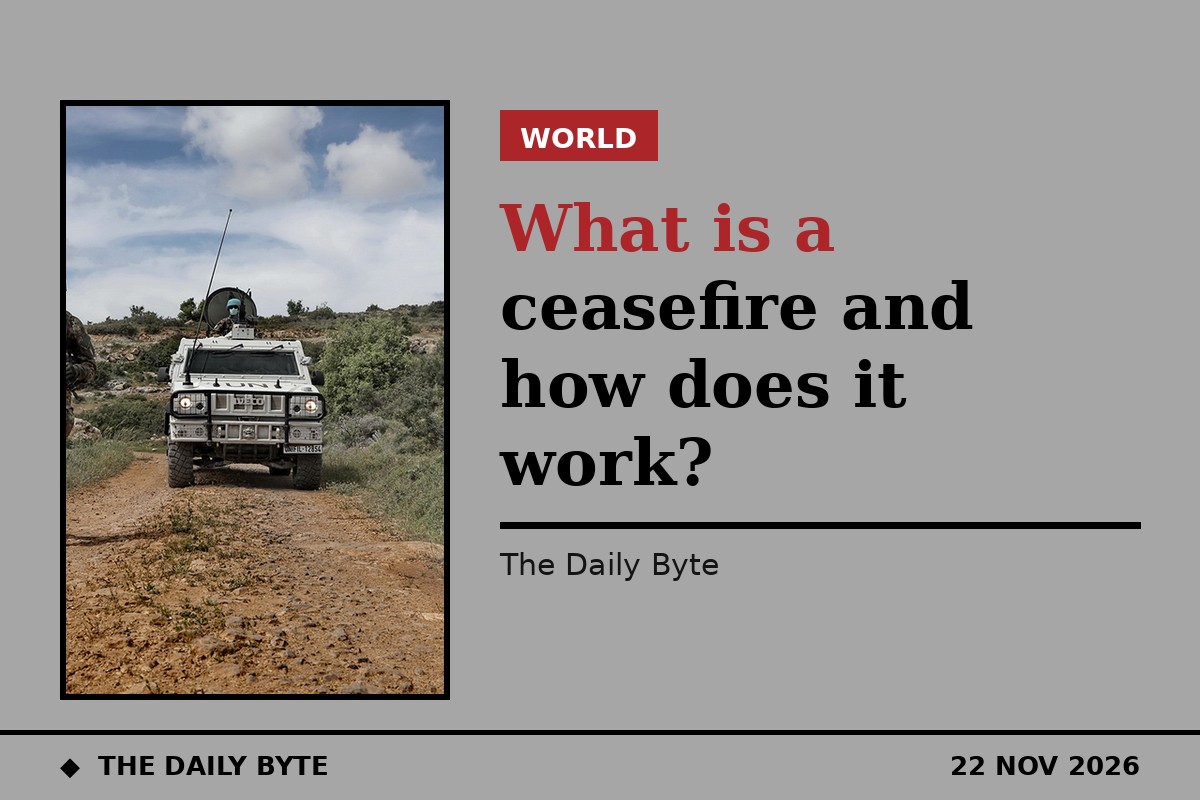
Monitoring is usually done by a third party. The classic model is a UN peacekeeping force deployed along the ceasefire line. The UN Disengagement Observer Force, deployed on the Golan Heights since 1974, is part of an arrangement that has kept the separation line between Israel and Syria largely quiet for decades. The UN Interim Force in Lebanon (UNIFIL) patrols the Blue Line between Lebanon and Israel to observe, monitor and report on the security situation on the ground.
Other models include joint commissions, where both sides sit together with a neutral chair to investigate incidents, and civilian monitoring missions such as the Organisation for Security and Co-operation in Europe (OSCE) Special Monitoring Mission in eastern Ukraine after the Minsk agreements of 2014 and 2015. That mission had hundreds of observers and reported ceasefire violations regularly, but its freedom of movement was often restricted and violations carried no political sanction. The conflict continued at low intensity and turned into full-scale war in 2022, a reminder that monitoring alone is not enough.
Civil society also plays a role. A 2026 PRIO policy brief found that civil society organisations often have better information about local dynamics, especially in remote areas, and can identify violations early. Their work is often informal: local knowledge, gender-sensitive reporting and early warning that formal missions struggle to replicate.
When a ceasefire is broken, the consequences depend on the agreement. Some violations are minor and local, such as a single shot fired by a nervous soldier, and are dealt with through the joint commission. Others are serious enough to collapse the deal. The Gaza ceasefire declared in October 2025 has held only fragilely, with repeated deadly incidents reported on both sides, while Yemen's 2022 truce collapsed in 2026. The January 2025 Israel-Hamas ceasefire, by contrast, centred on a phased hostage-prisoner exchange, showing how a ceasefire can be built around a concrete exchange rather than a general promise.
Why ceasefires fail
Most ceasefires fail for one of a handful of reasons. The first is that one or both sides never intended to keep it, and used the pause to rearm or reposition. The second is that the agreement was too vague to enforce, so each side accused the other of cheating and there was no trusted way to settle the argument. The third is that the parties who signed the deal do not control all the fighters on the ground, so a local commander or an allied militia can restart the fighting. The fourth is that the political issues behind the war were never addressed, so the pressure to fight again builds as soon as the pause ends.
Fortna's research offers a more hopeful finding: ceasefires that are detailed, monitored and backed by a credible third party last significantly longer than vague ones. The details matter more than the declarations. A ceasefire with a clear line on a map, a demilitarised zone, independent observers and a complaints procedure is a different thing from a press statement that fighting will stop.
Frequently asked questions
Does a ceasefire end a war? No. A ceasefire suspends the fighting. The legal state of war continues until a peace treaty or another political settlement ends it. The Korean armistice of 1953 is the clearest example: the fighting stopped, but no peace treaty has ever been signed.
What is the difference between a ceasefire and a peace treaty? A ceasefire deals only with the fighting: when it stops, where it stops and how compliance is checked. A peace treaty settles the political questions behind the war, such as borders, government and the status of disputed territory.
Who enforces a ceasefire? Usually nobody has the power to force compliance. Enforcement relies on monitoring, political pressure from the mediators and the parties' own interest in keeping the deal. The UN Security Council can authorise a peacekeeping force, but peacekeepers observe and report rather than fight.
Can a ceasefire be broken? Yes, and many are. Minor violations are often handled through joint commissions. Serious or repeated violations can collapse the agreement and lead to a resumption of full-scale fighting.
How long can a ceasefire last? Anything from a few hours to many decades. Humanitarian pauses last hours or days. The ceasefire line in Cyprus has held since 1974, and the Korean armistice has held since 1953, although neither conflict has been settled politically.
Ceasefires are imperfect, fragile and frequently broken. They are also the main tool the world has for stopping wars without winning them. Understanding what they are, and what they are not, is the first step in judging whether the latest one in the news is likely to hold. Sources: GSDRC ceasefires reading pack (UK government) and LegalClarity on ceasefires, truces and armistices, drawing on the UN Department of Political and Peacebuilding Affairs, the ICRC and PRIO research.


