What Is a Civil Partnership? UK Rules Explained
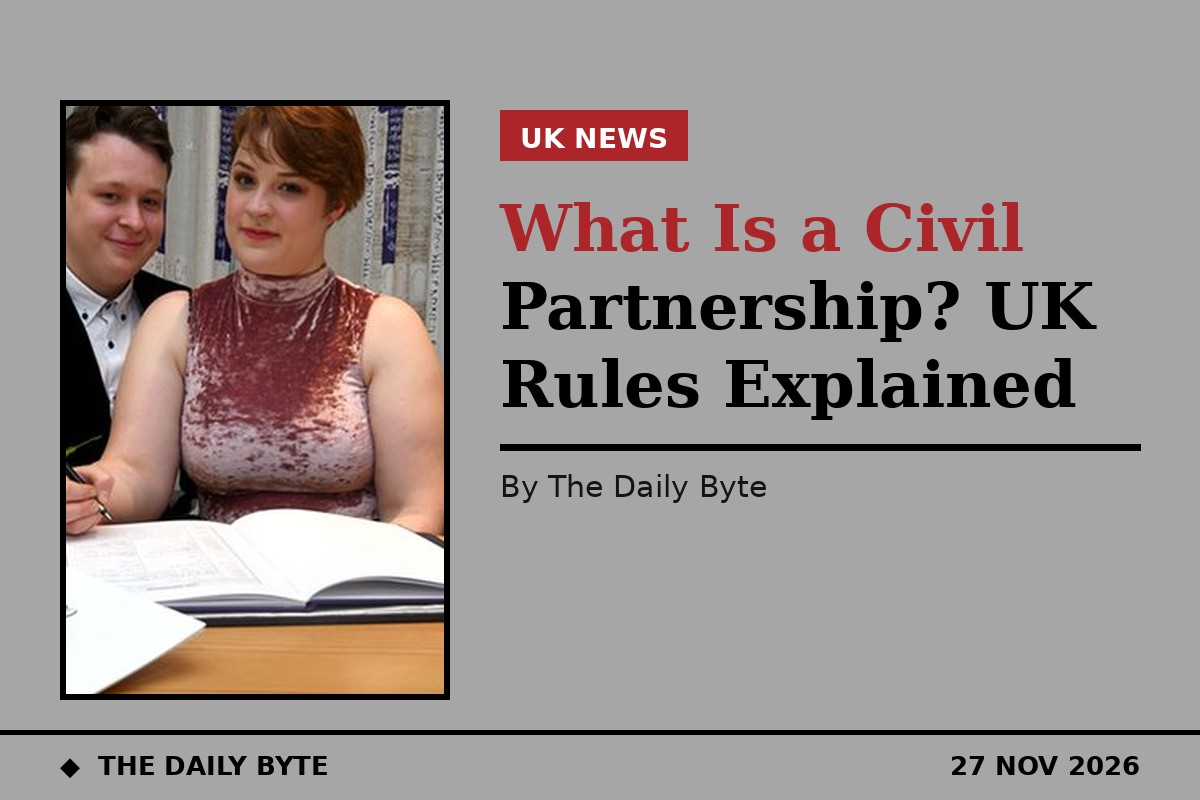
A civil partnership is a legally registered relationship between two people that gives them broadly the same legal rights and responsibilities as a married couple. It is formed by signing a civil partnership document in front of a registrar and two witnesses. No vows have to be exchanged and there is no ceremony. In England and Wales, civil partnerships have been open to both same-sex and opposite-sex couples since 31 December 2019.
Civil partnerships were created by the Civil Partnership Act 2004. They were originally available only to same-sex couples, giving them legal recognition at a time when same-sex marriage did not exist. After same-sex marriage was introduced, civil partnerships remained, and the law was later extended so that opposite-sex couples could also choose one. The change followed the Civil Partnerships, Marriages and Deaths (Registration etc) Act 2019, and it matters to couples who want the legal protection of a formal relationship without getting married. This guide explains the rules in England and Wales. Scotland and Northern Ireland have their own rules.
Who can enter a civil partnership?
Two people can register a civil partnership if they are both aged 18 or over, are not already married or in a civil partnership, and are not closely related to each other. The couple can be same-sex or opposite-sex. Since 27 February 2023, the minimum age has been 18. The Marriage and Civil Partnership (Minimum Age) Act 2022 removed the old rule that allowed 16 and 17-year-olds to register with parental consent, so parental consent no longer makes it possible for anyone under 18 to register.
Each partner must give notice at the register office for the area where they have lived for at least the previous seven days. Giving notice costs £35 per person, or £47 per person where one or both partners are subject to immigration control. After notice is given, the couple must wait at least 28 days before they can register, and the registration must take place within 12 months of giving notice. The couple can register at a register office or at approved premises. Every register office must offer a basic registration service, with the fee set at £46, £57 or £68 at the office's discretion, although a larger ceremony at another venue costs more.
To form the partnership, both partners sign the civil partnership document in the presence of each other, two witnesses and a civil partnership registrar. The witnesses and the registrar then sign as well. There is no requirement to exchange vows, and no religious service may be used while the registrar is officiating, because the registration itself is a civil process.
What rights do civil partners have?
Civil partners have broadly the same rights as married couples. The most important protections cover money, property, children and what happens if one partner dies or the relationship ends.
If a civil partner dies without a will, the surviving partner inherits under the intestacy rules in the same way as a surviving spouse. Transfers of assets between civil partners are exempt from inheritance tax, and a surviving partner can inherit any unused inheritance tax allowance. Many occupational and private pension schemes pay survivor benefits to a civil partner. A civil partner is recognised as next of kin, which matters for medical decisions and hospital visits. Where the couple have children, the usual rules on legal parenthood and parental responsibility apply.
If the relationship ends, the court has the same powers to make financial orders as it does on divorce. That can include dividing property, ordering maintenance or a lump sum, and sharing pensions under Schedule 5 to the Civil Partnership Act 2004.
Civil partnership versus marriage: what is the difference?
Civil partnership and marriage are separate legal institutions, but their legal consequences are now broadly similar. The main differences are practical rather than financial.
Formation: a marriage is formed by exchanging legally prescribed vows in a civil or religious ceremony. A civil partnership is formed by signing the civil partnership document in front of a registrar and two witnesses, with no vows and no religious element.
Ending: a marriage ends by divorce. A civil partnership ends by dissolution, a process that closely mirrors divorce.
Conversion: a same-sex couple in a civil partnership can convert it into a marriage for a fee of £55. Opposite-sex couples in a civil partnership have no equivalent conversion route in England and Wales.
Name and status: a marriage is registered as a marriage and a civil partnership is registered as a civil partnership. Neither status is a lesser version of the other. A civil partnership is a formal legal relationship with its own statutory framework, not an informal arrangement.
How does a civil partnership end?
A civil partnership ends on the death of a partner, by dissolution, or by annulment. Dissolution is the equivalent of divorce. Since 6 April 2022, dissolution has been no-fault under the Divorce, Dissolution and Separation Act 2020. Either partner, or both together, can apply by stating that the partnership has broken down irretrievably. Neither partner has to blame the other.
As with divorce, a partnership cannot usually be dissolved within the first year. Once that year has passed, an application can be made, and the court can deal with the finances at the same time, using the same powers it has on divorce. That includes orders about property, maintenance, lump sums and pension sharing.
Is a civil partnership right for you?
A civil partnership suits couples who want legal recognition and financial protection but do not want to marry. Some couples object to marriage on principle, some prefer the different terminology, and some simply like that the registration is a short civil act of signing a document rather than a ceremony with vows. Others choose it because it gives them inheritance, tax and pension protections that living together without a formal status does not.
Living together, however long, does not create the same rights. There is no such thing as a common-law marriage in England and Wales, so an unmarried couple has no automatic right to inherit under the intestacy rules, no inheritance tax exemption between them, and no automatic claim on the other's pension. A civil partnership closes those gaps in the same way marriage does.
Before registering, it is worth taking independent legal advice, particularly if either partner has children from an earlier relationship, owns property, runs a business, or has a pension to protect. A solicitor can explain how the rights apply to your situation and whether a will should be made or updated at the same time.
Frequently asked questions
Can opposite-sex couples enter a civil partnership?
Yes. Since 31 December 2019, civil partnerships in England and Wales have been open to both same-sex and opposite-sex couples.
Do we have to have a ceremony?
No. A civil partnership is formed by signing the civil partnership document in front of a registrar and two witnesses. You can choose a larger celebration at approved premises, but it is not required.
How much does it cost to register a civil partnership?
Giving notice costs £35 per person, or £47 per person if you are subject to immigration control. The registration itself costs more depending on the venue, but every register office must offer a basic service for £46, £57 or £68.
Can a civil partnership be converted into a marriage?
A same-sex couple can convert their civil partnership into a marriage for £55. Opposite-sex couples in a civil partnership have no conversion route in England and Wales.
How long must we wait before ending a civil partnership?
You cannot usually apply for a dissolution within the first year of the partnership. After that, either partner, or both together, can apply under the no-fault process.
Sources: Civil Partnership Act 2004 (legislation.gov.uk) and Sterling Law. This article is general information about the law in England and Wales, not legal advice.


