What Is a Coalition Government? UK Explained
A coalition government is a government formed by two or more political parties that agree to govern together. The parties share ministerial jobs, agree a joint programme of policies, and together hold enough seats in parliament to pass laws and survive votes of confidence. It is the usual answer when an election produces a hung parliament, meaning no single party has won an overall majority. The question is live again in November 2026 because New Zealand's general election on 7 November ended in a deadlock, with the incumbent three-party bloc holding a provisional one-seat majority and the official result not due until 27 November.
Coalitions are normal in many democracies, especially those that use proportional voting systems, where single-party majorities are rare. In the United Kingdom they are unusual at Westminster: the Conservative-Liberal Democrat coalition of 2010 to 2015 is the only example since the Second World War. This explainer sets out what a coalition government is, how one is formed, how it differs from a minority government and a confidence-and-supply deal, and why parties choose it.
What is a coalition government?
A coalition government is formed when two or more parties jointly form a government on the basis of a shared policy programme, with ministerial roles divided between representatives of the coalition parties. That is the definition used by the Institute for Government, the independent think tank that studies how government works. The point of the arrangement is arithmetic: together, the parties command a majority in the legislature, so the government can pass its budget and its legislation and survive a motion of no confidence.
A coalition is different from the other ways of governing after a hung parliament. In a minority government, one party governs alone without a majority and must win support vote by vote. Under a confidence-and-supply agreement, a smaller party promises to back the government on key votes, such as the budget and confidence motions, but does not join the government and its MPs hold no ministerial office. The Institute for Government draws exactly that distinction, using the Conservative-Democratic Unionist Party agreement of 2017 as the example of confidence and supply.
| Arrangement | Who governs | Who holds ministerial jobs | Example |
|---|---|---|---|
| Coalition government | Two or more parties together | Ministers from each coalition party | Conservative-Liberal Democrat, UK, 2010-15 |
| Minority government | One party alone | Ministers from that party only | Conservatives, UK, after September 2019 |
| Confidence and supply | One party, backed on key votes | Ministers from the governing party only | Conservatives with DUP support, UK, 2017-19 |
| Majority government | One party alone | Ministers from that party only | Usual UK outcome under first past the post |
When does a coalition government form?
A coalition is one solution to the problem of forming a government in a hung parliament, which the Institute for Government defines as a parliament in which no party holds a majority of seats in the House of Commons. In the UK, there are 650 MPs, so a party needs 326 seats for an outright majority. Three general elections since 1945 have returned a hung parliament: February 1974, May 2010 and June 2017. A hung parliament can also arise between elections, for example if MPs defect or the government loses seats at by-elections.
New Zealand's 2026 election is a current example. Voting on Saturday 7 November left the ruling centre-right National Party and the opposition Labour Party almost tied on the party vote, with Labour on 29.4 per cent and National on 29.2 per cent, about 3,650 votes apart, according to the Electoral Commission's preliminary count. On seats, National won 42, and with its coalition partners ACT on 13 seats and New Zealand First on 12, the governing bloc held 67 seats in a 131-seat House, one more than the 66 needed for a majority. The left-leaning bloc, including Labour on 36 seats, the Greens on 16 and the newcomer Opportunity Party on seven, held 64. The official result, including special votes, is not released until 27 November, and Prime Minister Christopher Luxon is leading a caretaker government until then.
How is a coalition government formed?
In the United Kingdom there is no fixed legal procedure for forming a coalition. The Institute for Government describes the UK as having an unordered government formation process, meaning there are no fixed rules governing which party has the right to try to form an administration first in a hung parliament. Parties are free to enter negotiations with whichever parties they choose. That contrasts with some other countries: in Greece, for example, the leader of the largest party is the first to be given an exploratory mandate by the president, and in Belgium the head of state appoints informateurs to explore coalition options.
The Cabinet Manual, the formal guidance on how government operates, states that when a general election does not result in an overall majority, the incumbent government is entitled to wait until the new Parliament has met to see if it can command the confidence of the House of Commons, but it is expected to resign if it becomes clear that it is unlikely to be able to command that confidence and there is a clear alternative. In 2010 this meant Gordon Brown remained in Downing Street for five days after the election while the Conservatives and Liberal Democrats negotiated their deal.
Negotiations usually cover three things: which policies the parties will pursue together, how cabinet and ministerial posts will be divided, and what happens when the parties disagree. In 2010 the two parties' negotiating teams, each of four senior MPs, produced an initial coalition agreement on 11 May 2010 and a fuller programme for government on 20 May. Each side had to give up some of its own promises to make the deal work. Once the agreement is settled, the leader who can command the confidence of the Commons is invited by the monarch to become prime minister and form the government.
What was the UK's last coalition government?
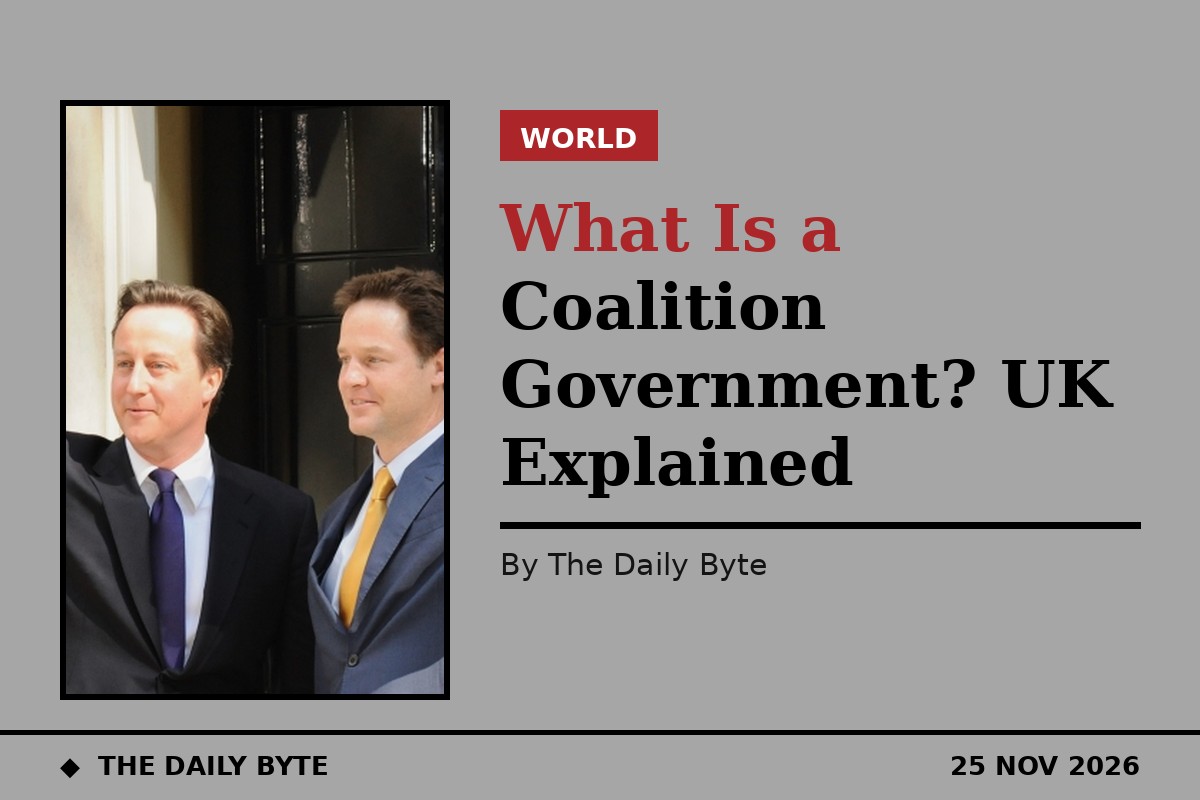
The Conservative-Liberal Democrat coalition was formed on 11 May 2010, after the general election on 6 May produced a hung parliament, the first in 36 years. The Conservatives had won the most seats but were 20 short of an overall majority. After five days of talks, David Cameron became prime minister and Liberal Democrat leader Nick Clegg became deputy prime minister. The cabinet was made up of 16 Conservatives and five Liberal Democrats. The coalition governed for the whole of the 2010-15 parliament and was dissolved on 8 May 2015, after the Conservatives won a majority at the 2015 general election.
It was the UK's first coalition government since the Churchill war ministry ended in 1945, and it remains the only example of coalition government at Westminster since then. Coalitions are more common in the UK's devolved legislatures, where the voting systems make single-party majorities harder to win. Since 1999 there have been coalition governments in both Scotland and Wales, and in Northern Ireland a coalition between the largest unionist and nationalist parties is a formal requirement of the Northern Ireland Act 1998.
Why do parties form coalitions, and what are the drawbacks?
Supporters argue that coalitions represent more voters. When no party has won a majority, a government that combines two or more parties reflects a wider range of opinion than a single party governing alone, and the need to compromise can produce more moderate, carefully considered decisions. That argument carries particular weight under proportional systems, where voters routinely split their support among several parties and a coalition is the expected outcome rather than an emergency measure.
Critics argue that coalitions can be weak and unstable. Nobody voted for the deal itself, which is agreed behind closed doors after polling day, and each party has to abandon promises it made to voters. Disagreements between partners can paralyse decision-making, and a smaller partner can hold disproportionate power because the government falls if it walks out. The 2010-15 coalition survived its full term, which is unusual by international standards, but the Liberal Democrats paid a heavy electoral price in 2015, when the Conservatives won a majority and governed alone.
How does a coalition government end?
A coalition normally ends in one of three ways. The most common is a general election, after which the parties may renew the coalition, form a new combination, or govern alone. A coalition can also collapse mid-parliament if the partners fall out irretrievably or one party withdraws its support, leaving a minority government or triggering an election. In New Zealand, the shape of the next government will not be known until the official result on 27 November and the coalition negotiations that follow, which the prime minister has said cannot meaningfully begin until the final count is known.
Frequently asked questions
Does the largest party always lead a coalition? Not necessarily. In the UK there are no fixed rules about who tries first, and the government is formed by whoever can command the confidence of the Commons. In practice the largest party usually leads, but a smaller party can lead a coalition if it can assemble a majority, and an incumbent prime minister can stay in office while negotiations continue.
Is a confidence-and-supply deal a coalition? No. Under a confidence-and-supply agreement the smaller party supports the government on the budget and confidence votes but does not join the government, and its MPs hold no ministerial office. In a formal coalition the parties share ministerial jobs and a joint programme.
Can a coalition form without a general election? Yes. A hung parliament can arise between elections, for example through by-election defeats or defections, and parties can then negotiate a new governing arrangement. The 2010 coalition was formed after an election, but the principle is the same: what matters is who can command the confidence of the House of Commons.
How long did the UK's last coalition last? Five years. The Conservative-Liberal Democrat coalition was formed on 11 May 2010 and dissolved on 8 May 2015, governing for the whole of the 2010-15 parliament.
Sources: Institute for Government, "Coalition government at Westminster" and "Hung parliaments"; Electoral Commission of New Zealand preliminary results for the 7 November 2026 general election, as reported on 8-9 November 2026.


