What Is a Deepfake? How to Spot Fake Videos
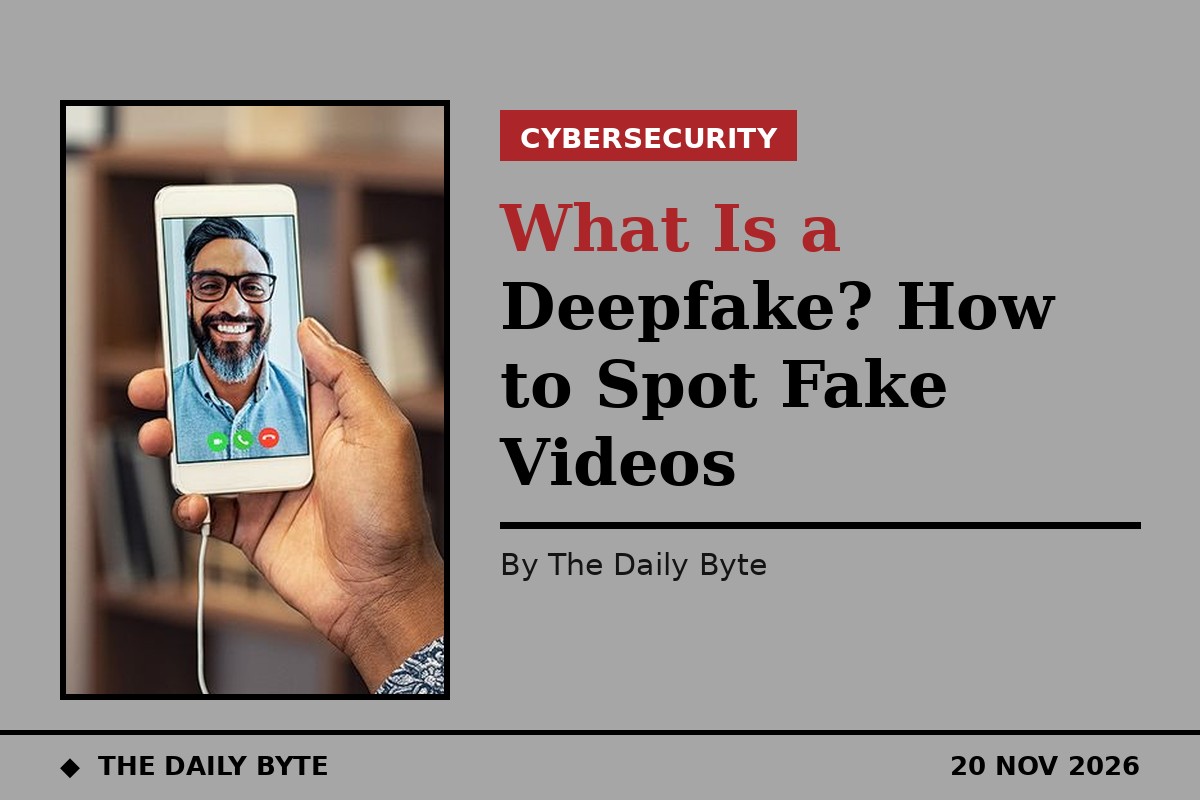
A deepfake is a photo, video or audio clip that has been created or altered with artificial intelligence so that it convincingly shows a real person saying or doing something they never said or did. The term is a blend of "deep learning" and "fake", and the technology is now good enough that a fake video call or voice message can be hard to tell from a real one. TikTok launched a likeness-detection tool globally in November 2026 to help users spot such fakes, which is a sign of how widespread the problem has become.
Deepfakes are not always harmful. They are used in films, satire, education and accessibility tools. But they are also used for fraud, political disinformation and intimate image abuse, and the laws are now catching up: Britain made sharing intimate deepfakes a crime under the Online Safety Act, and the United States passed its first federal deepfake law in 2025. This explainer covers how deepfakes are made, what they are used for, and how to protect yourself.
How are deepfakes made?
The word "deepfake" comes from a Reddit user who posted face-swapped videos in 2017, but the methods have changed a lot since then. Early deepfakes were built with autoencoders and generative adversarial networks, known as GANs, in which one neural network generates fake content and a second network tries to tell it apart from real content. Each round of that contest makes the output more convincing.
Newer tools use diffusion models and large speech models, which need far less training material than the early systems did. A few minutes of someone's voice, or a handful of photos, can now be enough to build a passable clone. Real-time face-swap software can overlay another person's face onto a live webcam feed, so a video call is no longer proof of who is on the other end. That is why the old advice to "check it on video" is no longer enough on its own.
What are deepfakes used for?
Legitimate uses include dubbing films into other languages with matching lip movements, bringing historical figures to life in museums, parody and satire, and giving a voice back to people who have lost theirs. But the harmful uses are what make the news. Criminals use cloned voices and fake video calls to impersonate bosses and order payments, a trick known as CEO fraud. In November 2026, three people were charged over an alleged 129 million dollar AI deepfake CEO fraud, showing the scale that such scams can reach.
Deepfakes are also used to create fake intimate images of real people, to spread false statements by politicians, and to produce fake job candidates who pass remote interviews with a swapped face or a cloned voice. The UK government has estimated that 8 million deepfakes were shared online in 2025, up from around 500,000 in 2023, a sixteen-fold rise in two years.
How can you spot a deepfake?
The visual clues that used to give deepfakes away, such as unnatural blinking, mismatched lighting or blurred edges around the face, have largely been eliminated by modern models. That does not mean detection is hopeless, but it does mean no single clue is reliable any more. What works better is checking the context: does the clip come from a trusted source, does the claim match what reputable outlets are reporting, and does the audio match the speaker's known voice and mannerisms?
Technical defences are improving. Automated detectors look for subtle artefacts in the pixels and the audio, though they struggle with compressed video and with new generation methods. Provenance standards such as C2PA content credentials attach a signed history to a piece of media, which can prove that genuine content is authentic, although they cannot label fakes that were never signed. Platforms are also adding their own checks: TikTok's likeness-detection tool, launched globally in November 2026, scans uploads for faces that resemble real people and flags them for review.
Are deepfakes illegal?
Creating a deepfake is not automatically illegal, but using one usually is. In the United Kingdom, the Online Safety Act 2023 made it a criminal offence to share intimate deepfake images without consent, and it is also illegal to create, or ask someone to create, fake intimate images of a person without their permission. Deepfake-enabled fraud falls under the Fraud Act 2006, and the Metropolitan Police advises victims of intimate image abuse, fraud or blackmail involving deepfakes to report it as a crime.
In the United States, the TAKE IT DOWN Act was signed into law on 19 May 2025. It makes it a federal crime to knowingly publish non-consensual intimate imagery, including AI-generated images, and requires platforms to remove such content within 48 hours of a valid notice from the victim. In the European Union, the AI Act requires deepfakes to be disclosed as artificially generated. The rules differ by country, but the direction is the same everywhere: the law is moving against non-consensual and fraudulent uses, while parody, satire and clearly labelled synthetic media remain lawful.
How do you protect yourself?
The most reliable defence is a process that does not depend on recognising a face or a voice. If you receive an urgent payment request, an instruction to move money or share sensitive data, or a surprising video call from a colleague, verify it through a different channel: call the person back on a number from your own directory, never one supplied in the message, and use a pre-agreed code word for sensitive requests if your workplace has one.
For personal safety, be cautious about how much clear video and audio of yourself you post publicly, since that material is the raw input for a clone. Use the reporting tools on platforms where a fake of you appears, keep copies of the evidence, and report intimate image abuse or fraud to the police. And remember that a video call, a voice note or a photo is now evidence that needs checking, not proof in itself.
Frequently asked questions
Is every deepfake illegal? No. A clearly labelled parody, a film effect or a consensual synthetic avatar is lawful in most countries. It becomes illegal when it is used to deceive, defraud, harass or abuse someone without their consent.
Can a video call be faked live? Yes. Real-time face-swap tools can put another person's face over a live caller, and voice cloning can fake the audio at the same time. If a call involves money or sensitive information, verify the request through a separate channel before acting.
What should I do if someone makes a deepfake of me? Save the evidence, report it to the platform where it appears, and report it to the police if it is intimate, threatening or part of a fraud. In the United States, the TAKE IT DOWN Act gives victims a right to have platforms remove non-consensual intimate images within 48 hours of a valid request.