What is a discharge petition in Congress?
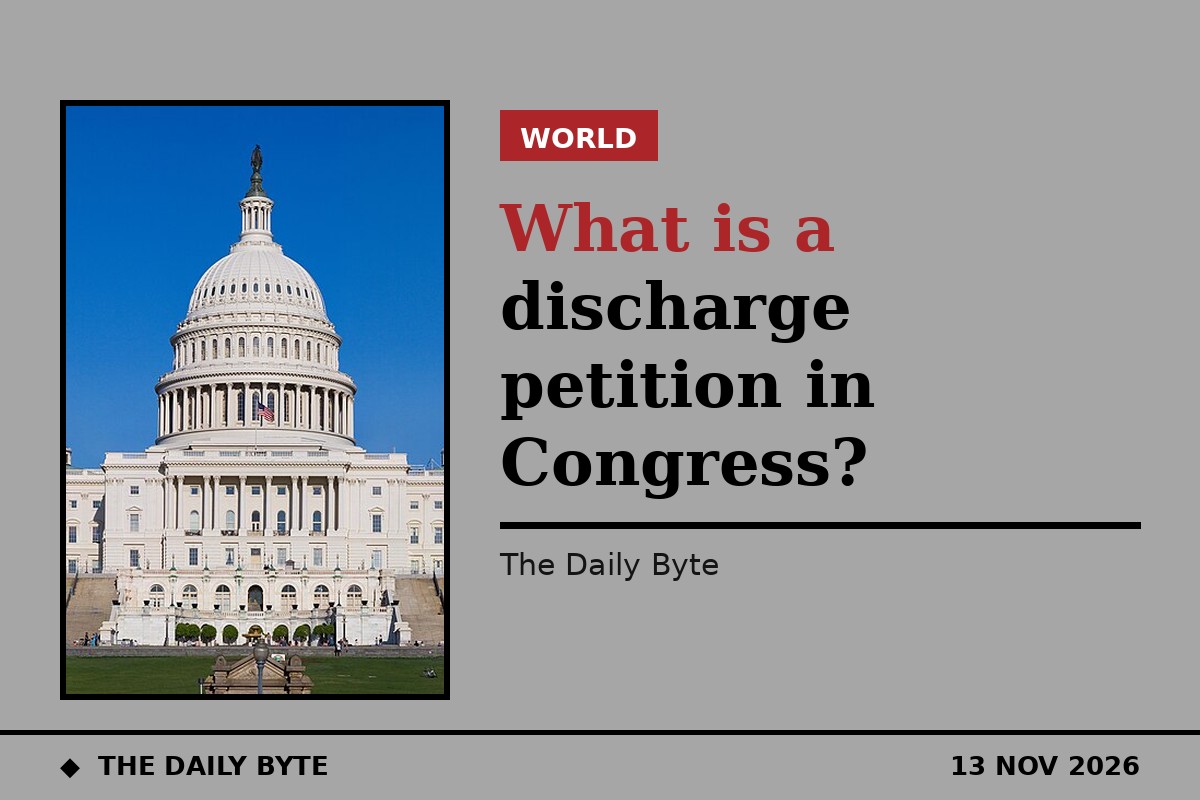
A discharge petition is a procedure in the US House of Representatives that lets a majority of members force a bill onto the floor for a vote, even when the committee holding it or House leaders will not schedule it. It takes 218 signatures — a majority of the 435-member House — and it is in the news because a petition led by Republican Representative Thomas Massie reached that number on 11 November 2026, forcing a vote on a second Epstein files bill.
How does a discharge petition work?
Under the House discharge rule, Rule XV, clause 2, a member can file a discharge petition once a bill has sat in committee for at least 30 legislative days without being reported. Members sign the petition at the Clerk’s desk while the House is in session, and they may add or remove their names until the total reaches 218. At that point the signature list is frozen and printed in the Congressional Record, and the motion is entered on the Discharge Calendar, according to the Congressional Research Service.
Reaching 218 signatures does not put the bill on the floor the same day. The motion must sit on the calendar for at least seven legislative days, and it can then be called up only on a “discharge day” — the second or fourth Monday of a month — and not during the last six days of a session of Congress. A second version of the procedure applies to the Rules Committee: if that committee has not reported a special rule for a bill after seven legislative days, members may petition to discharge it instead.
Why is a discharge petition in the news now?
On 11 November 2026, Massie announced that his discharge petition for the Epstein Files Transparency Act II had reached the required 218 signatures. Democratic Representative John Garamendi of California provided the decisive 218th signature, with Representative Adam Smith of Washington signing as the 217th, according to the House Clerk. All 214 Democrats signed, along with four Republicans: Massie, Nancy Mace, Ralph Norman and Brian Fitzpatrick, Axios reported.
The bill would let members of Congress, state attorneys general and survivors of Jeffrey Epstein’s abuse sue the Justice Department if it withholds or heavily redacts Epstein-related records that Congress previously ordered released. It follows the first Epstein Files Transparency Act, which was itself forced to a vote by an earlier Massie discharge petition, passed the House 427-1 on 18 November 2025 and was signed into law on 19 November 2025.
| Fact | Detail |
|---|---|
| Signatures needed | 218 — a majority of the 435-member House |
| House rule | Rule XV, clause 2 |
| Wait after 218 signatures | At least seven legislative days |
| Days a vote can be forced | Second or fourth Monday of the month |
| Current form of the rule adopted | 1931; threshold raised to 218 in 1935 |
Does reaching 218 signatures guarantee the bill becomes law?
No. A successful discharge petition only forces a vote in the House. The bill must still pass the House, then pass the Senate, and then be signed by the president before it becomes law. The vote is expected during the lame-duck session, before the new Congress takes over in January 2027, and passage is not guaranteed.
Frequently asked questions
How many signatures does a discharge petition need?
218 — a majority of the 435 members of the US House of Representatives.
Can members remove their signatures?
Yes. Members may add or withdraw their names at any time before the petition reaches 218 signatures, after which the list is frozen.
How soon can a vote happen after 218 signatures?
Not immediately. The motion must remain on the Discharge Calendar for at least seven legislative days and can then only be called up on a second or fourth Monday.
Sources: Axios, 11 November 2026; Congressional Research Service, The Discharge Rule in the House, 14 October 2015.


