What Is a Drone?
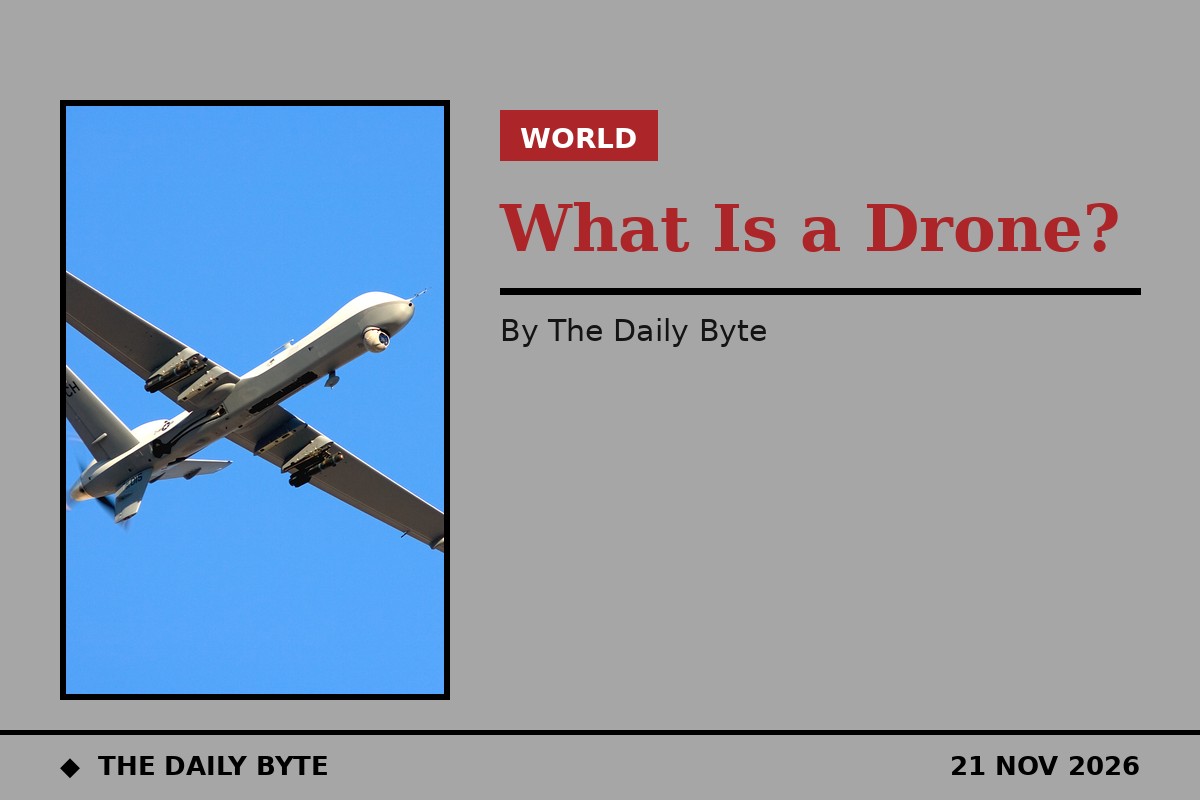
A drone is an aircraft with no pilot on board. It is flown either by a human operator on the ground, using a remote control and a live video link, or by itself, following a pre-programmed route or making its own decisions with onboard computers. The formal military term is unmanned aerial vehicle, or UAV; the whole system, including the ground station and the radio link, is called an unmanned aircraft system.
Drones range from a toy quadcopter weighing less than 250 grams to a military aircraft the size of a small aeroplane that can stay airborne for more than a day. They are now so common that they appear in the news almost every day, from wars in Ukraine and the Middle East to filming, farming and parcel delivery.
How does a drone fly?
Most small drones are quadcopters: four rotors, each with its own motor, lift the aircraft and steer it by spinning at different speeds. Tilt the rotors one way and the drone moves forward; spin them faster and it climbs. Larger military drones look more like ordinary aeroplanes, with fixed wings and a propeller or jet engine, and they take off from a runway or a catapult.
There are two basic ways to control a drone. In remotely piloted flight, an operator on the ground flies it in real time, watching a camera feed and sending commands over a radio data link. The operator may be a few hundred metres away, or, for a large military drone, sitting in a control station on another continent, connected by satellite.
In autonomous flight, the drone follows instructions loaded before take-off: a route of GPS waypoints, a height and a speed, and rules for what to do if the link is lost. Many drones combine the two, flying themselves between waypoints while a human watches the camera and takes over for the delicate part of the job. First-person-view, or FPV, drones add a headset showing the pilot what the camera sees, which is why they are used for racing and, in war, for precision attacks.
What kinds of drones are there?
Civilian drones are mostly small quadcopters used for photography, filming, surveying land, inspecting roofs, pylons and pipelines, monitoring crops and forests, and, in a few places, delivering parcels. Police forces use them to search for missing people and to watch crowds, and fire services use them to map wildfires. They are cheap, easy to fly and, in most countries, legal to own with only a basic test and registration.
Military drones split into two very different families. Surveillance and strike drones, such as the American MQ-9 Reaper, are large, long-endurance aircraft that watch a battlefield for hours and can fire missiles at targets they find. Iran claimed on 21 November 2026 that its forces had shot down US drones over the Strait of Hormuz, the latest in a long series of such claims around the waterway.
The other family is the small one-way attack drone. In Ukraine, both sides fly thousands of them: cheap FPV drones carrying a warhead, and longer-range one-way drones such as the Shahed type, which fly to a target and explode on arrival. An open-source log of the night of 20 to 21 November counted 148 Shahed-type drones among the weapons Russia fired at Ukraine, alongside ballistic and cruise missiles. These drones are not meant to come home, which is one reason they are so cheap and so numerous.
What are the rules for flying a drone in the UK?
In the UK, drones are regulated by the Civil Aviation Authority, and the rules changed on 1 January 2026. Anyone flying a drone or model aircraft weighing 100 grams or more outdoors must hold a Flyer ID, which means passing the CAA's free online theory test; the ID lasts five years. Previously the Flyer ID was only required for drones over 250 grams.
An Operator ID is also required if you own or are responsible for a drone weighing 250 grams or more, or weighing 100 grams or more and fitted with a camera. The operator is the person responsible for the drone, and the Operator ID number must be labelled on the aircraft. You must be 18 or over to register as an operator. Drones under 100 grams need neither ID, although the CAA still recommends taking the test.
The CAA's Drone and Model Aircraft Code sets out where you can and cannot fly, including height limits, distances from people and buildings, and bans on flying near airports, prisons and emergency incidents. Flying without the required IDs is against the law and can lead to a fine or prosecution. The rules change, so anyone buying a drone should check the CAA's own pages before flying.
Is a missile a drone?
No, although the confusion is understandable, because both are unmanned and both can be guided to a target. The difference is that a drone is an aircraft: it takes off, flies its mission and, in most cases, lands and can be used again. A missile is a munition: the vehicle itself is the weapon, it is used once, and it is destroyed when it hits. That is why the formal definition of a UAV describes an aircraft that can be expendable or recoverable and can carry a payload, while a missile with a warhead is generally not counted as a UAV at all.
The line blurs with one-way attack drones, which are also destroyed on impact. The practical distinction is that a drone flies like an aircraft, with wings or rotors and a controllable flight path, while a missile, especially a ballistic missile, follows a mostly unpowered arc after its rocket burns out. One-way drones are best thought of as a cheap, slow, reusable-aircraft technology used once, rather than as missiles.
Frequently asked questions
How far can a drone fly? A small consumer drone usually stays within a few kilometres of its operator, limited by battery life and the radio link. A large military drone such as the MQ-9 can fly thousands of kilometres and stay airborne for more than 24 hours, controlled by satellite from another continent.
Do you need a licence to fly a drone in the UK? You do not need a pilot's licence for ordinary recreational flying, but from 1 January 2026 you need a Flyer ID for any drone weighing 100 grams or more, and an Operator ID if the drone weighs 250 grams or more or has a camera and weighs 100 grams or more.
Can drones be shot down? Yes. Military drones are shot down regularly in war zones, by air-defence missiles, fighter jets and electronic warfare that jams their control links. Iran has repeatedly claimed to have shot down American MQ-9 drones, most recently on 21 November 2026.
What is an FPV drone? A first-person-view drone is flown by a pilot wearing a headset that shows the drone's camera feed, as if the pilot were sitting in the aircraft. FPV drones are used for racing, and in Ukraine they have become a standard weapon, with an operator steering a warhead-carrying drone directly into its target.
Sources: the definition and types of unmanned aerial vehicles; the Civil Aviation Authority's Drone and Model Aircraft Code, January 2026 edition; and reports of drone activity on 20 and 21 November 2026. The drone began as a military tool, but it is now an everyday aircraft, and the rules are still catching up with how fast it has spread.


