What Is a Fixed Penalty Notice? UK Rules Explained
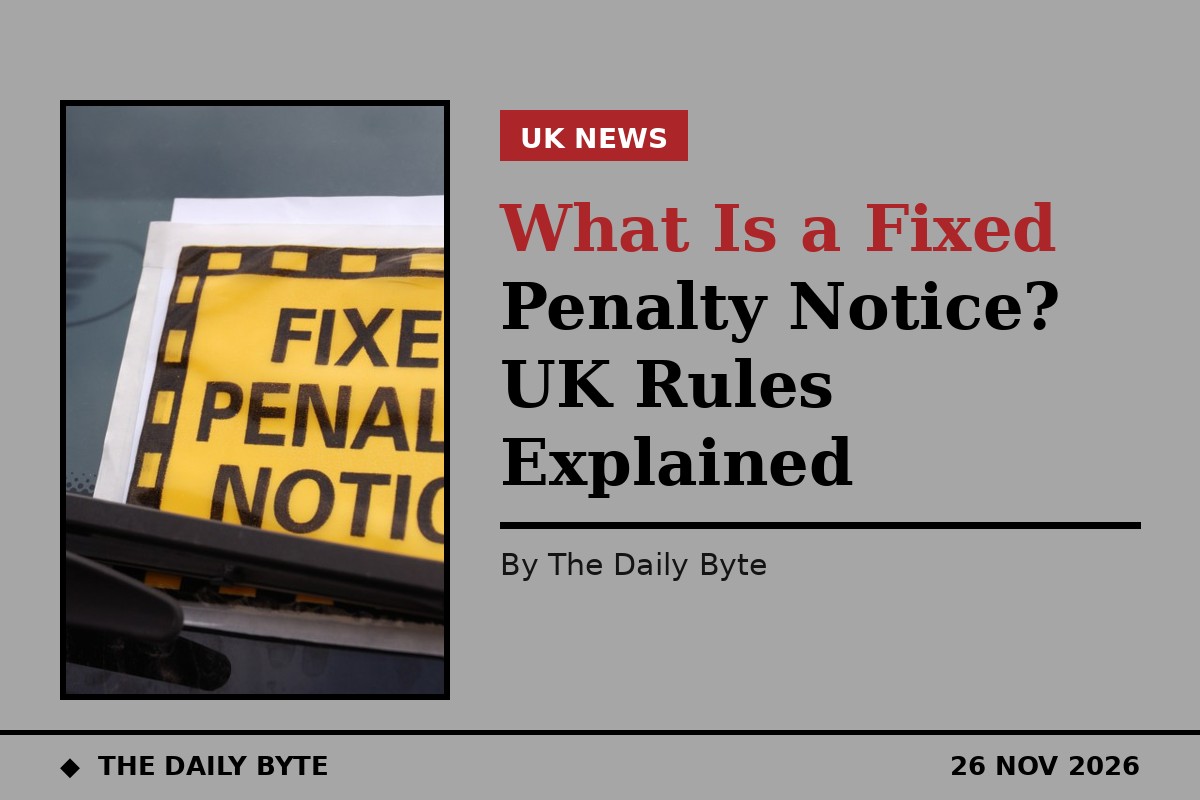
A fixed penalty notice, often shortened to FPN, is a notice that lets you settle a minor offence by paying a set amount of money instead of going to court. It is used across the UK for offences such as speeding, some parking offences and environmental offences such as littering. If you pay within the deadline printed on the notice, the matter ends there: you will not be prosecuted for that offence and there is no court hearing.
What is a fixed penalty notice?
A fixed penalty notice is a formal offer. The authority issuing it says it believes you committed a particular offence, and offers you the chance to discharge any liability to be convicted for that offence by paying a fixed sum. The amount is fixed, which means it does not vary with your income or circumstances in the way a court fine does. The notice states the offence, the amount to pay, how to pay and the deadline. It can be handed to you on the spot, for example by a police officer at the roadside, or sent to you by post.
There are two kinds. A non-endorsable fixed penalty notice carries a fine only. An endorsable fixed penalty notice carries a fine and penalty points on your driving licence. Speeding is the most common endorsable example: the standard fixed penalty is a £100 fine and three penalty points. Paying an endorsable notice means the points are added to your licence. Paying any fixed penalty notice settles the matter without a court appearance, and it does not result in a court conviction.
Who can issue a fixed penalty notice?
Fixed penalty notices are issued by several different authorities, depending on the offence. The police issue them for motoring offences, including speeding, using a mobile phone while driving and some parking offences. Local councils issue them for parking offences and for environmental offences such as littering, fly-tipping, dog fouling and graffiti. The Driver and Vehicle Standards Agency (DVSA) issues them for vehicle defects and offences such as breaking the rules on drivers' hours. What all of these have in common is that the offence is minor enough for the law to allow it to be dealt with outside court.
The notice will always say who issued it and for which offence. That matters, because the deadline, the amount and the way to challenge the notice all depend on the type of offence and the authority involved. A speeding notice from the police, a parking notice from a council and a littering notice from a council officer may look similar, but they are handled under different rules.
How much is a fixed penalty notice?
The amount depends on the offence, and it is set either by law or by the issuing authority within legal limits. The best-known figure is the speeding fixed penalty: a minimum of £100 and three penalty points on your licence. If a speeding case goes to court instead, the fine is worked out from your weekly income and can reach £1,000, or £2,500 for an offence on a motorway.
Parking fixed penalty notices work differently. GOV.UK says you usually have 28 days to pay. If you do not pay within 28 days, you will have to pay 50 per cent more. Penalty points apply only to certain types of parking fixed penalty notice, for example for leaving a vehicle in a dangerous position. Most parking fixed penalty notices carry a fine only.
Fixed penalty notices for environmental offences, such as littering, usually have to be paid within 14 days, according to GOV.UK. The exact deadline is always printed on the notice itself, so check it rather than assuming the same period applies to every kind of notice. The amount for an environmental offence is set by the council within the legal maximum for that offence.
What happens if you do not pay?
An unpaid fixed penalty notice does not simply go away. For a parking notice, the amount rises by 50 per cent after 28 days, and if you still do not pay you will be prosecuted and may have to pay a bigger fine as well as court costs. For an environmental offence, GOV.UK warns that you might be prosecuted and have to pay more if you do not pay on time.
For speeding, failing to respond to a fixed penalty notice means the case is likely to go to the magistrates' court. There, fines are set in bands according to how far over the speed limit you were driving. Band A, for minor speeding, usually means three points and a fine of 25 to 75 per cent of your weekly income. Band B usually means four to six points, or a driving ban of 7 to 28 days, and a fine of 75 to 125 per cent of weekly income. Band C, for the most serious speeding, usually means six points or a ban of 7 to 56 days, and a fine of 125 to 175 per cent of weekly income. In every band the court fine is capped at £1,000, or £2,500 on a motorway.
How do you pay a fixed penalty notice?
The notice itself tells you how to pay, and you should follow those instructions. In England and Wales, speeding fixed penalty notices can usually be paid online through the GOV.UK penalty notice service, using the reference number on the notice and your driving licence number. Payment by phone or by post is also usually possible, and the details are on the notice. In Scotland, speeding fines can be paid online, by phone or by post through the Scottish Courts and Tribunals Service. The DVSA has its own payment service for roadside fines, and you need the payment code it sends you. Whatever the offence, the key point is the deadline: pay or respond within the period stated, which is usually 28 days for motoring and parking notices.
How do you challenge a fixed penalty notice?
You cannot appeal a fixed penalty notice in the ordinary sense, because it is an offer rather than a court decision. If you believe you did not commit the offence, the way to challenge it is to refuse the offer and have the case heard in court. For a parking fixed penalty notice, GOV.UK says you need to go to a magistrates' court, and the back of the ticket tells you how to do this. You will be sent a summons with a date to attend a court hearing.
For an environmental offence, you can first challenge the notice with the authority that issued it, giving evidence to show why you should not receive the penalty. If that challenge is rejected, or if you cannot challenge it that way, you can choose not to pay and defend your case in court. The risk is real: if the court finds you guilty, you might have to pay more than the original penalty, plus court costs.
For speeding, the process usually starts before the fixed penalty notice arrives. If you are caught by a camera, the registered keeper of the vehicle receives a notice of intended prosecution, usually within 14 days of the offence, together with a Section 172 notice asking who was driving. The keeper must return that notice within 28 days. Once the driver is identified, the driver receives either a fixed penalty notice or a court summons. If you are offered a speed awareness course instead of points, taking it avoids the penalty points, although you still pay for the course, which usually costs around £100. Courses are generally offered only for minor speeding and only if you have not completed one in the previous three years.
If you decide to go to court over a speeding allegation, you will need a real ground for your defence, such as the notice arriving outside the legal time limit, an error in who was identified as the driver, or a problem with the evidence. Simply disagreeing with the speed limit or the penalty is not a defence, and a court that finds you guilty will usually impose a higher fine than the fixed penalty.
Fixed penalty notice or penalty charge notice?
The two are easy to confuse, especially for parking. A penalty charge notice, or PCN, is a civil penalty, usually issued by a local council for a parking contravention, and it is dealt with through an appeals process rather than the criminal courts. A fixed penalty notice is issued for an offence, and it is challenged by asking for a court hearing. The notice itself will say which type it is and who issued it. Private companies that manage car parks issue their own parking charge notices, which are invoices rather than official penalties, and they are challenged with the company itself. If you are unsure what you have received, read the notice and check the issuer before you pay or appeal.
How long do penalty points stay on your licence?
Penalty points from a speeding offence stay on your driving licence for four years from the date of the offence, according to MoneyHelper. Points can also add up: if you collect 12 or more penalty points within three years, you can be disqualified from driving under the totting-up rules. That is one reason a speed awareness course, where it is offered, can be worth taking for a first or minor offence: it keeps the points off your licence altogether.
Rules checked against GOV.UK guidance on 26 November 2026. Fixed penalty notice amounts and deadlines vary by offence and by the authority that issued the notice, so always read the notice itself before acting.
Frequently asked questions
Q: Is a fixed penalty notice a criminal record?
A: No. Paying a fixed penalty notice settles the matter without a court hearing, so it does not result in a court conviction. Penalty points, where they apply, are recorded on your driving licence, and your insurer may ask about them, but the notice itself is not a criminal conviction.
Q: What if the fixed penalty notice was sent to the wrong person?
A: For camera-detected speeding, the notice of intended prosecution goes to the registered keeper, who must name the driver within 28 days. If you were not the driver, give the correct driver's details. Failing to return the notice is itself an offence that can lead to a court appearance.
Q: What if I lose my fixed penalty notice?
A: Contact the authority that issued it. The notice will usually have been issued by the police, the council or the DVSA, and the police fixed penalty office can give you the reference number you need to pay. Do not ignore it: the deadline still applies even if you have lost the paper.


