What Is a Gigafactory? Tesla's Huge EV Plants
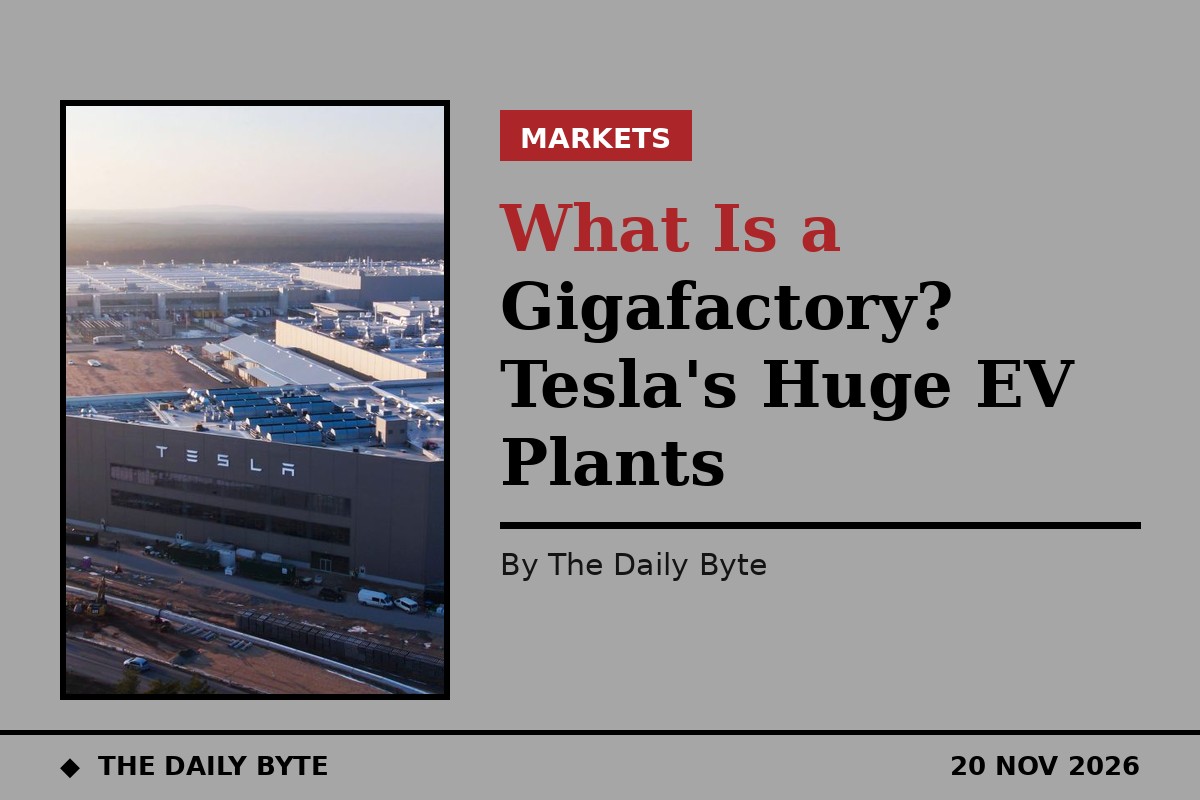
A gigafactory is a giant factory built to produce electric vehicles, lithium-ion batteries and energy-storage products on a massive scale. The name comes from "giga", meaning a billion: the first such plant was designed to produce batteries measured in gigawatt-hours, at a scale no single factory had attempted before. The term was coined by Tesla, and it is now used across the industry for any huge battery or electric-vehicle plant. Tesla's German plant, Gigafactory Berlin-Brandenburg, is back in the news after the company announced a €3 billion expansion there on 16 November 2026.
What sets a gigafactory apart is not just its size, although the buildings are among the largest in the world. It is the combination of scale and vertical integration: battery cells, battery packs, drivetrains and finished vehicles are made under one roof, by robots, in volumes meant to cut the cost of batteries and electric cars. That idea has reshaped how the car industry builds factories.
Where Does the Word Gigafactory Come From?
Elon Musk, Tesla's chief executive, is believed to have first used the term "Gigafactory" in November 2013, telling investors on the company's third-quarter earnings call that a "giga factory" would be needed to supply batteries for its planned high-volume car, the Model 3. The output, he said, would need to be comparable to all lithium-ion battery production in the world in one factory. Tesla later set the target at 35 gigawatt-hours (GWh) of cells a year by 2020 — roughly the entire world's lithium-ion output in 2013.
The "giga" in the name therefore refers to the unit of energy, not simply to the building being gigantic, although the buildings are that too. One gigawatt-hour is the energy of generating one billion watts for one hour, and an electric car battery is typically measured in tens of kilowatt-hours, so a plant producing 35 GWh a year is making enough cells for hundreds of thousands of cars.
What Makes a Gigafactory Different from a Normal Car Plant?
A conventional car plant assembles vehicles from parts made elsewhere: engines from one supplier, batteries from another, electronics from a third. A gigafactory collapses much of that chain into a single site. At Tesla's Nevada plant, battery cells made with Panasonic sit alongside drive-unit production; at Berlin, battery cells, packs, drivetrains and finished Model Y cars are produced in the same complex using advanced robotics. Making more of the car in-house cuts transport, reduces exposure to supply-chain disruption and, at sufficient volume, cuts the cost of each battery.
Scale is the other difference. The Nevada plant was planned at around 10 million square feet when complete — roughly the size of 262 American football fields — making it one of the largest buildings in the world by volume. The plants are also designed around renewable energy: Tesla planned for the Nevada factory to be powered by renewable sources, including rooftop solar, as part of its aim of net-zero energy operation.
Tesla's Five Gigafactories
| Factory | Location | Opened / production began | What it makes |
|---|---|---|---|
| Gigafactory Nevada (Giga Nevada) | Sparks, Nevada, USA | Grand opening July 2016; cells from January 2017 | Battery cells, drive units, Semi truck |
| Gigafactory New York (Giga New York) | Buffalo, New York, USA | Production from 2017 | Solar panels, Solar Roof, Supercharger cabinets |
| Gigafactory Shanghai (Giga Shanghai) | Shanghai, China | Production from December 2019 | Model 3 and Model Y |
| Gigafactory Berlin-Brandenburg (Giga Berlin) | Grünheide, Germany | Opened March 2022 | Model Y; battery cells (4680) |
| Gigafactory Texas (Giga Texas) | Austin, Texas, USA | Production from April 2022 | Model Y, Cybertruck, Cybercab |
Sources: Electrek; Manufacturing Digital.
Tesla's first factory, at Fremont in California, is not a gigafactory: it was bought from the General Motors–Toyota NUMMI joint venture in 2010 and builds cars rather than batteries at gigawatt-hour scale. The company also builds energy-storage products at three Megafactories, in Lathrop, Shanghai and Texas, which are separate from the five gigafactories. A sixth gigafactory, in Mexico, is on hold.
Gigafactory Berlin-Brandenburg in Focus
Gigafactory Berlin-Brandenburg, known as Giga Berlin, is Tesla's only car plant in Europe. It stands at Grünheide, just east of Berlin, opened in March 2022 after about two years of construction, and builds the Model Y. The site employs around 12,600 people and has capacity to build around 375,000 vehicles a year. Tesla is also adding production of its 4680 battery cells at the site, with 18 GWh of annual capacity planned.
The plant has been controversial as well as productive, facing disputes over water use, forest clearance and union recognition, and it sits in a German car industry that is cutting back: BMW is cutting jobs, Volkswagen has considered plant closures, and Mercedes has suspended new investment in Germany. Against that background, Tesla's decision to invest billions more in Grünheide stands out.
The €3 Billion Cybercab Expansion
On 16 November 2026, Tesla confirmed it will invest around €3 billion (about $3.3 billion) in a new production building at Giga Berlin, designed to build its Cybercab robotaxi. The new hall, north of the existing plant, will be joined by ancillary buildings and a second wastewater treatment plant, and Tesla says the expansion will make Grünheide its most technologically advanced gigafactory. The Cybercab is a two-seat, steering-wheel-free autonomous vehicle, and the new building is designed for annual capacity of up to one million of them.
The timetable is: a building permit application before the end of 2026, construction starting in the first half of 2027, and Cybercab production beginning in 2029. Brandenburg's minister-president, Dietmar Woidke, called the investment and the prospect of up to a million Cybercabs a decision of enormous economic significance. If Tesla reaches its target, the expanded Grünheide plant could overtake Volkswagen's Wolfsburg headquarters as Europe's biggest car factory by capacity — although the Cybercab cannot yet legally operate without a driver in Europe, and has not been sold at scale anywhere, so the bet carries obvious risk.
Gigafactories Beyond Tesla
The word has outgrown its maker. By extension, a gigafactory now means any factory aiming to produce batteries, electric vehicles or related equipment in very large volumes, and other manufacturers and battery makers use the term for their own plants. Europe, China and North America are all racing to build battery gigafactories, driven by the same logic that created Tesla's first one: batteries are the most expensive part of an electric car, and making them at scale is the surest way to bring the price down.
That race is also a policy race. Governments offer subsidies and permits to attract gigafactories because they bring thousands of jobs and anchor a supply chain of suppliers around them. The gigafactory has therefore become more than a building: it is a unit of industrial policy, and a shorthand for whether a country is serious about the electric transition.
Frequently Asked Questions
How big is a gigafactory?
Very big. Tesla's Nevada plant was planned at around 10 million square feet when complete, one of the largest buildings in the world by volume, and the Berlin plant covers a vast campus of factory halls, parking and logistics at Grünheide. The defining measure, though, is output: tens of gigawatt-hours of batteries a year, or hundreds of thousands of vehicles.
Is every Tesla factory a gigafactory?
No. Tesla's Fremont plant in California, its first factory, builds cars but is not called a gigafactory, because it does not produce batteries at gigawatt-hour scale. The company's five gigafactories are in Nevada, New York, Shanghai, Berlin-Brandenburg and Texas.
What does GWh mean?
A gigawatt-hour is a unit of energy: one billion watts generated or consumed for one hour. It is one million times a kilowatt-hour, the unit on a household electricity bill and the usual measure of an electric car's battery size.
When will the Berlin Cybercab factory open?
Tesla plans to file for a building permit before the end of 2026, start construction in the first half of 2027, and begin Cybercab production at Grünheide in 2029, with eventual capacity of up to one million vehicles a year.