What Is a Gilt?
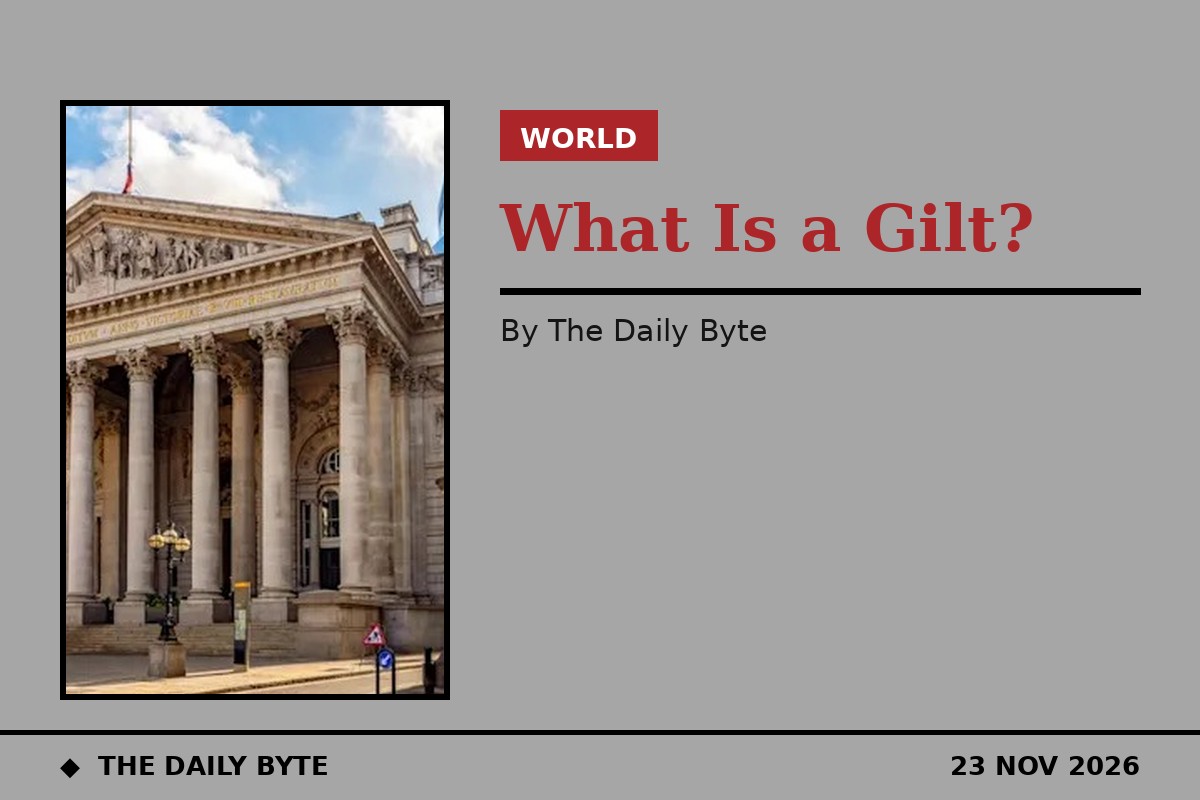
A gilt is a bond issued by the United Kingdom government. When you buy one, you are lending money to the state. In return, the government promises to pay you interest, usually twice a year, and to repay the full face value of the bond on a fixed date in the future. It is, in plain terms, a government IOU — and it is the instrument that funds a large part of British public spending.
Gilts came back into the headlines in November 2026, when the yield on the two-year gilt moved back above 5%, its highest level since October 2023, as traders bet that the Bank of England would raise interest rates again in December. If you have ever wondered what a gilt actually is, why its yield matters, and who buys these bonds, this explainer sets out the answers.
The short answer
A gilt — short for a gilt-edged security — is a sterling-denominated debt security issued by HM Treasury. The name dates back to the days when the Bank of England issued paper certificates with gilded, or gold-coloured, edges. The phrase stuck, and it now describes the whole market in British government bonds.
The UK Debt Management Office, an executive agency of HM Treasury, describes a gilt as a UK government liability denominated in sterling and listed on the London Stock Exchange. The office also makes a point that matters a great deal to investors: the British government has never failed to make an interest or principal payment on a gilt as it fell due. That unbroken record is why gilts are treated as one of the safest sterling investments available, and why their yield is used as a benchmark for the cost of borrowing across the British economy.
How a gilt works: coupon, principal and maturity
Every gilt has three basic features. First, a coupon, which is the interest rate the government pays on the bond. Second, a principal, also called the nominal or face value, which is the sum repaid when the bond matures. Third, a maturity date, which is the date on which that repayment falls due.
Take a conventional gilt as an example. Suppose the government issues a gilt with a coupon of 4% and a face value of £100, maturing in ten years. Whoever holds that gilt receives £4 a year, normally paid as £2 every six months, for ten years. On the maturity date, the holder receives the final coupon payment plus the £100 principal. The coupon is fixed when the gilt is first issued, so it reflects the level of interest rates at that time rather than the level when the bond is later bought or sold.
Gilts are named by their coupon and their maturity year, so a bond might be described as the 4% Treasury Stock 2036. Maturities vary widely. Some gilts mature within a few months, while others run for decades, with the longest stretching to around fifty years. Short-dated gilts, those maturing within a few years, are the most sensitive to expectations about Bank Rate. Longer-dated gilts are more sensitive to expectations about inflation and the public finances over the long term.
Crucially, gilts can be bought and sold on the secondary market after they are issued. An investor does not have to hold a gilt until it matures. The price at which a gilt trades rises and falls with demand, interest-rate expectations and views about the economy. That moving price is what produces the gilt yield, which is explained below.
The main types of gilt
Most gilts fall into one of three groups. Conventional gilts are the simplest and by far the largest group, making up around three-quarters of all gilts in issue. They pay a fixed coupon every six months and repay a fixed principal at maturity. If you hear someone talk about "the gilt market" without further detail, they almost always mean conventional gilts.
Index-linked gilts are the second group. Their coupon payments and their principal repayment rise and fall in line with inflation, as measured by the Retail Prices Index, with a lag built into the calculation. The United Kingdom was one of the first developed economies to issue this kind of bond, with the first index-linked gilts appearing in 1981. They are popular with pension funds and insurers whose own liabilities also rise with prices, because they protect the real, inflation-adjusted value of the money invested.
Green gilts are the third group. They work in the same way as conventional gilts, but the money raised is allocated, under a published government framework, to spending on environmental and climate-related projects. They allow investors who want their money to support the transition to a lower-carbon economy to do so while holding a mainstream government bond.
Alongside gilts, the government also issues Treasury bills. These are short-term bonds that mature within a year, and they form a much smaller part of government financing than gilts do.
Who issues gilts, and how are they sold?
Gilts are issued by the UK Debt Management Office, known as the DMO, on behalf of HM Treasury. The Bank of England used to be responsible for issuing gilts, but that job moved to the DMO in April 1998, shortly after responsibility for setting interest rates passed from the Treasury to the Bank in May 1997.
Each year, the government forecasts how much it needs to borrow and hands the DMO a financing remit. That document sets out how much gilt debt must be sold, how much of it should be conventional and how much index-linked, and what mix of short, medium and long maturities is wanted. The Institute for Government notes that in 2026/27 the government expects to borrow £137 billion to fund its spending, and to spend a further £141 billion redeeming gilts that have matured.
The DMO sells most gilts through auctions, in which a group of banks and securities houses known as gilt-edged market makers bid for the bonds. These firms have obligations to the market, including taking part in auctions, in exchange for their privileged position. Occasionally the DMO sells a large new gilt through a syndicate of banks instead, a route used when it wants to place a very large amount of debt in one go.
Once issued, gilts trade freely. Pension funds, insurance companies, banks and overseas investors are the largest holders, alongside the Bank of England, which built up a large stock of gilts through its quantitative easing purchases after the financial crisis. Individual investors can also buy gilts, usually through a stockbroker or an investment platform, in units with a face value of £100.
What is a gilt yield, and why does it move?
The yield on a gilt is the return an investor gets from buying it at its current market price and holding it to maturity. It is the single most watched number in the gilt market, because it is effectively the interest rate the government pays to borrow.
Price and yield move in opposite directions. When the price of a gilt rises, its yield falls, because the fixed coupon payments now represent a smaller return on the higher price paid. When the price falls, the yield rises. So when headlines say that gilt yields have risen, they mean gilt prices have fallen and the government must now pay more to borrow.
Several forces move yields. The most important is expectations about Bank Rate, the interest rate set by the Bank of England. If investors think Bank Rate will rise, they demand higher yields on gilts, particularly on short-dated ones, because a gilt must compete with simply holding cash at the Bank's rate. Inflation expectations matter too: higher expected inflation erodes the value of fixed future payments, so investors demand a higher yield to compensate. Views about the scale of government borrowing also play a part, since a heavier supply of new gilts can push prices down and yields up.
That is what happened in November 2026. The Bank of England raised Bank Rate from 3.75% to 4% on 5 November, its first increase since 2023. Its chief economist, Huw Pill, then said in an interview that market pricing of about a further 0.9 percentage points of tightening was "not outrageous", and that there was further to go. Traders responded by pushing the two-year gilt yield through 5% on 16 November, touching an intraday high of 5.015%, its highest level since October 2023, and rate futures implied roughly a 91% chance of another increase at the Bank's December meeting. The Bank's next decision is due on 17 December 2026.
Who buys gilts?
Gilts are bought predominantly by financial institutions, particularly pension funds and insurance companies. That has been true for decades: these investors have long-term liabilities, such as pensions that must be paid for many years, and gilts give them a predictable stream of payments stretching far into the future. Banks hold gilts as a safe, liquid asset, and overseas investors, including foreign central banks and sovereign wealth funds, hold them as part of their sterling reserves.
The Bank of England itself became a major holder after the financial crisis, when it created new money to buy gilts under quantitative easing. Those purchases were designed to hold down long-term interest rates. The Bank has since been reducing its holdings, a process that returns more gilts to private hands and adds to the supply the market must absorb.
Ordinary savers hold gilts only indirectly in most cases, through a pension fund or an investment fund. But anyone can buy them directly through a broker, and they are also held inside many low-risk investment portfolios and cash-like funds.
Why gilts matter to everyone
Gilts may sound like a specialist market, but their yield ripples through everyday finance. The interest rate the government pays to borrow is a benchmark for the whole economy. When gilt yields rise, the cost of government borrowing rises, which means more of the tax take goes on interest payments and less is available for public services, unless taxes rise or spending is cut.
Gilt yields also feed into the pricing of other forms of borrowing. The rates on fixed-rate mortgages, for example, are priced off swap rates that move closely with gilt yields, so a sustained rise in yields tends to push up the cost of new fixed-rate mortgage deals. Annuity rates, which determine the income a pension pot buys at retirement, also move with gilt yields: higher yields generally mean better annuity rates for people retiring. And the value of pension funds themselves rises and falls with gilt prices, since gilts are such a large part of their holdings.
That is why a move in the two-year gilt yield above 5% attracts so much attention. It is not only a signal about where traders think Bank Rate is heading. It is also a signal about the cost of funding the state, the cost of mortgages, and the value of the savings that millions of people rely on.
Are gilts safe?
Gilts are generally regarded as very low risk, and the DMO's point that the British government has never missed a payment on them is the foundation of that reputation. An investor who holds a gilt to maturity will receive the coupon payments and the principal as promised, provided the government honours its debts, which it always has.
That does not mean gilts are risk-free. An investor who sells before maturity can lose money if the price has fallen, and prices fall when interest rates rise. Inflation is a risk too: a conventional gilt pays a fixed coupon, so if inflation runs higher than expected, the real value of those payments shrinks. Index-linked gilts are designed to guard against that risk, but they tend to offer lower yields in exchange.
There is also the question of what "safe" means in practice. Gilts are safe in the sense that the borrower is the state, which can raise taxes and, in extremis, ask its central bank for support. They are not safe in the sense of guaranteeing a positive return after inflation, nor in the sense that their market price cannot fall sharply, as it did during the market turmoil of 2022.
What a gilt is not
A gilt is not a savings account. Money in a bank account is protected, up to a limit, by the Financial Services Compensation Scheme, and its value does not move with the market. A gilt's price moves every day, and selling early can mean getting back less than was paid.
A gilt is also not the same as money lent to the government through National Savings and Investments products, such as Premium Bonds. Those are separate retail savings products run by a government-owned company. And a gilt is not a share: a shareholder owns part of a company and receives dividends that can rise or fall, while a gilt holder is a lender to the state with a fixed contractual return.
Finally, a gilt is not the same as a corporate bond. Companies also borrow by issuing bonds, but they can fail, and their bonds carry that risk. The yield on a corporate bond is therefore usually higher than the yield on a gilt of the same maturity, with the gap — known as the spread — reflecting the extra risk of lending to a company rather than to the government.
Sources: UK Debt Management Office, "About gilts"; Institute for Government, "The gilt (or bond) market"; Morningstar and Reuters reporting on gilt yields in November 2026.


