What Is a Light-Day? Voyager 1 Explained
NASA confirmed on Thursday 19 November 2026 that Voyager 1, the farthest-flying spacecraft humanity has ever built, has reached one light-day from Earth. The probe crossed the threshold at 5:16 a.m. EST (10:16 GMT) on Wednesday 18 November, about 16.1 billion miles (25.9 billion kilometres) from home. No human-made object has ever been that far away before.
The confirmation itself took a day to arrive, for a reason that is the whole point of the milestone: at Voyager 1's distance, even a radio signal travelling at the speed of light needs about 24 hours to reach Earth. NASA's Jet Propulsion Laboratory (JPL) in California heard from the probe early on Thursday, through the Deep Space Network station near Madrid, and announced the crossing later that day.
What is a light-day?
A light-day is the distance light travels in 24 hours. Light moves at 299,792 kilometres per second, so in a full day it covers about 25.9 billion kilometres (16.1 billion miles). It is a unit of distance, not time, and astronomers use it in the same way they use light-years, only on a smaller scale: light from the Sun takes about eight minutes to reach Earth, and about five and a half hours to reach Pluto. Voyager 1 is now more than four times as far from the Sun as Pluto is, and still travelling.
The same measure explains why talking to the spacecraft has become so slow. A command sent from Earth now takes about 24 hours to arrive, and any reply takes another 24 hours to come back, so a single exchange needs roughly two days. That delay will only grow as Voyager 1 moves farther away. Its twin, Voyager 2, is about 13.8 billion miles from Earth, or just over 20 hours of one-way light time, and is not expected to reach one light-day until November 2035.
How did NASA know it had crossed the line?
NASA could not confirm the crossing until the probe's signal arrived, a day after the event. There was an added complication: Voyager 1 stopped sending science and engineering data on 14 November, and the flow had not resumed when the milestone was confirmed. What kept coming was the spacecraft's carrier signal, the steady radio tone that normally carries the data. Mission engineers used that carrier signal, together with calculations of the probe's trajectory, to confirm that it had passed the one-light-day mark, and they are still analysing the problem with the data stream. Suzanne Dodd, the Voyager project manager at JPL, said the team was confident the data could return despite the time-delayed troubleshooting.
What is Voyager 1, and where is it going?
Voyager 1 launched on 5 September 1977, with its twin Voyager 2, to take advantage of a rare alignment of the outer planets. It flew past Jupiter and Saturn, returning the first high-resolution images of the two giants and their moons, and then headed out of the Solar System. In 2012 it crossed the heliopause, the boundary of the Sun's influence, and entered interstellar space, the region between the stars.
It is still moving at about 38,000 miles per hour (61,000 kilometres per hour), heading towards a star called Gliese 445, about 17 light-years away. It will not get there in any human timescale: at its present course it is expected to pass within about 1.7 light-years of the star in roughly 40,000 years. On board it carries the Golden Record, a gold-plated disc of sounds and images of Earth, made in case any other intelligence ever finds it.
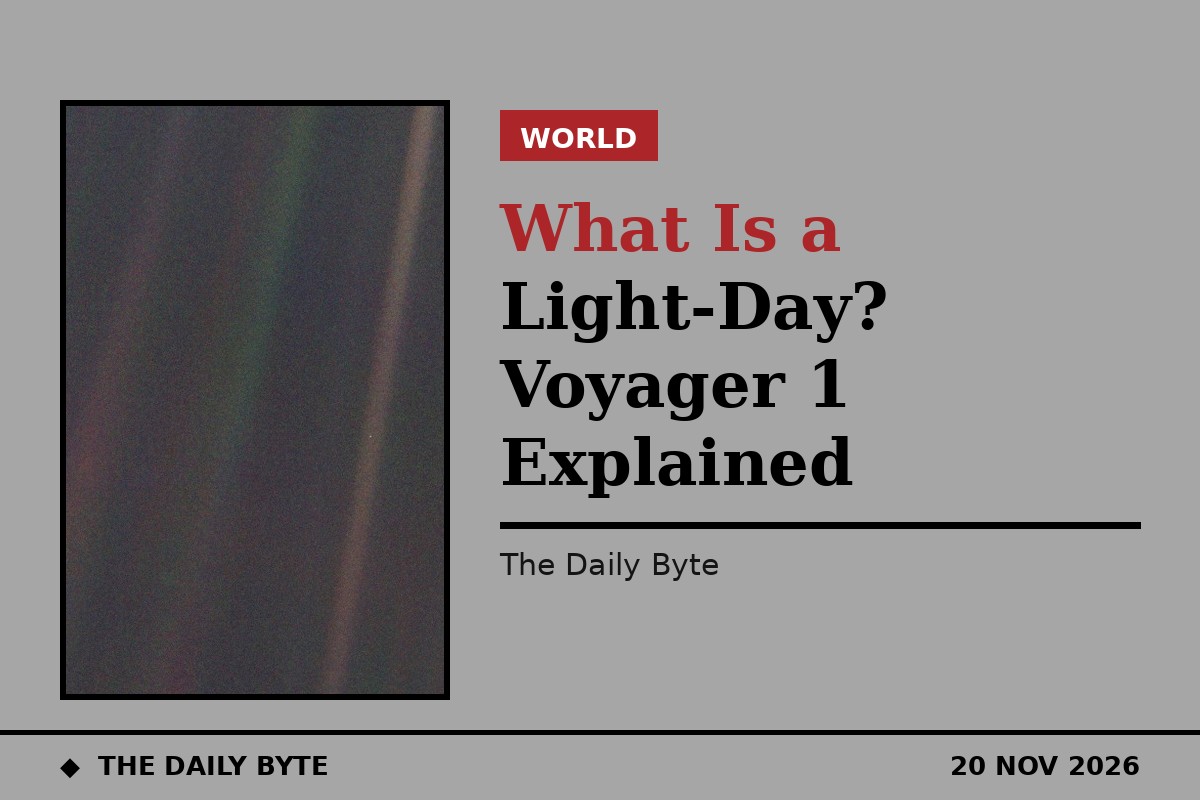
One of the mission's most famous moments came in 1990, when Voyager 1 turned its camera back towards home and photographed Earth as a single tiny dot caught in a beam of sunlight, an image that became known as the Pale Blue Dot. The spacecraft in the photograph with this article is that same probe, still flying, 36 years later.
Why does this milestone matter?
The crossing changes nothing physical about the spacecraft. As the mission's scientists have stressed, it is an engineering milestone, a measure of how far a machine built in the 1970s has carried human reach. "It's never happened before, and it may never happen again, it's that kind of extraordinary," said Kareem Badaruddin, the Voyager mission manager at JPL. Dave Gallagher, the director of JPL, called it "yet another historic feat on an extraordinary voyage of discovery".
It also marks the beginning of the end of the mission. Both Voyagers run on plutonium power that fades by about four watts a year, and engineers have been switching off instruments and heaters to keep the essential systems going. NASA has said the current science instruments should stay powered until at least the 50th anniversaries of the launches in the summer of 2027, but the power will run out eventually, and when it does Voyager 1 will fall silent while continuing to drift through interstellar space. NASA marked the milestone with a worldwide "Shine Bright" celebration, inviting people to flash the letters V-G-R, for Voyager, in Morse code towards the sky.
What happens next?
On 4 February 2027, Voyager 1 will be one light-day from the Sun, a slightly different measure from the distance from Earth, which shifts as our planet moves around its orbit. Engineers will keep working to restore the science data that stopped on 14 November. Whatever happens, the probe will keep moving away from us at 38,000 miles per hour, and every day the round trip for a message will get a little longer.
Frequently asked questions
How far is one light-day in miles? About 16.1 billion miles (25.9 billion kilometres), the distance light travels in 24 hours.
How long does a message take to reach Voyager 1? About 24 hours each way, so a command and its reply take roughly two days.
Is Voyager 1 still working? Yes, but not fully. Its carrier signal is still reaching Earth, while its science and engineering data stopped arriving on 14 November 2026 and engineers are investigating.
Will Voyager 1 ever come back? No. It is on a one-way journey out of the Solar System, heading towards the star Gliese 445.


