What Is a Lunar Eclipse? Blood Moon Explained
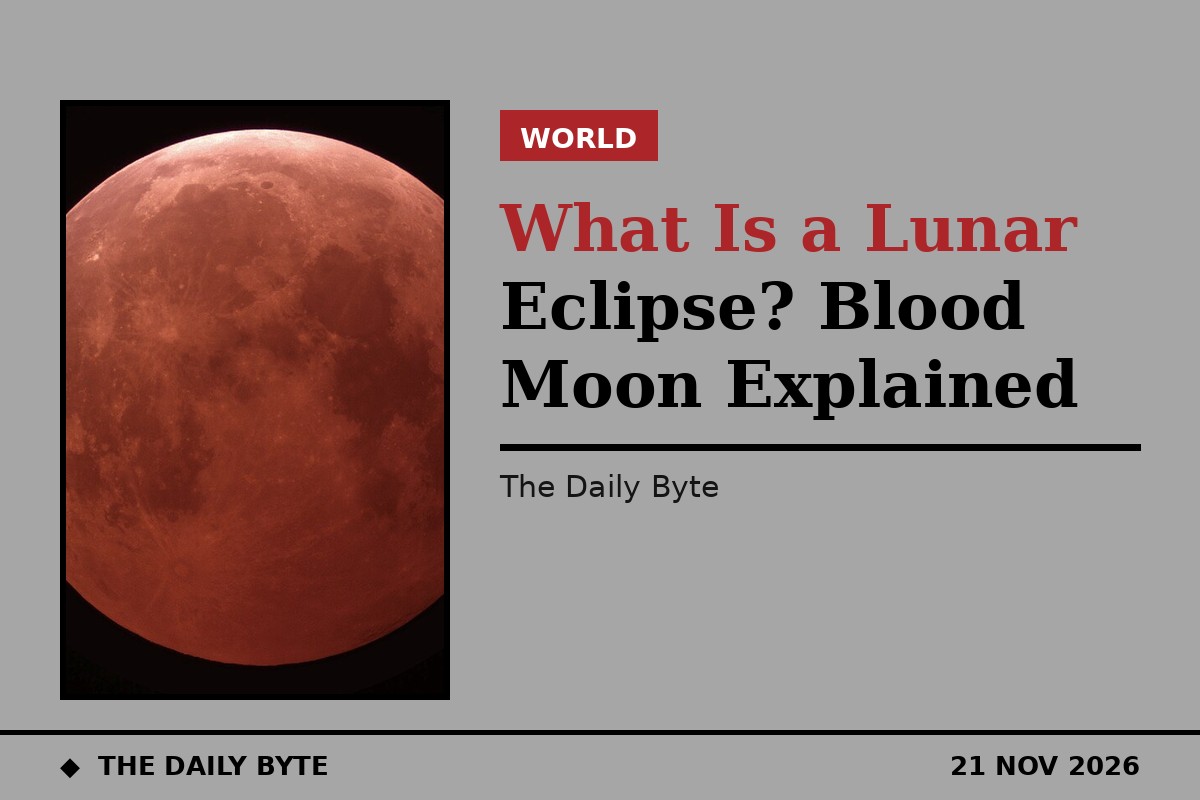
A lunar eclipse happens when the Earth passes between the Sun and the Moon and blocks sunlight from reaching the Moon. It can only occur at full Moon, when the three bodies are lined up, and the Moon slides into the shadow that the Earth casts into space. During a total lunar eclipse the whole Moon is covered by the Earth’s dark inner shadow and turns a deep copper red, which is why it is often called a blood Moon.
It is the counterpart of a solar eclipse, in which the Moon passes in front of the Sun and casts its shadow on the Earth. The difference is one of scale: the Moon’s shadow on the Earth is narrow, so a solar eclipse is visible only along a thin path, while the Earth’s shadow is huge, so a lunar eclipse can be seen from anywhere on the night side of the planet where the Moon is above the horizon.
Why there is no lunar eclipse every month
The Moon takes about 29.5 days to go from one full Moon to the next, so you might expect a lunar eclipse every month. It does not happen, because the Moon’s orbit around the Earth is tilted by about five degrees compared with the Earth’s orbit around the Sun. Most months, the full Moon passes above or below the Earth’s shadow instead of through it.
Eclipses only become possible during short windows, known as eclipse seasons, when the Moon crosses the plane of the Earth’s orbit near full Moon. That is why lunar eclipses arrive in batches: on average there are about three a year, and in some years there can be as many as five, counting the faintest kind.
The three types of lunar eclipse
The Earth casts two shadows. The umbra is the dark inner shadow directly behind the Earth, where the Sun is completely hidden. The penumbra is the larger, fainter outer shadow, where the Sun is only partly covered. Which shadow the Moon passes through decides the type of eclipse.
A total lunar eclipse is the most dramatic kind. The Moon passes fully into the umbra, and instead of vanishing it glows red. It is the rarest of the three from any one place, occurring roughly once every two and a half years for a given location, although total eclipses happen somewhere on Earth more often than that. A partial lunar eclipse happens when only part of the Moon enters the umbra, so a dark, reddish bite is taken out of one side while the rest stays bright. Partial eclipses are the most common kind, occurring around three times a year. A penumbral lunar eclipse happens when the Moon passes only through the outer shadow. The Moon grows slightly darker and greyer, but the change is so subtle that it is difficult to notice even through a telescope. A total penumbral eclipse, where the whole Moon is inside the penumbra but none of it enters the umbra, is the rarest of all, occurring between zero and nine times a century.
Why the Moon turns red
The red colour is sunlight that has been filtered through the Earth’s atmosphere. When the Moon is inside the umbra, no direct sunlight reaches it, but some sunlight skims past the edge of the Earth, passes through the atmosphere, and is bent, or refracted, into the shadow. On the way through, the atmosphere scatters the shorter blue wavelengths away, while the longer red wavelengths pass through and reach the Moon. It is the same process that makes sunrises and sunsets red.
The exact shade depends on the state of the atmosphere at the time. After a large volcanic eruption, extra dust and ash in the air can make the eclipsed Moon look darker, almost black. When the air is clear, the Moon glows a bright copper orange. Astronomers are not especially fond of the term blood Moon, which comes from folklore rather than science, but it has become the popular name for a total lunar eclipse.
How long does a lunar eclipse last?
A lunar eclipse is a slow event. From the first faint dimming to the last, the whole eclipse can last several hours, although the period of totality — when the Moon is completely inside the umbra — usually lasts about an hour. The most recent lunar eclipse, on 28 August 2026, was a deep partial eclipse: at its maximum, about 96 per cent of the Moon’s face was covered by the Earth’s shadow, making it look almost like a total eclipse without quite becoming one. The whole event lasted five hours and 38 minutes, with maximum eclipse at 04:12 UTC.
Eclipses repeat in a cycle called the saros, which lasts 18 years and 11 days. After one saros, the Sun, Earth and Moon return to almost exactly the same alignment, so a very similar eclipse occurs. Ancient astronomers used the saros to predict eclipses long before the geometry was understood.
When is the next lunar eclipse?
The next lunar eclipse will be a penumbral one on 20 to 21 February 2027, when the Moon will pass through the outer part of the Earth’s shadow and appear slightly darker than usual. It will be a subtle event, and many casual observers will not notice it at all.
The next total lunar eclipse — the next true blood Moon — is further away. For observers in the UK, the next total lunar eclipses fall on 31 December 2028, when the eclipse will also be visible across Europe, Asia, Australia, Africa and parts of North America; 26 June 2029, visible from the UK, western and central Europe, Africa, South America and much of the USA; and 20 December 2029, visible from the UK, Europe, Africa, Asia and the Americas. The New Year’s Eve eclipse of 2028 will be a memorable one: much of the world will welcome in 2029 under a red Moon.
How to watch a lunar eclipse
Unlike a solar eclipse, a lunar eclipse is completely safe to look at with the naked eye. The Moon during an eclipse is no brighter than an ordinary full Moon — in fact it is much dimmer — because you are only ever seeing reflected sunlight. No special glasses or filters are needed, and no specialist equipment is required at all.
To get the best view, be on the night side of the Earth when the eclipse happens, under a clear sky, with as little local light around you as possible. A spot with an unobstructed view of the sky, away from tall buildings and trees, is ideal. Binoculars or a small telescope will show the shadow creeping across the Moon’s craters in detail, but the unaided eye is enough to enjoy the colour change, which is the heart of the spectacle.
Lunar eclipse or solar eclipse?
The two are easy to confuse but are opposites. In a lunar eclipse, the Earth is between the Sun and the Moon, the Moon goes dark, it happens at full Moon, it lasts hours, it is visible from half the planet, and it is safe to watch. In a solar eclipse, the Moon is between the Sun and the Earth, the Sun goes dark, it happens at new Moon, totality lasts only a few minutes, it is visible only along a narrow path, and looking at the Sun directly can damage your eyes.
Both are caused by the same thing: three bodies in space lining up. The Moon is the one doing the lining up in both cases, and the five-degree tilt of its orbit is what makes either kind of eclipse an event worth waiting for rather than a monthly routine.
Frequently asked questions
Can a lunar eclipse happen during the day? It can be visible at moonrise or moonset in daylight, but only while the Moon is above the horizon on the night side of the Earth. The eclipse itself always happens at full Moon, which is when the Moon is opposite the Sun.
Why is it called a blood Moon? Because the Moon turns red during totality. The name is popular rather than scientific: the red comes from sunlight filtered and bent through the Earth’s atmosphere, the same effect that colours sunsets.
How often do total lunar eclipses happen? About twice every three years globally, and about once every two and a half years from any one location. Partial and penumbral eclipses are more frequent, bringing the average total to about three lunar eclipses of all kinds per year.
Is it safe to look at a lunar eclipse? Yes. A lunar eclipse is no brighter than a full Moon, and it is safe to watch with the naked eye, with binoculars, or through a telescope. Only solar eclipses need eye protection.
What is a super blood Moon? A total lunar eclipse that happens when the Moon is at its closest to Earth, when it looks slightly larger and brighter than usual and is sometimes called a supermoon. The names stack: a total eclipse at closest approach is a super blood Moon, and if it also falls on the first full Moon of the year, the old name for which is the wolf Moon, it becomes a super blood wolf Moon, as happened on 21 January 2019.


