What Is a Meteor Shower? Geminids 2026 Explained
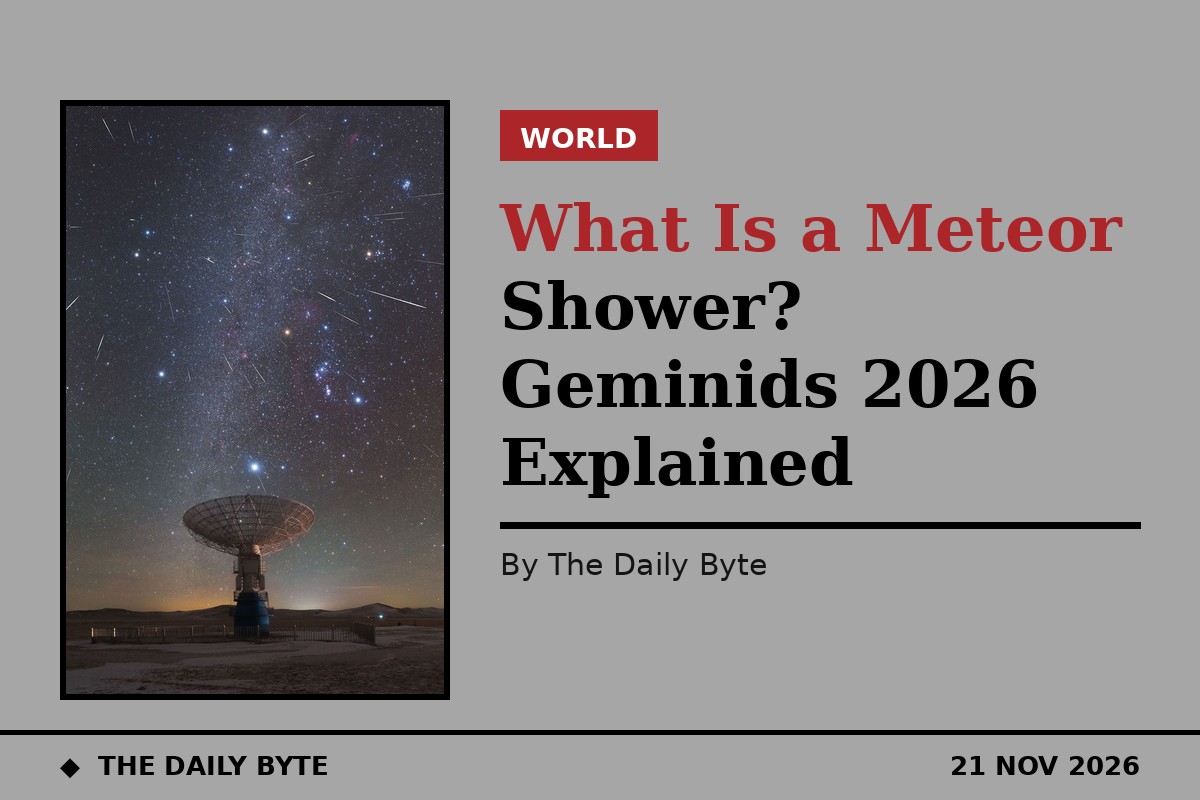
A meteor shower is one of the few sky events you can enjoy with no equipment at all: just a dark sky, a clear night and a little patience. Every year, the Earth passes through streams of dust left behind in space, and the dust burns up as it hits our atmosphere, painting brief streaks of light across the sky. The next big one is the Geminids, the strongest and most reliable meteor shower of the year, and in 2026 it peaks on the night of 13-14 December. Under a dark sky, the Natural History Museum says stargazers could see up to 150 meteors an hour at the peak. This explainer answers the questions people actually ask: what a meteor shower is, why the Geminids are special, when to look, and how to get the best view.
A shower is not a storm of falling stars in the way the name suggests. Nothing is falling from the stars at all. The streaks of light are tiny grains of dust, most of them no bigger than a grain of sand, burning up high in the atmosphere as the Earth sweeps through a trail of debris in space. On an ordinary clear night you might see a handful of these streaks, known as sporadic meteors. During a shower, the Earth is passing through a much denser part of a debris stream, so the rate jumps from a few an hour to dozens, or in the case of the Geminids, more than a hundred.
What is a meteor shower?
The words around meteor showers are easy to mix up, so it helps to start with the three names for the same object at different stages. While it is still travelling through space, the object is a meteoroid, a small piece of rock or dust. When it plunges into the Earth's atmosphere and burns up, the streak of light it makes is a meteor, the shooting star you see. If a piece is big enough to survive the fall and reach the ground, it is called a meteorite. Almost everything in a meteor shower is far too small to survive: the grains burn up completely, tens of kilometres above our heads, and nothing reaches the ground.
A shower happens because the debris is not spread evenly through space. It is concentrated along the orbit of the body that shed it, forming a narrow stream. When the Earth crosses that stream, we get a shower, and because the Earth returns to the same point in its orbit at the same time every year, the same showers return on the same dates. That is why the Geminids always arrive in December, the Perseids always arrive in August, and the Leonids always arrive in November. The calendar of showers is, in effect, a map of the debris trails the Earth crosses on its yearly journey around the Sun.
What makes the Geminids different?
Most of the major meteor showers are fed by comets, icy bodies that shed dust as they swing close to the Sun. The Geminids are the exception, and that is what makes them interesting to astronomers. Their parent body is the asteroid 3200 Phaethon, sometimes called a rock comet, and the Geminids are the only major annual shower whose source is an asteroid rather than a comet. The dust grains in the Geminid stream are denser than comet dust, which is one reason the meteors tend to be bright and, as the Natural History Museum notes, often multicoloured.
The Geminids are also unusual in how fast they move. NASA's Astronomy Picture of the Day notes that Geminid meteors enter the Earth's atmosphere at about 22 kilometres per second. That is slower than many other showers, and the slower entry is part of why Geminid meteors often seem to linger a fraction longer and glow more steadily than the swift, brief streaks of some other showers. They are also reliable: where some showers vary wildly from year to year, the Geminids deliver a strong display almost every December, which is why astronomers call them the king of the meteor showers.
When is the Geminid meteor shower in 2026?
The Geminids are active from 4 to 20 December 2026, according to the Natural History Museum, so it is possible to catch a Geminid on any clear night in that window. The peak, when rates are highest, falls on the night of 13-14 December. The shower is visible all night long, and the Old Farmer's Almanac notes that the radiant, the point in the sky the meteors appear to come from, is highest a little after midnight, which makes the hours after midnight the best time to watch. Because the peak is broad, with high rates lasting roughly ten to twelve hours, viewers in the Americas, Europe and Asia all get a good chance on the peak night.
The Moon is on our side this year. In 2026 the Geminids peak under a waxing crescent Moon, and EarthSky notes that the thin crescent will not interfere much with viewing. The Natural History Museum adds a small note of caution, saying viewing may be interrupted by some moonlight because the peak falls just before a first quarter Moon, but the Moon will set early enough and be faint enough that it should not spoil the show. Clear, dark skies matter far more than the Moon this year.
What is the radiant, and where do you look?
Every meteor shower has a radiant, a point in the sky from which all its meteors appear to stream. For the Geminids, the radiant lies in the constellation of Gemini, near the bright twin stars Castor and Pollux. The effect is a trick of perspective: the dust grains are actually travelling along parallel tracks, but because they are coming towards us, their paths appear to converge in the distance, just as railway tracks appear to meet at the horizon. NASA's explanation of its Geminid photographs makes exactly this point, noting that the parallel meteor tracks only look as if they radiate from a single point.
In practice, you do not need to stare at the radiant. Meteors can appear anywhere in the sky, and the longest, most impressive streaks often show up some distance away from it. The best approach is to face the darkest part of the sky you can find, lie back, and take in as much of it as possible. In the northern hemisphere, Gemini rises in the early evening and climbs high overnight, so the constellation is well placed for most of the night on the peak date.
How many meteors will you actually see?
The headline figure of 150 meteors an hour needs a little unpacking. It is the zenithal hourly rate, the number a single observer would count in one hour under a perfectly dark sky with the radiant directly overhead. Almost nobody watches under those perfect conditions, so the real count is usually lower. From a dark rural site, you might see well over fifty an hour near the peak, and from a suburb, where street lights wash out the fainter meteors, the count falls sharply. From a brightly lit city centre, you may see only a handful.
That does not mean the shower is not worth watching from a town. The Geminids include plenty of bright meteors, and even a dozen in an hour is a memorable sight. The key is darkness: get as far from street lights and lit windows as you can, and give your eyes time to adjust to the dark before you start counting. A telescope or binoculars will not help, because they narrow your field of view, and a meteor could flash past anywhere in the sky. Your unaided eyes, taking in the widest possible sweep of sky, are the best instrument for the job.
How to watch the Geminids
Watching a meteor shower is simple, but a little preparation makes it much more enjoyable. First, check the weather forecast for cloud, because even a thin layer of cloud will hide the fainter meteors. Second, pick the darkest spot you can reach safely, away from street lights, and let your eyes adapt to the dark. Third, dress far more warmly than you think you need to: you will be standing or lying still on a December night, and the cold will find you long before the meteors do. A reclining chair, a blanket and a hot drink all help, and a red torch, if you need light at all, will disturb your night vision less than a white one.
Be patient. Meteor rates are not steady: they come in bursts, with quiet minutes followed by several meteors in quick succession. Give yourself at least half an hour under the sky, and longer if you can. If the peak night is cloudy where you are, do not give up: the Geminids are active for more than two weeks, and the nights either side of the peak can still be rewarding. The shower's broad maximum means that even a night or two away from the peak can produce a good display.
What about the Ursids?
The Geminids are not the last shower of the year. The Ursids, which come from the trail of the comet 8P/Tuttle, are due to peak on 22 December, according to the Natural History Museum, and they usually produce fewer than ten meteors an hour. They are a much quieter affair, but for anyone who catches the meteor-watching bug during the Geminids, they offer a small encore just before Christmas. After that, the next major shower is the Quadrantids in early January.
Frequently asked questions
Are meteor showers dangerous? No. The dust grains that make the streaks burn up high in the atmosphere, and the Geminids are far too small to reach the ground. Watching a shower is entirely safe. Can you see the Geminids from the UK? Yes. The shower is best seen from the northern hemisphere, and the UK is well placed, with the radiant high in the sky overnight. The only real obstacles are cloud and light pollution. Do you need a telescope? No, and a telescope would make things worse by narrowing your view. Your eyes are the best tool. What is the difference between a meteor and a shooting star? There is none: a shooting star is simply the popular name for a meteor, the streak of light made when a speck of space dust burns up in the atmosphere.


