What Is a NEET? The Milburn Review, the Numbers and What Happens Next Explained
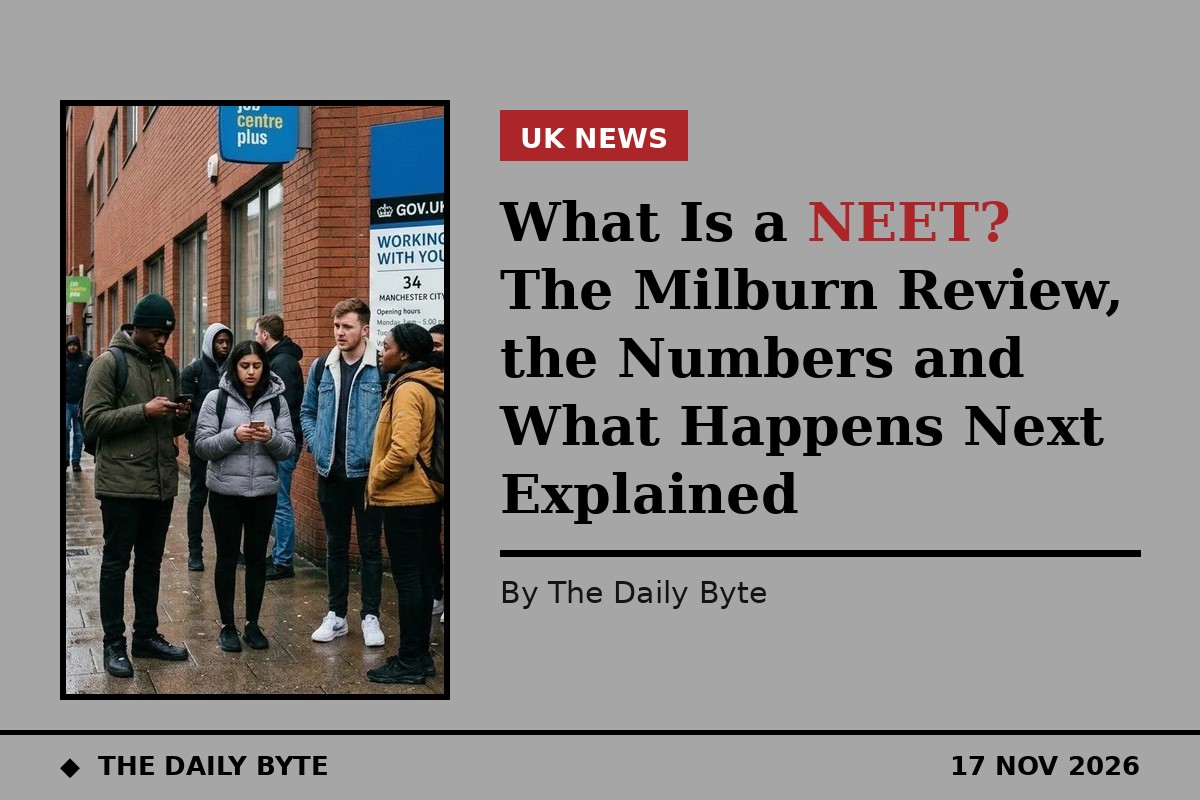
NEET describes a young person aged 16 to 24 who is not in education, employment or training. Almost one million young people in the United Kingdom fall into that group, about one in eight of everyone in that age band, and on 17 November 2026 a major government-commissioned review set out a ten-year plan to cut the rate sharply. This guide explains what NEET means, who it covers, how the number is counted, what the Milburn review proposes and what happens next.
The review, led by former health secretary Alan Milburn and titled From a Welfare State to a Working State: A New Settlement for the Next Generation, was published by the Department for Work and Pensions on 17 November 2026. It calls for what Milburn describes as a "complete system reset" in how the state supports young people, and it sets a target of reducing the share of 16 to 24-year-olds who are NEET from around 13 per cent today to about 5 per cent by 2036.
What does NEET mean?
NEET is a statistical term used by the Office for National Statistics (ONS) and government departments. It stands for "not in education, employment or training" and it applies to people aged 16 to 24 who are not doing any of those three things at the time they are counted.
Education covers school, college, university and most formal training courses. Employment covers paid work, including part-time work and self-employment. Training covers apprenticeships and other structured work-based learning. A young person who is doing none of these is counted as NEET, even if they are actively looking for work.
The age range matters. The measure covers 16 to 24-year-olds, which is the period when most people move from compulsory education into further study, training or work. Someone who leaves school at 16 and takes a year out before starting a course, or a graduate who spends a few months between university and a first job, can be NEET for a short time without it becoming a lasting problem. The concern in the Milburn review is about young people who stay detached for much longer.
How many young people are NEET in the UK?
The review puts the number at nearly one million. It records 981,000 people aged 16 to 24 as NEET in the second quarter of 2026, which is about 13 per cent of the age group, or roughly one in eight young people. The review says the rate is the highest since 2014 and describes the UK as having the second-highest youth inactivity rate in Europe last year.
The scale is what has driven the political attention. The review estimates that youth disengagement costs the country about £125 billion a year, taking account of lost earnings, lower tax revenue and higher benefit and public service costs. It also warns that, without action, the number could rise to about 1.27 million young people, or 16.3 per cent of the age group, by 2031.
Separate figures published by the ONS on the same day underline the pressure on young workers. Unemployment among 18 to 24-year-olds stood at 13 per cent, nearly three times the national rate of 4.6 per cent. The two figures measure different things, but they point in the same direction: the jobs market is toughest for the youngest workers.
Who becomes NEET, and why?
There is no single reason a young person becomes NEET, and the review stresses that the group is not a single type of person. Some are unemployed and looking for work. Others are not looking for work at all, because they are ill, caring for a family member, or have dropped out of the system altogether.
Health is a large part of the picture. The review found that a growing share of young people who are NEET have a health condition or disability, including mental health problems, and it argues that the benefits system has too often paid people to stay out of work rather than helping them back in. Its interim report, published in May 2026, also described young people spending long periods at home, often looking for work online, with fewer chances to meet people face to face and build the confidence that helps in interviews and in settling into a job.
Education and qualifications matter too, but the review argues they are not the whole story. Some young people leave school without the grades they need for college or an apprenticeship. Others have qualifications but struggle to turn them into a job, particularly in places where there are few employers hiring young workers. The review also points to the cost and complexity of the system itself, with support split between schools, colleges, Jobcentre Plus, the NHS and local councils, and no single service responsible for a young person who falls through the gaps.
NEET is not the same as unemployed
The two terms are often used as if they mean the same thing, but they do not. A person counts as unemployed under the international definition used by the ONS if they are without work, available to start within two weeks, and have looked for work in the past four weeks. NEET is a wider group: it includes unemployed young people, but it also includes those who are economically inactive, meaning they are not working and not looking for work.
That distinction matters for policy. Helping an unemployed young person usually means help finding a job, such as careers advice, interview practice or a work placement. Helping an inactive young person may first mean help with health, housing, childcare or basic skills before a job is a realistic prospect. The Milburn review argues that the current system is built mainly around the first group and does too little for the second.
What does the Milburn review propose?
The final report runs to 278 pages and makes recommendations across education, welfare, health and employment. Its central proposal is a new local Youth Opportunity Service in every part of England, which Milburn describes as the "engine room" of his plan. Every young person who is NEET would get a named adviser within 14 days of joining the service and a personalised Participation Plan within four weeks, setting out what they and the state will do and by when. After a year of engagement, they would be guaranteed a six-month paid job.
The review also proposes a legal guarantee of education, training or work for every young person, applying whether or not they claim benefits. On education, it calls for more than 150,000 extra young people a year in further education, a doubling of the number of young people completing an apprenticeship, and new checks on writing, numeracy and speaking skills at key stage 3 in schools.
On welfare, the most contested proposals concern under-25s. The review recommends replacing the health element of Universal Credit and Personal Independence Payment (PIP) for under-25s with a new Youth Allowance paid at the standard Universal Credit rate, alongside targeted support for those with significant, established and continuing disability-related costs. It also recommends gradually cutting the National Insurance employers pay on workers aged under 25, starting in retail and hospitality, and a £3,000 Youth Jobs Grant to encourage firms to take young people on.
The review puts a price on the programme: an initial £500 million in 2027-28, rising to about £5.8 billion a year by 2036-37. Its modelling suggests the reforms could help around 440,000 additional young people into sustained work by 2036, with about 600,000 more participating in education, employment or training overall.
What happens next?
None of the proposals is law yet. The review is independent advice to the government, and ministers have not adopted it in full. The government is expected to publish a formal response before the end of 2026, followed by a White Paper setting out detailed proposals in early 2027. That is when it will become clear which recommendations survive and which are dropped or changed.
Reaction so far has been split. Business groups and trade unions welcomed the report as a bold and practical intervention, while disability charities warned that replacing PIP and the Universal Credit health element for under-25s could leave some young disabled people worse off. A small number of Labour backbench MPs have also warned against cutting support for young people. The government has signalled support for the direction of the review, and the prime minister has spoken of the need to act on its findings, but it has not committed to the exact design.
Where can young people get help now?
Young people who are NEET can get free help now, without waiting for the review to become policy. Jobcentre Plus offers work coaches and support for people looking for work, and the National Careers Service provides free advice on courses, apprenticeships and careers. Apprenticeship vacancies are listed on GOV.UK, and colleges and training providers can advise on courses for 16 to 18-year-olds, which are free in England. Anyone who is ill or caring for someone can also ask a GP or local council about the support available in their area.
The Milburn review argues that this help is too fragmented, which is why it proposes a single Youth Opportunity Service as the front door. Whether that service is created will be decided when the government responds to the review.
Frequently asked questions
Is NEET an official term? Yes. It is the term the ONS and government departments use for 16 to 24-year-olds not in education, employment or training.
Does being NEET mean being unemployed? No. Unemployed young people are part of the NEET group, but NEET also includes young people who are not looking for work, for example because they are ill or caring for someone.
At what age does NEET apply? The measure covers 16 to 24-year-olds.
Has the number of NEETs risen? Yes. The Milburn review says the rate, at about 13 per cent, is the highest since 2014, and warns it could reach 16.3 per cent by 2031 without action.
Will the Milburn proposals become law? Not automatically. The government is expected to respond before the end of 2026 and publish a White Paper in early 2027. Until then, the proposals are recommendations, not policy.
Sources: GOV.UK, From a Welfare State to a Working State: a new settlement for the next generation (17 November 2026); Reuters, "UK youth-crisis plan will meet hard global reality" (17 November 2026). Figures for NEET numbers, costs and targets are as published in the review and reported by Reuters and the Press Association.