What Is a No-Fly Zone?
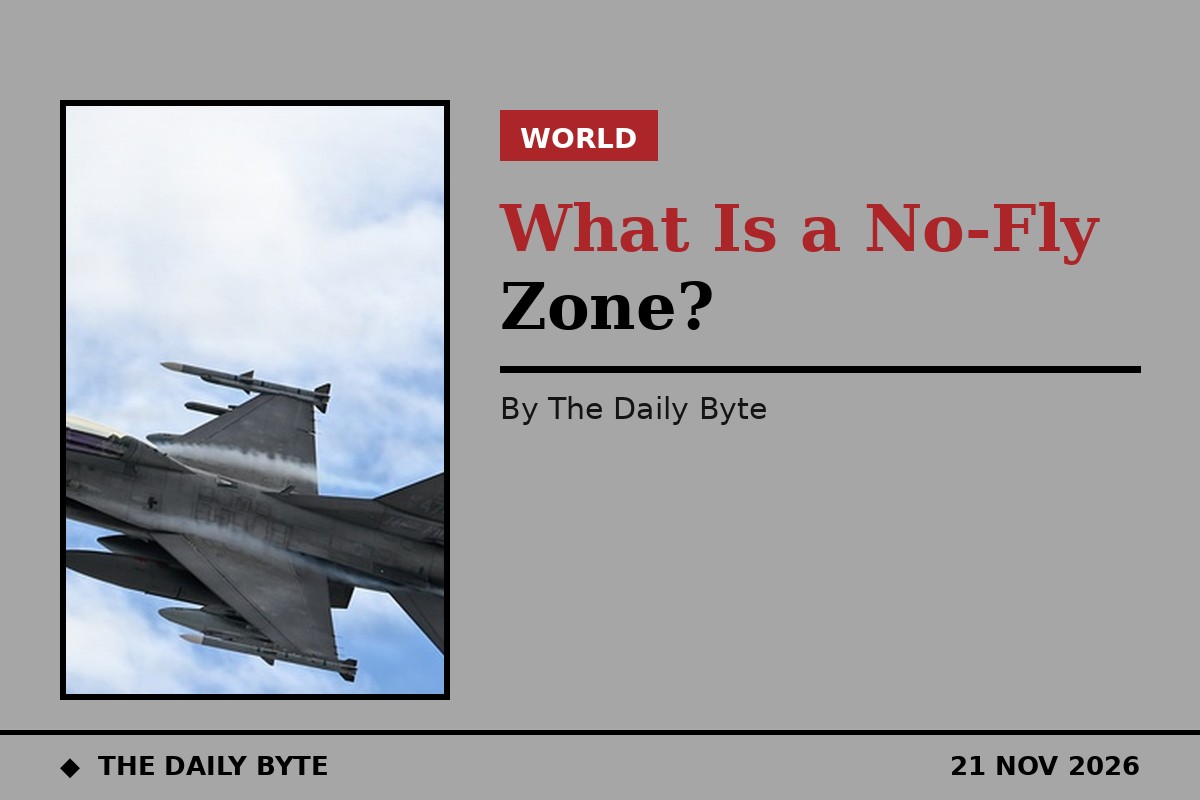
A no-fly zone is an area of sky where certain aircraft are banned from flying, and where that ban is backed by military force. It is not a request, a warning or a line on a map: it is a decision, usually by the United Nations or a group of allied states, that named aircraft will be stopped from entering a defined piece of airspace, by interception or by being shot down if they refuse to turn back.
The idea sounds simple, but putting one in place is one of the most serious steps a group of countries can take short of war. That is why they are rare, and why Ukraine, which has asked for one repeatedly since 2022, has never been given one.
How does a no-fly zone work?
A no-fly zone has three parts: a declaration, a patrol and a threat. First, an authority declares which airspace is closed, to whom, and from when. The ban normally covers military aircraft of a named side, while civilian airliners are usually kept out too.
Second, the enforcing countries keep fighter jets in the sky around the clock, supported by surveillance planes, radar and refuelling tankers. When an unauthorised aircraft is detected, fighters are sent to intercept it: they approach, identify it, order it to turn back, and escort it out. If it refuses, the rules of engagement decide what happens next, and in a wartime no-fly zone that can mean shooting it down.
Third, enforcement usually means attacking the ground as well as the sky. A country whose planes are banned can still threaten the patrols with surface-to-air missiles, so enforcers normally destroy the air defences inside and around the zone first. That is what makes a no-fly zone an act of war in all but name: to police the sky, the enforcer must be ready to bomb targets on the ground.
Who can declare a no-fly zone?
The clearest legal route is the United Nations Security Council. Acting under Chapter VII of the UN Charter, the Council can authorise member states to enforce a ban on flights. That is what happened over Libya in 2011, when Resolution 1973 authorised a no-fly zone to protect civilians and NATO took control of enforcing it days later.
A no-fly zone can also be imposed by a coalition of states acting without a Security Council resolution. The no-fly zones over Iraq in the 1990s were enforced by the United States, the United Kingdom and France without an explicit new UN resolution authorising them, and their legal basis has been disputed ever since.
There is also a civilian version of the idea. Air exclusion zones are sometimes set up around sensitive places or major events, for example over London during the 2012 Olympic Games, to guard against terrorist attack by air. Those are policed by the host country's own air force, not by an international coalition.
No-fly zones in history
There have been only a handful of full no-fly zones, and each one worked differently.
After the 1991 Gulf War, the US-led coalition set up two no-fly zones over Iraq: a northern one to stop Saddam Hussein's air force attacking the Kurds, and a southern one to protect the Shia population. Coalition aircraft patrolled them until the invasion of Iraq in 2003.
In Bosnia, the Security Council banned military flights in 1992 with Resolution 781. NATO first monitored violations under Operation Sky Monitor, then enforced the ban with Operation Deny Flight from 1993, which later widened to air strikes against Bosnian Serb forces and helped end the war in 1995.
In Libya in 2011, the Security Council authorised a no-fly zone on 17 March to protect civilians from Muammar Gaddafi's forces, and NATO took command of the operation until the end of the intervention. Critics argue the mission went beyond protecting civilians and became part of the campaign that removed Gaddafi, which is one reason later proposals have faced such scepticism at the UN.
Why has NATO refused one over Ukraine?
President Volodymyr Zelensky asked NATO to close the skies over Ukraine in the first days of the full-scale invasion in February 2022, and he has repeated the request many times since. NATO refused, and has refused every time.
The alliance's reasoning, set out by then Secretary-General Jens Stoltenberg on 4 March 2022, is blunt: the only way to enforce a no-fly zone over Ukraine is to send NATO fighter planes into Ukrainian airspace and shoot down Russian planes. That would mean destroying Russian air defences first, including systems based in Russia and Belarus, and it would put NATO and Russia into direct armed conflict. As Stoltenberg put it, the allies were not willing to risk a full-scale war in Europe with a nuclear-armed power. The United States took the same view: a no-fly zone would require the US military shooting down Russian planes and prompting a potential direct war with Russia.
Ukraine is also not a member of NATO, so the alliance's collective defence commitment does not apply to it. NATO has instead supplied Ukraine with air-defence weapons, including Patriot interceptor missiles funded jointly by Germany and Norway, so that Ukraine can defend its own skies itself.
Why airspace is in the news today
Airspace rules made headlines again on Saturday 21 November, when Finland said a Russian helicopter was suspected of violating Finnish airspace near the coastal town of Loviisa, reaching about 4.1 kilometres inside Finnish territory. The incident came hours after a drone attack set a Russian cargo ship, the Sparta II, on fire in the Gulf of Finland. Finland's defence minister, Antti Häkkänen, said the suspected violation was possibly connected to rescue or surveillance operations around the damaged ship, and the Finnish Border Guard is investigating.
An airspace violation is not the same thing as a no-fly zone. Finland's airspace is sovereign Finnish territory, and any foreign military aircraft needs permission to enter it; a no-fly zone is a ban imposed, usually on someone else's territory, in wartime. But the incident is a reminder of why the rules of the sky matter: a few kilometres of unauthorised flight, in a tense region, is enough to trigger a formal investigation and a diplomatic protest.
Frequently asked questions
Is a no-fly zone the same as an air blockade? No. A no-fly zone bans certain aircraft from an area, usually the military aircraft of one side. An air blockade is broader: it aims to cut off all air access to a place, including civilian flights and supplies.
Can a no-fly zone stop missiles and drones? Not by itself. A no-fly zone is designed to stop crewed military aircraft. Ballistic missiles, cruise missiles and one-way attack drones need separate air-defence systems on the ground.
Who enforces a no-fly zone? Whoever has the aircraft to do it: usually a coalition led by one or two large air forces, acting under a UN resolution or on their own authority. Enforcement is expensive and continuous, because the patrols cannot stop while the zone is in force.
Has a no-fly zone ever been declared over Ukraine? No. Ukraine has asked for one since February 2022 and NATO has declined each time, on the grounds that enforcing it would mean direct war between NATO and Russia.
Sources: United Nations Security Council Resolution 1973 and the Libya operation; the Iraq and Bosnia precedents; NATO's 4 March 2022 decision; and the Finnish Defence Ministry's statement of 21 November 2026.


