What Is a Payday Loan? UK Rules Explained
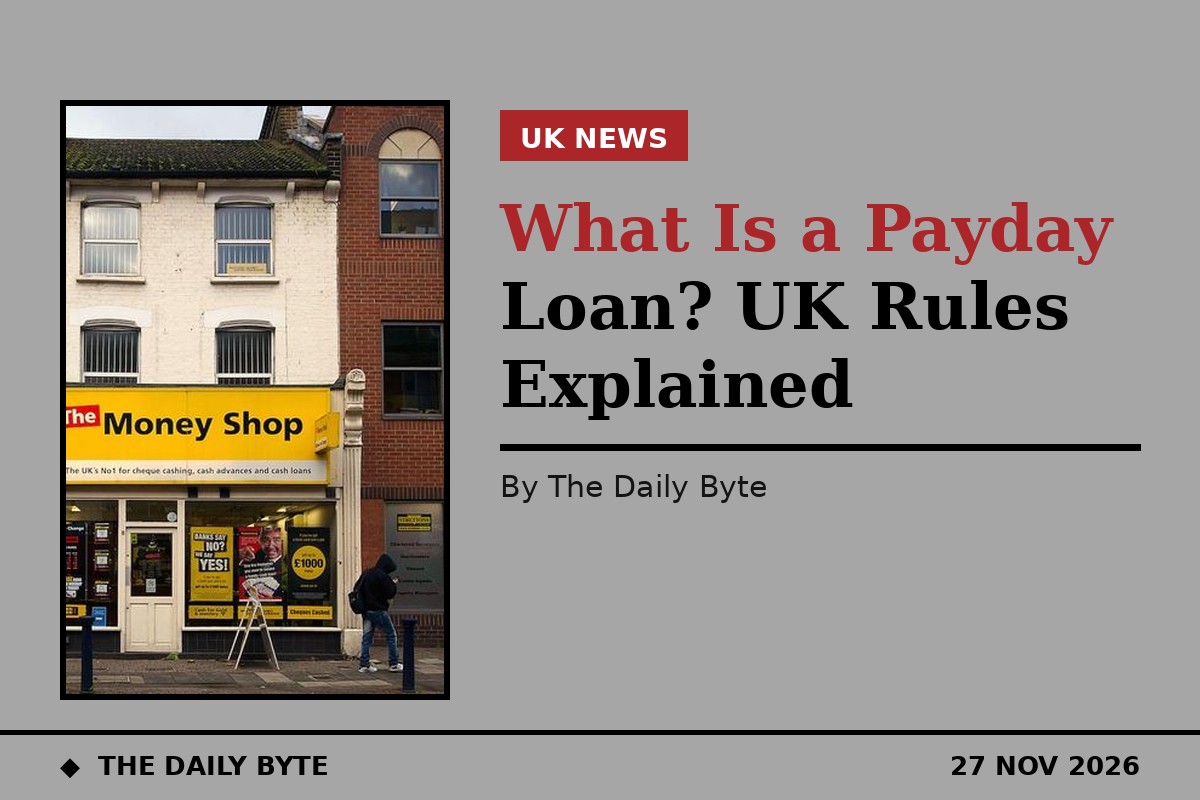
A payday loan is a short-term, high-interest, unsecured loan that must be repaid by the time you receive your next regular pay cheque, usually within 30 days of the loan being made. That is the definition used by nidirect, the Northern Ireland government service, and it is the form of borrowing the Financial Conduct Authority (FCA) regulates as high-cost short-term credit. Payday loans are legal in the UK, but what a lender can charge is capped by law: interest and fees cannot exceed 0.8 per cent of the amount borrowed per day, default fees are capped at £15, and you can never be made to pay back more in interest, fees and charges than the amount you borrowed in the first place.
People usually turn to a payday loan when they cannot borrow money elsewhere and need to deal with an emergency or an unexpected cash-flow problem. The amount borrowed is often small, perhaps only a few hundred pounds, but the full amount must be repaid by a fixed date, usually the next payday. Because the loan is short-term and unsecured, the cost of borrowing is high, and the annual percentage rate (APR) quoted can run into four figures. That headline APR can be misleading on its own: it is an annualised rate applied to a loan that lasts a matter of weeks. What matters in practice is the FCA price cap, which limits what you can actually be charged.
How does a payday loan work?
Payday loans are offered by online companies and high street loan shops. You apply for a set amount, the lender carries out checks, and if the loan is agreed the money is paid into your bank account, usually quickly. Repayment is normally arranged by direct debit or by a continuous payment authority (CPA) on your bank account, which lets the lender take the repayment directly, or by a post-dated cheque that the lender cashes on the due date. A CPA is not the same as a direct debit and does not carry the same guarantee, so it is worth knowing which method your lender will use.
Before a lender can agree a loan, the law requires it to do several things. It must be authorised by the FCA, and the FCA publishes a list of licensed lenders on the FCA Register, so you can check a lender before you borrow. It must tell you what its APR is before you sign a loan agreement. It must check your creditworthiness before it gives you a loan, rolls one over or increases the amount of credit, and it must satisfy itself that you can afford the repayments. It must also give you written information and a copy of the contract you have signed. If a lender does not do these things, or is not on the FCA Register, do not borrow from it: an unauthorised moneylender, sometimes called a loan shark, is operating outside the law.
How much does a payday loan cost? The FCA price cap
The FCA confirmed its price cap rules for high-cost short-term credit in November 2014, and the cap has been in force since 2 January 2015. It has three parts, and all three apply at the same time.
| Cap | Limit |
|---|---|
| Initial cost cap | Interest and fees of no more than 0.8% of the amount borrowed per day |
| Default fees cap | No more than £15 if you do not repay on time |
| Total cost cap | Interest, fees and charges never more than 100% of the amount borrowed |
The total cost cap means you will never have to pay back more than twice the amount you borrowed. The FCA's own example is that someone taking out a loan for 30 days and repaying on time will not pay more than £24 in fees and charges per £100 borrowed. The same arithmetic gives the maximum repayment on other amounts over 30 days.
| Amount borrowed | Most you repay after 30 days if you repay on time |
|---|---|
| £100 | £124 |
| £250 | £310 |
| £500 | £620 |
The daily cap is charged on the amount borrowed, day by day, and it is not compounded. Even so, the cost is steep: nidirect notes that rates higher than 1,000 per cent APR are common on payday loans. That is why the cap matters so much, and why the cheapest payday loan is still an expensive way to borrow. Before you sign anything, make sure you know the interest rate charged and the financial penalties for falling behind with repayments, and do not borrow more than you can repay, or for longer than necessary: if you miss the repayment, the cost of borrowing even a small amount can quickly increase.
Can a payday loan be rolled over?
Yes, but only twice. The law says a payday loan must not be extended, or rolled over, more than twice. A CPA must also not be used more than twice to recover money from your bank account. Each rollover adds further interest and charges, so a loan that is rolled over costs considerably more than one repaid on time, and the total cost cap still applies. If you cannot repay in time, your loan rolls over, your debt increases and you could get into financial difficulty, so the rollover limit is a protection, not a plan to rely on.
What happens if you cannot repay a payday loan?
If you miss a payment, interest and charges will be added to what you owe, within the caps described above. The first step is to contact the lender straight away rather than ignoring the problem: FCA rules require regulated lenders to treat customers in financial difficulty fairly, and the lender should discuss the options with you. Free, independent debt advice is available, and nidirect points to Advice NI in Northern Ireland, while MoneyHelper publishes information about payday loans for the UK as a whole. If you rely regularly on payday loans, you should look at your household budget, because repeated short-term borrowing is a sign that the underlying budget does not balance.
If you feel a payday lender has acted unreasonably, complain to the lender first and give it a chance to resolve the problem. If you are not satisfied with its response, you can contact the Financial Ombudsman Service, which gives consumers a free, independent service for resolving disputes with financial businesses.
Alternatives to a payday loan
Do not sign a payday lending agreement until you have tried to borrow money elsewhere. The alternatives nidirect suggests are to check whether help is available from government, to speak to your bank about an agreed overdraft — remembering to ask the bank to give you a good deal on rates and to find out the total overdraft cost before you borrow, because a bank can charge a set-up fee, interest and other charges — and to check whether your local credit union can help. A credit union is a not-for-profit lender, and its loans are typically far cheaper than a payday loan. Whatever route you take, make sure you can afford to repay the debt in full when it is due.
Frequently asked questions
Are payday loans legal in the UK?
Yes. Payday lending is legal and regulated by the Financial Conduct Authority, which has capped what lenders can charge since 2 January 2015. The protection only applies if the lender is authorised, so always check the FCA Register first.
What is the most I can ever repay on a payday loan?
Never more than twice the amount you borrowed. The total cost cap means interest, fees and charges together cannot exceed 100 per cent of the amount borrowed, so a £200 loan can never cost you more than £400 in total.
Can I extend a payday loan if I cannot pay on time?
A loan can be rolled over no more than twice, and a continuous payment authority can be used no more than twice to recover money from your account. Each rollover adds cost, so speak to the lender and seek free debt advice instead of rolling the loan over by default.
What should I do if I cannot repay my payday loan?
Contact the lender straight away, do not ignore the debt, and get free debt advice from MoneyHelper or a local advice service. If the lender has acted unreasonably, complain to it first, then to the Financial Ombudsman Service.
Where can I check whether a lender is authorised?
On the FCA Register, published by the Financial Conduct Authority. If the lender is not listed there, do not borrow from it.
Sources: Financial Conduct Authority, "FCA confirms price cap rules for payday lenders", 11 November 2014 (cap in force 2 January 2015); nidirect, "Payday loans", updated 25 February 2026.


