What Is a Prenuptial Agreement? UK Rules Explained
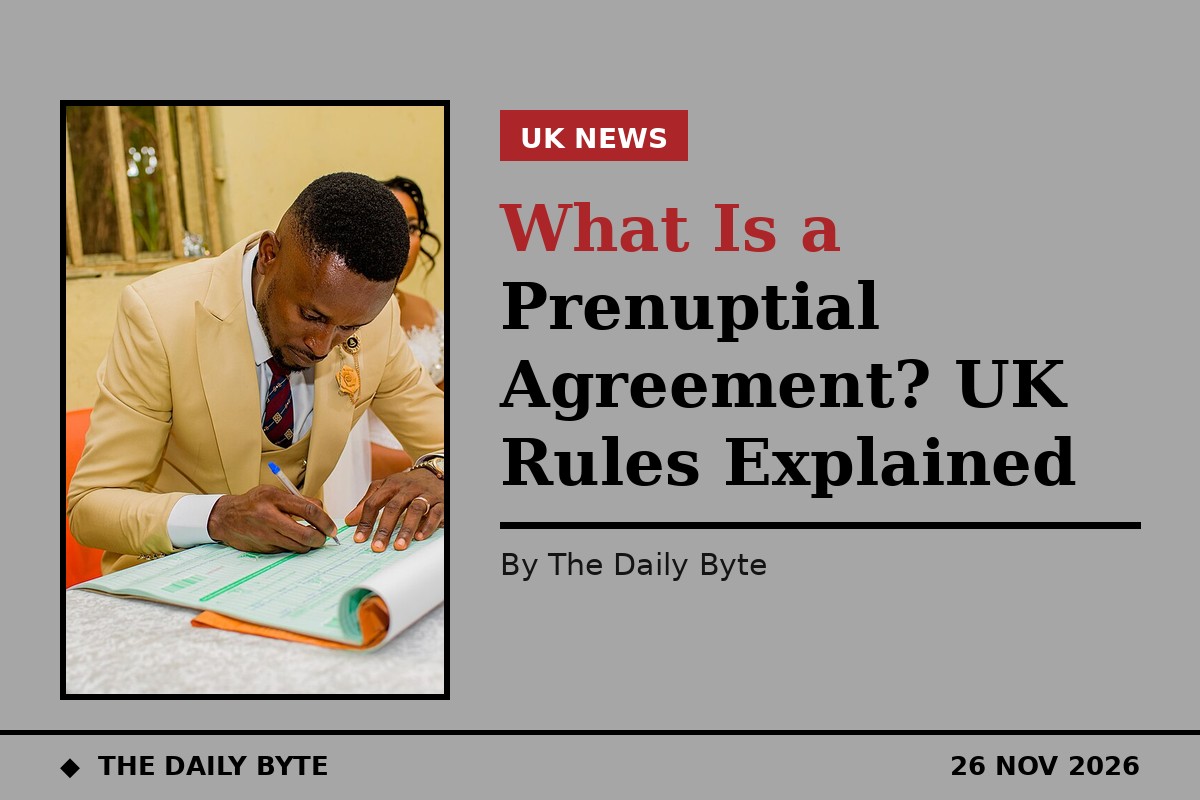
A prenuptial agreement, often called a prenup, is a written agreement made by two people before they marry or enter a civil partnership, setting out how their money and property should be divided if the relationship ends. In England and Wales a prenup is not automatically legally binding, but since the Supreme Court's decision in Radmacher v Granatino in 2010, a court will normally give effect to one that was freely entered into, with a full appreciation of its implications, unless it would be unfair to hold the parties to it. That single principle is the whole of the law in miniature, and the rest of this guide explains what it means in practice, what a good agreement needs, and what it cannot do.
Prenups were once seen as unromantic, or as something only the very wealthy or celebrities bothered with. That has changed. They are now common among business owners, people who stand to inherit family wealth, couples marrying for a second time, and anyone who brings significantly more assets into a marriage than their partner. This guide covers England and Wales. Scotland and Northern Ireland have different rules, so anyone living there should take local advice.
What is a prenuptial agreement?
A prenuptial agreement is a formal written agreement created between two partners before marriage, and it aims to set out their intentions for how their financial affairs should be managed if the marriage ends. It typically records what each person owns before the wedding, including property, savings, investments, business interests, pensions and debts, and it sets out how those assets, and any wealth built up during the marriage, should be treated on divorce. It can also address spousal maintenance and how future inheritances should be handled.
The agreement is private, made between the couple, and it is usually drawn up by solicitors. But it is not a contract like a commercial deal. The family court keeps a broad discretion under section 25 of the Matrimonial Causes Act 1973 to make whatever financial order it regards as fair, and no private agreement can remove that discretion. That is why a prenup is best understood not as a guarantee, but as a powerful piece of evidence about what the couple intended, which the court will weigh alongside everything else.
Are prenups legally binding in the UK?
In England and Wales, prenuptial agreements are not automatically legally binding. There is no statute that says a prenup binds the court. However, since the Supreme Court ruling in Radmacher v Granatino [2010] UKSC 42, courts will give a prenup decisive weight provided it was freely entered into by each party with a full appreciation of its implications, unless it would not be fair to hold the parties to it.
The Radmacher case concerned a husband who had signed an agreement before the wedding giving up any claim on his wife's family wealth, and who later sought a large award on divorce. The Supreme Court held that the court should give effect to a nuptial agreement that was freely entered into by each party with a full appreciation of its implications, unless in the circumstances prevailing it would not be fair to hold the parties to it. In practice, that means a well-drafted prenup is highly likely to be upheld by a court, but a judge always retains the discretion to depart from its terms if doing so is necessary to achieve a fair outcome.
The fairness question is judged at the time of the divorce, not at the time of signing, which may be many years later. Circumstances change: children are born, businesses fail or flourish, one partner gives up work to care for the family, or illness strikes. An agreement that was fair when signed can become unfair to enforce, and the court will take that into account.
What makes a prenup likely to be upheld?
There is no statutory checklist yet, but the courts, the Law Commission's 2014 recommendations and the 2026 reform proposals all point to the same safeguards. The more of these an agreement meets, the stronger it is likely to be.
Full financial disclosure: both parties must openly share the broad picture of their assets, debts, income and financial commitments, usually in a schedule attached to the agreement. A party who hides assets undermines the whole agreement, because the other side cannot be said to have understood what they were agreeing to.
Independent legal advice: each person should have their own solicitor, from a different firm, who explains the agreement and its implications. The advice is usually confirmed in a certificate signed by the adviser and attached to the agreement.
Time: the agreement should be signed at least 28 days before the wedding, the benchmark the Law Commission proposed. The process should start months earlier. An agreement signed on the eve of the ceremony invites the argument that there was pressure to sign.
No pressure: the agreement must be entered into freely. Fraud, duress, misrepresentation, undue pressure and exploitation of a dominant position to secure an unfair advantage can all undermine it. The court will look at the facts, including the age and emotional state of the parties and whether the marriage would have gone ahead without the agreement.
Fairness and needs: the court will not enforce terms that leave a spouse, or more importantly a child, in real need, however cleanly the agreement was made. Needs are assessed at the point of divorce, not the point of signature. A review clause, providing for the agreement to be revisited if children are born or circumstances change substantially, strengthens it.
An agreement that meets every one of these safeguards is not guaranteed to be enforced, but one that fails several of them is likely to carry little weight. The two-part test the courts apply is, first, whether the agreement was valid when it was made, and second, whether it remains fair to uphold it at the time the financial order is made.
What can a prenup cover, and what can it not do?
A prenup can ring-fence property owned before the marriage, protect a family business from being divided on divorce, keep an expected inheritance separate, define how wealth built up during the marriage should be shared, set out how debts should be handled, and record arrangements for spousal maintenance. For second marriages, it can protect assets intended for children from an earlier relationship.
There are firm limits. A prenup cannot decide where children will live or how much time they spend with each parent: the court always decides child arrangements on the basis of the child's welfare. It cannot oust the court's power to meet a spouse's or a child's needs. It cannot contain illegal terms, and it cannot bind third parties. Any clause that tries to do these things will simply be ignored.
A postnuptial agreement is the same kind of agreement made after the marriage has taken place, rather than before it. The Radmacher test applies in the same way, and because the parties are already married there is no wedding-day pressure to argue about, which can make a postnuptial agreement in some ways easier to defend. Couples who did not sign a prenup, or whose circumstances have changed since they did, often use one instead.
How much does a prenup cost, and how long does it take?
A straightforward agreement typically costs between 1,000 and 3,000 pounds plus VAT, plus the cost of the other party's independent advice, according to a guide reviewed in October 2026. Complex cases involving businesses, trusts, overseas assets or significant wealth cost more. The process should start at least three months before the wedding, because disclosure, negotiation and advice take weeks, and the agreement needs to be signed at least 28 days before the ceremony.
That cost should be weighed against the alternative. A contested financial dispute on divorce can cost many times more in legal fees, and can take a year or more to resolve through the courts. A prenup does not remove the court's discretion, but it narrows the argument considerably, and in many cases it allows a financial settlement to be agreed quickly and without a contested hearing.
Could the law change?
The Law Commission has long recommended reforming the law on prenuptial agreements. In 2014 it proposed introducing qualifying nuptial agreements, a new category of prenup that would be fully binding if certain safeguards were met. That proposal has not yet become law. In December 2024 the Law Commission published a further scoping report on financial remedies on divorce and dissolution, and in February 2025 prenuptial agreements were debated in the House of Lords.
The Ministry of Justice then consulted on the subject in 2026. Its consultation, A fairer end to relationships, ran from 5 June to 14 August 2026 and asked again about introducing qualifying nuptial agreements. The consultation has closed and the government is analysing responses. None of this is law yet, so the current approach under Radmacher still applies, but anyone signing a prenup today should know that the legal landscape may change during their marriage.
Do you need a prenup?
A prenup is most obviously useful where one partner owns a business, stands to inherit significant wealth, owns property bought before the relationship, is marrying for a second time with children from an earlier relationship, or brings far more assets into the marriage than the other. In those cases it protects what was built or inherited before the marriage, and it gives both sides certainty about the financial consequences of divorce.
It is not only for the wealthy. Any couple who want certainty about their finances, or who want to avoid a contested court battle if the marriage ends, can benefit. But a prenup is not a substitute for honest conversation: the disclosure process itself forces a couple to talk openly about money before they marry, which many family lawyers regard as one of its most valuable effects. If circumstances change substantially, for example if children are born or one partner stops working to care for them, the agreement should be reviewed and updated.
Frequently asked questions
Are prenups legally binding in the UK?: Not automatically in England and Wales, but since Radmacher v Granatino in 2010 a court will normally give effect to an agreement that was freely entered into, with a full appreciation of its implications, unless it would be unfair to do so.
How far before the wedding should a prenup be signed?: At least 28 days before the ceremony, the benchmark proposed by the Law Commission. The process should start at least three months before the wedding so there is time for disclosure, negotiation and independent advice.
Can a prenup protect an inheritance?: Yes, protecting inherited and family wealth is one of the most common reasons for signing a prenup, provided the agreement is properly made with full disclosure and independent legal advice, and provided it does not leave the other spouse or any children in real need.
What happens if we never divorce?: Nothing. A prenuptial agreement only takes effect if the marriage ends. If the couple stay together, it simply sits in a drawer, although it should be reviewed if circumstances change.
This guide is general information about the law in England and Wales, not legal advice. Anyone considering a prenuptial agreement should speak to a family solicitor, and both parties should take independent advice before signing. Sources: Connaught Law, Prenuptial Agreements UK 2026; Demstone Chambers, Are Prenuptial Agreements Legally Binding in England and Wales?


