What is a recession in the UK?
By The Daily Byte
·11 Nov 2026
·3 min read
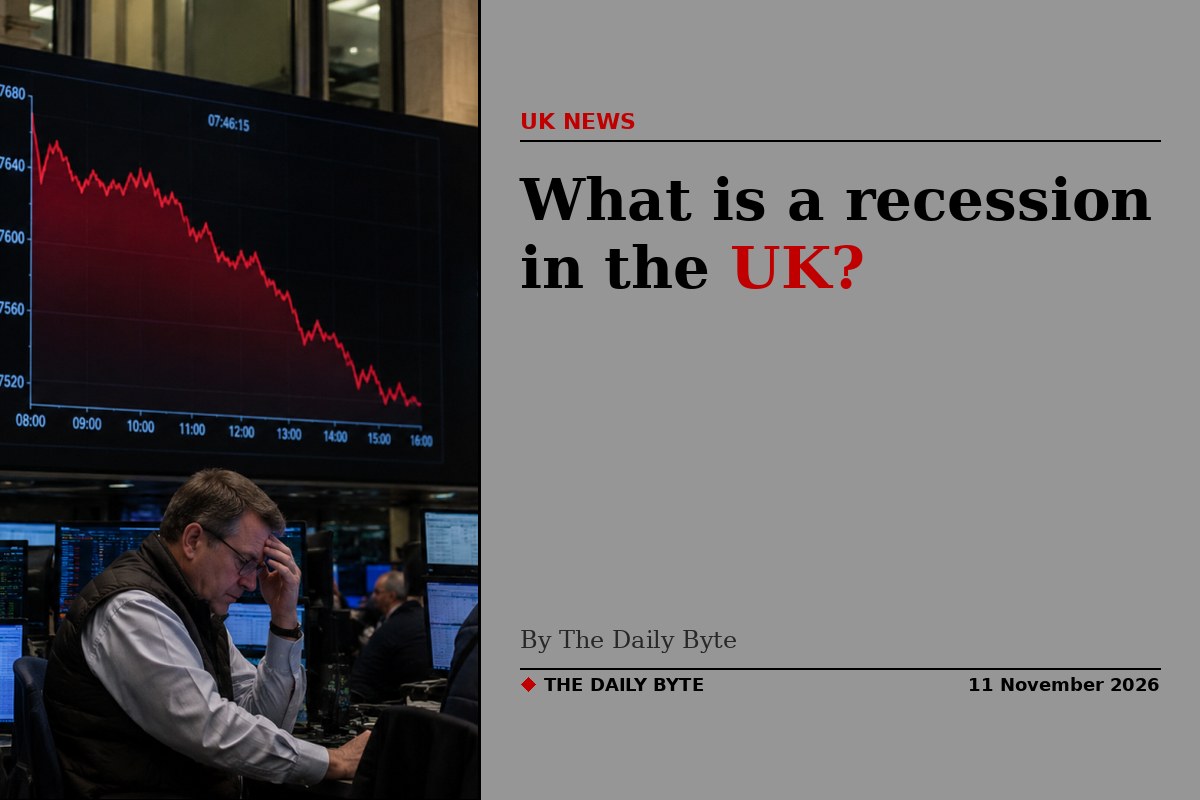
A recession is a period when a country's economy shrinks rather than grows. In the UK, the shorthand most often used is a "technical recession": two consecutive quarters — six months — in which gross domestic product (GDP) falls. But there is no official definition of a recession, and the Office for National Statistics (ONS) is careful about using the word at all, as it explains on the [ONS blog](https://blog.ons.gov.uk/2022/11/11/uncertainty-and-the-r-word-what-exactly-is-a-recession/amp/).
## How is a recession measured?
Economic growth is measured by GDP, the yardstick for the size and health of an economy. In the UK, the ONS reports GDP monthly, based on surveys of thousands of consumers and businesses. A technical recession is declared, in the popular sense, when real GDP — adjusted for price changes — contracts for two calendar quarters in a row, as [MoneyWeek](https://moneyweek.com/economy/uk-economy/605507/what-is-a-recession) explains.
| Fact | Detail |
| --- | --- |
| Common definition | Two consecutive quarters of falling GDP |
| Measure used | Real GDP, published by the ONS |
| Official status | No official definition; the ONS does not declare recessions |
| Last UK technical recession | Late 2023: GDP fell 0.1% in Q3 and 0.3% in Q4 |
## Who decides the UK is in a recession?
Nobody, formally. The ONS publishes the GDP data but says it avoids deciding when the country is in recession, and the UK has no dedicated committee for dating the economic cycle. A recession headline is therefore an interpretation of the latest GDP estimates — and because those estimates can be revised, a quarter that first appears to meet the two-quarter test can later be reclassified.
## Does two quarters of falling GDP always mean a real recession?
Not necessarily. The ONS warns the rule of thumb can mislead: an economy could shrink by 0.1% for two quarters while growing strongly either side, which most people would not call a recession. Its chief economist, Grant Fitzner, puts the common-sense understanding differently: a recession is "a prolonged and significant downturn in economic activity". That is why economists also look at jobs, incomes and spending, not GDP alone.
## When was the UK last in a recession?
The UK was last in a technical recession at the end of 2023. GDP fell by 0.3% in the final quarter of 2023, following a fall of 0.1% in the previous quarter. Across 2023 as a whole, however, GDP still grew by 0.1% compared with 2022 — a reminder that a technical recession can be shallow even when the headline sounds severe.
## Frequently asked questions
**Is a recession the same as a depression?**
No. A recession is the two-quarter shorthand described above. A depression is generally used for a far longer and deeper collapse, rarely applied to modern UK downturns.
**Can a recession be revised away?**
Yes. Early GDP estimates are revised as more data arrives, so a quarter first reported as negative can later be revised to positive.
Source
Office for National Statistics — https://blog.ons.gov.uk/2022/11/11/uncertainty-and-the-r-word-what-exactly-is-a-recession/amp/