What Is a Refugee? Definition, Rights and How Asylum Works
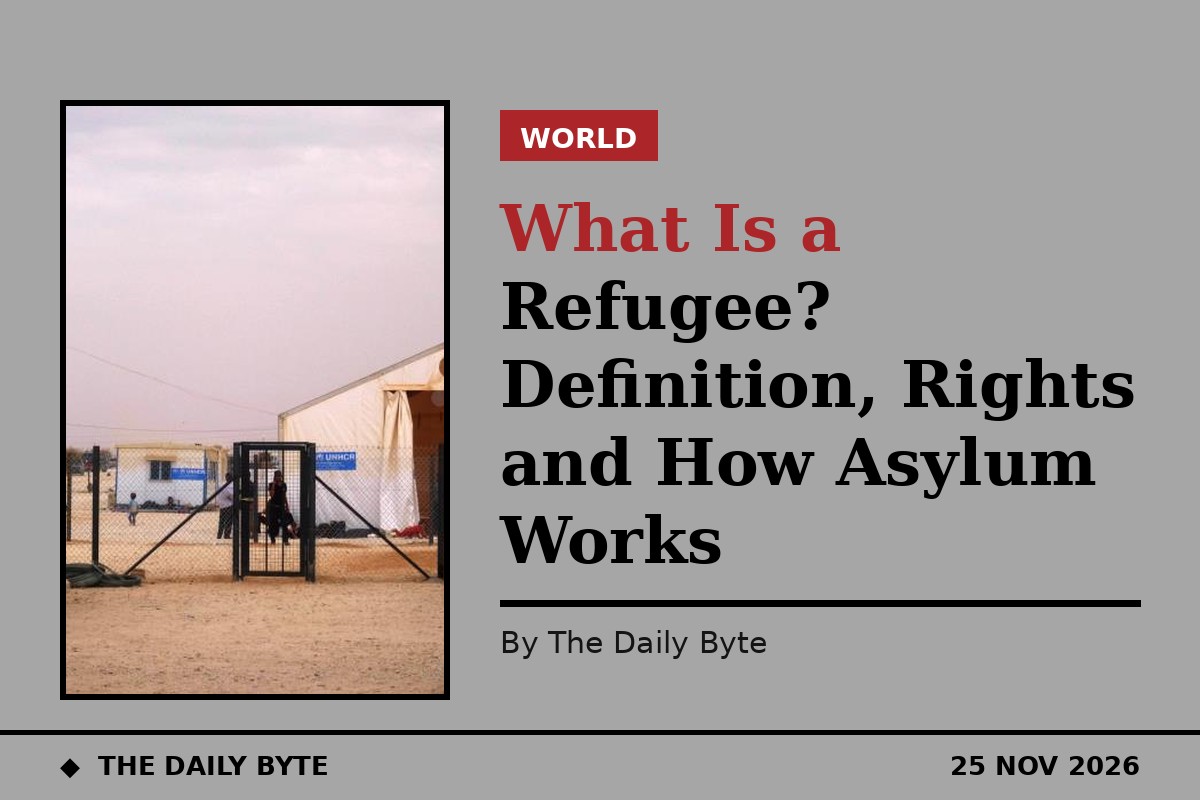
A refugee is a person who has been forced to flee their own country and seek safety in another country because of persecution, war or violence, and who cannot return home because they would be in danger. That is the core of the definition in international law, set out in the 1951 Refugee Convention. At the end of 2025 there were 41.6 million refugees in the world, part of 117.8 million people forcibly displaced worldwide, according to the United Nations Refugee Agency, UNHCR.
Refugees are often confused with asylum seekers and with migrants, but the three words mean different things in law, and the difference decides what protection a person can claim. This explainer sets out the legal definition, the rights refugees have, how many people are affected, and how the system works in the UK.
What is the legal definition of a refugee?
Article 1A(2) of the 1951 Convention Relating to the Status of Refugees defines a refugee as a person who, "owing to well-founded fear of being persecuted for reasons of race, religion, nationality, membership of a particular social group or political opinion, is outside the country of his nationality and is unable or, owing to such fear, is unwilling to avail himself of the protection of that country". A person without a nationality is covered in the same way if they are outside the country where they used to live and cannot or will not return.
Four elements matter. First, the person must be outside their own country. Second, there must be a well-founded fear of persecution, which means the fear must be both genuine and supported by evidence about conditions in the home country. Third, the fear must be linked to one of the five reasons listed in the Convention: race, religion, nationality, membership of a particular social group, or political opinion. Fourth, the person must be unable or unwilling to seek the protection of their own government.
The Convention was adopted on 28 July 1951, in the aftermath of the Second World War, when millions of Europeans were displaced. As originally written it applied only to events in Europe before 1951. The 1967 Protocol removed those time and geographical limits, so the definition now applies universally. Regional agreements have gone further: the 1969 African Union Convention and the 1984 Cartagena Declaration in the Americas also cover people fleeing external aggression, occupation, foreign domination, internal conflict, massive human rights violations or events seriously disturbing public order.
Not every hardship qualifies. According to the United Nations, the lack of food, water, education, health care or a livelihood would not ordinarily, by itself, sustain a refugee claim under the 1951 Convention. People fleeing poverty alone are treated as migrants, not refugees, even though their situation may be desperate.
Refugee, asylum seeker, migrant or internally displaced person?
The words are often used as if they were interchangeable. In law they are not, and the table below sets out the difference.
| Term | Meaning | Key point |
|---|---|---|
| Refugee | A person outside their country who meets the 1951 Convention definition and cannot return for fear of persecution. | Has a legal right to international protection, including not being sent back to danger. |
| Asylum seeker | A person who has applied for refugee status and is waiting for a decision. | Not yet recognised as a refugee; the claim may be granted or refused. |
| Migrant | A person who moves to another country, usually for work, study or family reasons. | A broad term; migrants choose to move and can generally return home safely. |
| Internally displaced person (IDP) | A person forced to flee their home but who remains inside their own country. | Has not crossed a border, so is not a refugee and is not covered by the 1951 Convention. |
| Stateless person | A person not recognised as a national by any state. | May also be a refugee, but statelessness is a separate legal problem. |
One common misunderstanding is that a person only becomes a refugee when a government says so. Under international law, a person who meets the definition is a refugee whether or not they have been formally recognised; recognition confirms the status rather than creating it. When large numbers of people flee at once, whole groups may be granted refugee status on a prima facie basis, so that individual cases do not have to be examined one by one. A separate group is the Palestine refugees: around 6 million people are supported by the United Nations Relief and Works Agency for Palestine Refugees (UNRWA), which was set up in 1949.
What rights do refugees have?
The cornerstone of refugee protection is the principle of non-refoulement, set out in Article 33 of the 1951 Convention. It states that a refugee has the right not to be sent back to a country where their life or freedom would be at risk. This is widely regarded as binding on all states, whether or not they have signed the Convention.
Beyond that, the Convention sets minimum standards for how refugees must be treated. They are entitled to the basic rights of any other foreigner in the host country, including the right to practise their religion, to pursue education, and to move about freely. States are expected to give refugees access to courts, to allow them to work and to provide identity and travel documents. Refugees should also be able to apply for naturalisation in time, and children born to refugees should not be left stateless.
UNHCR, the UN Refugee Agency, is mandated to protect refugees and to coordinate international action on their behalf. It was established by the UN General Assembly on 14 December 1950 with a three-year mandate to complete its work and then disband. Instead, it has been working ever since. At the end of 2025 it was mandated to protect 28.5 million refugees and 7.2 million other people in need of international protection.
How many refugees are there in the world?
UNHCR's Global Trends report, published in June 2026, gives the picture for the end of 2025. The figures are the most recent available and they show a system under strain, but also the first fall in forced displacement for a decade.
| Figure | Number | Source and note |
|---|---|---|
| Refugees worldwide, end of 2025 | 41.6 million | UNHCR; people forced to flee their home countries. |
| People forcibly displaced worldwide, end of 2025 | 117.8 million | UNHCR Global Trends; about 1 in every 70 people on earth. |
| Asylum seekers worldwide, 2025 | 9 million | UNHCR, via the Congressional Research Service. |
| Refugees who returned home in 2025 | 4.4 million | UNHCR; most refugees want to return once it is safe. |
| All people who returned in 2025 | 14.7 million | UNHCR; includes 10.3 million internally displaced people. |
| Palestine refugees supported by UNRWA | 6 million | UNHCR; a separate mandate dating from 1949. |
The overall number of forcibly displaced people fell slightly in 2025, the first annual decline in a decade, but it remains near historic highs: the number of refugees has nearly doubled since 2016 and the number of asylum seekers has more than tripled in the same period. More people were able to return home in 2025 than in recent years, but durable solutions continue to lag behind needs, and millions of refugees remain in prolonged displacement. According to UNHCR, three in four forcibly displaced people live in countries with high to extreme exposure to climate-related hazards.
The funding picture is also deteriorating. UNHCR's global funding fell by 1.2 billion dollars in calendar year 2025, a drop of nearly 25 per cent on 2024. Resettlement, the transfer of refugees from a host country to another country that has agreed to admit them, has shrunk sharply: UNHCR made 35,000 resettlement submissions in 2025, down from 203,777 in 2024, with 23 countries taking part.
How does asylum work in the UK?
In the UK, a person who arrives and asks for protection is an asylum seeker. The Home Office decides the claim. If the claim is accepted, the person is recognised as a refugee and is given permission to stay. If it is refused, the person can appeal, and in some cases can make further submissions. People who do not qualify as refugees may still be granted leave to remain for humanitarian or other reasons.
The scale of the system has grown sharply. In 2025 there were 82,600 applications for asylum in the UK, relating to 101,900 people, according to the House of Commons Library. The number of people receiving an initial decision reached 135,151 in the year ending December 2025, 56 per cent more than the previous year and five times the average annual number of decisions in the decade to 2020. Of those, 54,887 people were granted refugee protection or other leave at initial decision, and 80,264 were refused, the highest number of refusals since comparable records began in 2002.
The grant rate, the share of initial decisions that result in protection, was 42 per cent in 2025, down from 47 per cent the year before and well below the peak of 76 per cent in 2022, but still higher than in any year before 2019. Grant rates vary sharply by nationality: in the year ending March 2025, almost all claims from Sudan (99 per cent) and Syria (98 per cent) were granted, and 86 per cent of claims from Eritrea. In the year to September 2025, the UK received 110,000 asylum applications including dependants, the highest number ever recorded, and still ranked fifth in Europe in absolute numbers, behind Germany, France, Spain and Italy.
The backlog has fallen as decision-making has sped up. The number of cases awaiting an initial decision stood at 32,400 by June 2026. Around 112,000 people were receiving asylum support in the year to September 2025, with just over 36,000 in hotel accommodation. Refugee family reunion, which allows refugees to bring close family members to the UK, reached a record 21,000 grants in the year ending September 2025.
Asylum seekers are generally not allowed to work while their claim is being decided, and they receive limited financial support instead. Once recognised as a refugee, a person can work, claim benefits on the same basis as other residents, and use the NHS. In the year ending June 2026, the most common nationalities of people claiming asylum were Pakistani (10 per cent), Eritrean (8 per cent), Iranian (8 per cent), Sudanese (7 per cent) and Afghan (7 per cent).
Why are refugees in the news in November 2026?
Three themes dominate. The first is numbers: record asylum applications in the UK, falling grant rates, and a government trying to clear the backlog while tightening the rules, including through the Immigration and Asylum Bill now before Parliament. The second is returns: 2025 saw one of the highest return figures ever recorded, with 4.4 million refugees going home, a reminder that most refugees want to return once it is safe to do so.
The third is money. UNHCR lost nearly a quarter of its funding in 2025, and resettlement places have fallen sharply, which leaves more refugees in prolonged displacement in the countries that host them. The debate in Britain, as elsewhere, is about how to balance control of the border with the obligation not to return people to danger, and about who pays for the system that protects them.
Frequently asked questions
Is an asylum seeker the same as a refugee? No. An asylum seeker is someone who has applied for refugee status and is waiting for a decision. A refugee is someone whose claim has been accepted, or who meets the 1951 Convention definition even before formal recognition.
Can a refugee be sent back to their home country? Not if their life or freedom would be at risk there. The principle of non-refoulement in Article 33 of the 1951 Convention forbids it. A person can be returned if they are found not to be a refugee and have no other right to remain.
Do refugees have to claim asylum in the first safe country they reach? There is no rule in the 1951 Convention that requires this. The Convention requires refugees to present themselves to the authorities without delay and to show good cause for any illegal entry, but it does not oblige them to stay in the first country they reach.
How many refugees does the UK take compared with other countries? The UK received 110,000 asylum applications including dependants in the year ending September 2025, a record, but it still ranked fifth in Europe in absolute numbers, behind Germany, France, Spain and Italy.
Sources: UNHCR, "Refugees"; United Nations, "Refugees"; House of Commons Library, "Asylum statistics"; GOV.UK, "How many people are granted asylum in the UK?"; Congressional Research Service, "Global Refugee Resettlement: Background and Selected Issues", September 2026.


