What Is a Shell Merger in a Dying Star?
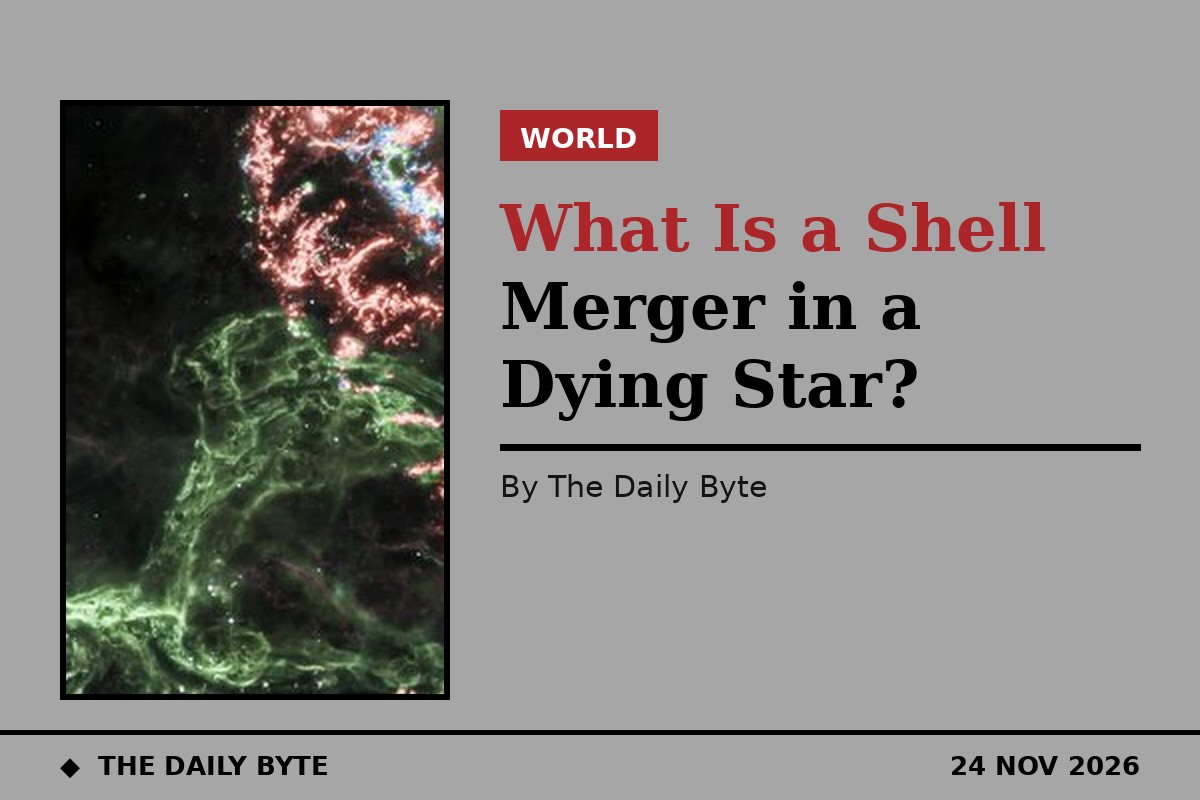
On 23 November 2026, NASA and the European Space Agency announced that the James Webb Space Telescope had found evidence of a shell merger inside the star that became Cassiopeia A, one of the most studied supernova remnants in the sky. A shell merger is a violent mixing event deep inside a massive star, in which two of the separate layers where different elements are burning churn together and merge, changing the star's structure shortly before it explodes. Webb found the fingerprint of that event in the dust left behind by the explosion, and the results were published the same day in The Astrophysical Journal Letters.
That matters because the dust from a supernova is not just debris. It is a record of the star that died, and it is also the raw material for the next generation of stars and planets. By reading the chemistry of individual dust clumps in Cassiopeia A, astronomers could work out what was happening inside its parent star in the hours before it destroyed itself.
| Key fact | Detail |
|---|---|
| Discovery | Evidence of a shell merger in the star that became Cassiopeia A |
| Announced | 23 November 2026, by NASA and the European Space Agency |
| Published | The Astrophysical Journal Letters, 23 November 2026 |
| Telescope | James Webb Space Telescope, Mid-Infrared Instrument (MIRI) |
| Object | Cassiopeia A, about 11,000 light-years away, spanning about 10 light-years |
| Explosion seen from Earth | About 340 years ago |
| Lead author | Tea Temim, Columbia University |
| Key evidence | Silica dust in one region, carbon dust in another, magnesium silicates in the Green Monster |
What did the James Webb telescope actually find?
Webb observed Cassiopeia A, known as Cas A, in mid-infrared light, using its Mid-Infrared Instrument, known as MIRI. The observations were sharp enough to separate the dust emission from individual clumps of debris, each roughly the size of the Solar System, instead of averaging the chemistry across large regions of the remnant. That resolution is what made the new result possible: earlier telescopes could show that Cas A contained dust, but they could not pick out the chemistry of one clump from another.
The team did not choose where to look at random. They used data from NASA's retired Spitzer Space Telescope, which had identified three specific regions for Webb to examine in detail. Two of those regions sit inside Cas A's reverse-shocked zone, the place where an inward-moving shock wave collides with debris thrown outward by the explosion. Webb found that the ejected material in one of the two regions contained mostly silica dust, while the other was dominated by carbon dust. The contrast between the two is the heart of the result: in a star whose burning layers had stayed neatly separate, the debris should show clean chemical boundaries, but the pattern Webb measured does not look like that.
The third region was the Green Monster, a structure first discovered by Webb in earlier images of Cas A. It turned out to be rich in complex magnesium silicates, and unlike the other two regions it was made from material the star shed before it exploded, rather than from the supernova's ejecta. Mapping the dust composition across the whole remnant, and combining Webb's data with X-ray observations from NASA's Chandra X-ray Observatory and the JAXA-led XRISM mission, the team found that the signatures of the merger are present throughout much of the remnant, not in one isolated patch. As NASA's report of the study puts it, the observations together indicate that the merger was under way very shortly before the supernova explosion.
What is a shell merger?
A shell merger is what happens when the layered structure inside a dying massive star breaks down. In the final stages of such a star's life, different elements burn in separate concentric shells, like the layers of an onion. Material inside those shells churns and circulates, and that churning can cause two neighbouring shells to merge shortly before the supernova explosion. In the case of Cas A, the evidence points to the oxygen-burning and carbon-burning shells merging together.
"Material within these shells churns and circulates, which can cause the shells to merge shortly before the supernova explosion," said Tea Temim, lead author of the study and a research scientist at Columbia University. "So, for example, the oxygen- and carbon-burning shells in a star merge together and change the structure of the star significantly. And that would then change the chemical abundances that you would see after a supernova explosion in the ejecta of a supernova remnant."
The new study does not claim to have watched a merger happen. What it offers is evidence that fits the merger scenario better than the alternative of neatly separated layers: the researchers compared the dust's chemistry with models of how explosions forge elements, and the comparison favours a parent star whose carbon and oxygen burning shells had merged. The European Space Agency's release describes the process as theorised to occur mere hours before a star's supernova explosion.
How does a massive star build its layers?
To understand why a shell merger matters, it helps to know how a massive star is put together. Stars begin their lives as large clouds of mostly hydrogen gas and cosmic dust called molecular clouds. Gravity causes these clouds to collapse, the material heats up, and protostars, infant stars, form. Under the constant pressure of gravity, hydrogen inside a protostar begins to fuse into helium, and the protostar becomes a full-fledged star like our Sun.
In a massive star, that is only the start. As hydrogen in the core runs out, the core contracts and heats until helium begins to fuse into heavier elements. The process repeats, with increasingly heavier elements fusing in the core, eventually stopping at iron, and lighter elements fusing in surrounding layers. The result is a set of concentric shells, each burning a different element, and each shell is a record of a stage in the star's history. Hydrogen burns in the outermost layers, then helium, carbon, neon, oxygen and silicon in shells further in, with an iron core at the centre.
Iron is where the chain ends, because fusing iron consumes energy instead of releasing it. Once the iron core grows too massive to support itself, it collapses in a fraction of a second, and the rebound blows the star apart in a supernova. The elements forged in the shells are scattered into space, where some of them condense to form dust grains, which can clump together. That is why the dust in a supernova remnant is so informative: its chemistry is a direct sample of the shells, frozen at the moment of the explosion.
Why does a shell merger change the explosion?
A shell merger matters because it rewrites the star just before the most violent event in its life. When the oxygen-burning and carbon-burning shells merge, the star's structure changes significantly, and so does the mix of elements the explosion throws out. The merger stirs material that would otherwise have stayed in separate layers, so elements that formed in different parts of the star end up blended in the debris. That changes the chemical abundances astronomers measure in the remnant, and it changes what the supernova contributes to the galaxy around it.
This is also why the result is useful beyond Cas A itself. Astronomers cannot watch a massive star's final hours directly, but if the dust in a remnant carries a readable signature of a merger, the dust of other remnants can be read the same way. Dan Milisavljevic, an associate professor at Purdue University and a co-author of the study, put it this way: "With Webb, the vast improvement in being able to resolve at the individual clump level helps us do more sophisticated dust chemistry. As a result, we can tie the explosion back to the makeup of the progenitor star hundreds of years afterward."
The finding also feeds into a bigger question about where the elements around us come from. The oxygen we breathe, the carbon in our bodies and the silicon in rocks and computer chips were all forged inside stars and scattered by supernovae. Understanding which elements a given supernova releases, and in what amounts, is essential to explaining how those elements enrich future generations of stars and planets. A merger that changes the mix by a large amount is therefore not a detail: it changes the accounting of what a star gives back to its galaxy.
What is the Green Monster?
The Green Monster is a structure inside Cas A that Webb discovered in earlier images, named for its appearance in the telescope's pictures, where it shows up as a green, web-like feature winding through the remnant. In the new study it played the role of a control sample. Its spectrum matches warm magnesium silicate dust, and its position and composition point to an origin in material the star shed before it exploded, rather than in the debris of the explosion itself.
That distinction is what makes it valuable: the two reverse-shocked regions record the explosion, while the Green Monster records the star's earlier mass loss. Comparing the two lets the team separate the chemistry of the explosion from the chemistry of the star's earlier wind, strengthening the case that the silica-versus-carbon contrast really does record a merger inside the star.
Why does the dust matter so much?
Supernova dust is one of the main ways galaxies build up solid material for new stars and planets. But there is a long-standing puzzle about how much of it survives: as the remnant expands, a reverse shock sweeps back through the debris and can destroy dust grains.
The new Webb observations speak directly to that question. "Identifying the different types of dust grains formed in the chemically distinct layers of a supernova brings us one step closer to understanding how much dust supernovae contribute to the interstellar dust reservoir in our galaxy," said Ilse De Looze, a co-author of the paper and an associate professor at Ghent University in Belgium. "By revealing the composition of this newly formed supernova dust, JWST also provides crucial insights into how well these grains can survive the powerful reverse shocks that sweep through the supernova debris, ultimately determining how much dust can escape into the interstellar medium."
Different kinds of dust survive differently. Silica grains and carbon grains do not behave the same way when a shock wave hits them, so knowing which type formed where, and in what amounts, is a necessary step towards working out how much dust escapes. Webb's dust map, which covers the whole remnant, gives astronomers that inventory for Cas A for the first time, clump by clump.
What happens next?
The study's most lasting contribution may be its method: a new way to infer the structure of a star that exploded, by studying the dust its remnant left behind. The same approach can now be applied to other remnants, to see whether shell mergers are common or Cas A is unusual. If they are common, models of massive stars will have to include them as a routine part of a star's final hours.
More observations will follow. Webb can revisit Cas A and other remnants, and the X-ray data from Chandra and XRISM will keep providing an independent check on what the dust is saying. For now, the picture is this: a massive star, about 11,000 light-years away, spent its final hours churning its inner layers together, then exploded about 340 years ago as seen from Earth. Its dust has been drifting through space ever since, carrying a record of those last hours, and on 23 November 2026, Webb finally read it.
Frequently asked questions
What is a shell merger? A shell merger is a mixing event inside a dying massive star, in which two of the concentric layers where different elements burn, such as the oxygen-burning and carbon-burning shells, churn together and merge shortly before the star explodes as a supernova. It changes the star's structure and the mix of elements the explosion releases.
Did Webb watch the star explode? No. Webb observed the remnant left behind, about 340 years after the explosion's light reached Earth. The telescope read the chemistry of dust clumps in the debris, and that chemistry records what the star's interior looked like in the hours before it exploded.
Can I see Cassiopeia A in the sky? Not with the naked eye. Although the remnant spans about 10 light-years, it lies about 11,000 light-years away, so it appears tiny and faint, and it is studied with large telescopes and spacecraft.
Is the shell merger proven? Webb's data supports the shell-merger scenario; it does not prove it beyond doubt. The evidence is the pattern of dust chemistry across the remnant, which fits a star whose carbon and oxygen shells had merged. The finding is published in The Astrophysical Journal Letters, where other astronomers can test it.
Why does this discovery matter? Because it explains which elements a supernova releases and how they enrich the galaxy. The dust from exploded stars is the raw material for new stars and planets, so understanding a process that changes that mix helps explain how the elements around us came to be.


