What Is a Solar Storm?
On the morning of Monday 24 November 2026, space weather was quiet. The Sun was not throwing a tantrum, no geomagnetic storm was under way, and the aurora was confined to the far north. Yet forecasters were already watching the end of the week. A coronal hole had rotated into an Earth-facing position, and the fast stream of solar wind it releases was expected to reach Earth around 27 November, with minor geomagnetic storm conditions likely on 27 and 28 November. That is the rhythm of a solar storm: days of calm, a warning issued in advance, and then a disturbance that most people will only notice as coloured light in the night sky, while engineers watch power grids, satellites and radio signals far more closely.
A solar storm is a disturbance in the space around Earth caused by activity on the Sun. The phrase is used loosely, and that looseness causes confusion, because it covers several different things that happen at different speeds and do different kinds of damage. A solar flare is a sudden flash of light and X-rays from the Sun's surface. A coronal mass ejection, usually shortened to CME, is a huge cloud of charged particles thrown out from the Sun's outer atmosphere. A geomagnetic storm is what happens when one of those clouds, or a fast stream of solar wind, hits Earth's magnetic field and shakes it. When people say "solar storm", they usually mean the geomagnetic storm at the Earth end of that chain, and that is the meaning used in this explainer.
The Sun is not a calm ball of light. It is a star made of hot, electrically charged gas, and its surface is threaded with magnetic fields that twist, stretch and snap. Sunspots are the visible sign of that restlessness: dark patches where strong magnetic fields poke through the surface and cool the gas around them. Around sunspots, magnetic energy can build up for days and then release in minutes. The result can be a flare, a CME, or both at once. None of this is rare. The Sun produces flares every day, and CMEs several times a week when it is active. Most miss Earth entirely, because space is large and Earth is a small target. The ones that matter are the ones aimed at us.
Where a solar storm begins
Everything starts with the solar wind, the constant stream of charged particles that flows out from the Sun in all directions. Near Earth it usually travels at around 300 to 500 kilometres per second, which is fast enough to cross the 150 million kilometres between the Sun and Earth in a few days. The solar wind is always blowing, and Earth's magnetic field, the magnetosphere, stands in its way like a rock in a river, deflecting most of it around the planet. That shield is why life on Earth is not constantly battered by charged particles from space.
A solar storm begins when that steady flow is disrupted. There are two main ways this happens. The first is a coronal mass ejection. A CME is a billion-tonne cloud of plasma and magnetic field that erupts from the Sun's corona, the hot outer atmosphere, and races outward at speeds that can exceed 2,000 kilometres per second. A fast CME can reach Earth in less than a day; a slow one takes three or four. The second is a high-speed stream from a coronal hole, a darker, cooler region of the corona where the Sun's magnetic field opens out into space and lets the solar wind escape faster than usual. Coronal holes can last for months, and because the Sun rotates roughly once every 27 days, the same hole can send a fast stream towards Earth again and again, about once a month. The stream expected around 27 November 2026 comes from exactly this kind of coronal hole, which is why forecasters could see it coming days in advance.
Solar flares are part of the same story but they are not the same thing as a CME. A flare is a burst of electromagnetic radiation, mostly light and X-rays, that travels at the speed of light and reaches Earth in about eight minutes. It can disturb radio communications on the side of Earth facing the Sun within minutes, but it carries no particles with it, so it does not by itself cause a geomagnetic storm. A CME is slower but far more substantial: it is actual matter, and when it arrives it can push Earth's magnetic field around for hours or days. Some of the largest storms in history were caused by CMEs that followed big flares, which is why the two are so often mentioned together, but it is the CME, or the fast solar wind stream, that does the magnetic damage.
What happens when one reaches Earth
When a CME or a fast stream arrives, the first thing it meets is the magnetosphere. If the magnetic field carried by the solar wind points north, roughly in the same direction as Earth's own field at the point of contact, the shield stays mostly closed and little energy gets in. If it points south, the two fields link up in a process called magnetic reconnection, and energy pours into the magnetosphere. That is the decisive detail, and it is also the hardest to forecast, because the direction of the field inside a CME cannot be measured until the cloud is almost upon us, about an hour away at the L1 point, a million and a half kilometres sunward of Earth, where monitoring spacecraft sit.
Once energy gets in, several things happen at once. Electric currents surge through the magnetosphere and down into the upper atmosphere. Charged particles spiral along magnetic field lines towards the poles and collide with oxygen and nitrogen in the air, and those collisions release light: the aurora. At the same time, the magnetic field measured on the ground begins to swing, sometimes by hundreds of nanoteslas in a few hours. That changing magnetic field is what a geomagnetic storm is, in the strict sense: a temporary disturbance of Earth's magnetic field, measured by magnetometers on the ground and summarised in indices such as Kp.
The Kp index is the number forecasters quote most often. It runs from 0 to 9 and is calculated every three hours from magnetometer readings at stations around the world. A Kp of 0 to 2 means quiet conditions. A Kp of 3 or 4 means active or unsettled. A Kp of 5 is the threshold for a storm. The higher the number, the stronger the disturbance. In its three-day forecast issued at 00:30 UTC on 24 November 2026, NOAA's Space Weather Prediction Center reported that the greatest observed three-hour Kp over the previous 24 hours had been 2, and that the greatest expected Kp for 24 to 26 November was 3.67, below storm level. In plain terms, nothing was happening, and nothing was expected to happen for the next three days. That is a forecast, not a promise, and it is updated every few hours as new data arrives.
The G1 to G5 scale, explained
Because a bare Kp number means little to most people, NOAA grades geomagnetic storms on a five-step scale, G1 to G5, in the same spirit as hurricane categories. The scale turns the Kp index into plain expectations about what could happen to power systems, spacecraft, navigation and radio, and how far from the poles the aurora may be seen. G1 is minor, at Kp 5. G2 is moderate, at Kp 6. G3 is strong, at Kp 7. G4 is severe, at Kp 8. G5 is extreme, at Kp 9. Anything below Kp 5, including Kp 4, is active or unsettled but is not a storm on this scale.
At G1, the effects are modest. Power grids may see weak fluctuations, satellites feel only a minor impact on their operations, and the aurora is commonly visible at high latitudes, in places such as northern Michigan and Maine in the United States, or across northern Scotland and Scandinavia in Europe. NOAA lists about 1,700 G1 storms per 11-year solar cycle, which makes them routine: they happen often, and most pass without anyone on the ground noticing. At G2, high-latitude power systems may see voltage alarms, high-frequency radio can fade at higher latitudes, and the aurora can reach as far south as New York and Idaho. There are about 600 of these per cycle.
At G3, voltage corrections may be needed on power grids, satellite navigation can suffer intermittent problems, high-frequency radio can be hit, and the aurora can appear as far south as Illinois and Oregon. About 200 occur per cycle. At G4, widespread voltage control problems are possible, some protective systems may trip key grid assets, satellite navigation can be degraded for hours, and the aurora can reach Alabama and northern California. About 100 occur per cycle. At G5, some grid systems may collapse or black out, transformers may be damaged, high-frequency radio may be impossible in many areas for one to two days, satellite navigation can be degraded for days, and the aurora can be seen as far south as Florida and southern Texas. Only about four G5 storms occur per solar cycle, which is why they are remembered for decades.
The two other NOAA scales are worth knowing because they are often confused with the G scale. The S scale, S1 to S5, covers solar radiation storms, which are streams of energetic protons that can affect astronauts and high-flying aircraft and can upset satellite electronics. The R scale, R1 to R5, covers radio blackouts caused by solar flares, which affect the sunlit side of Earth within minutes of a flare. A single solar event can produce readings on all three scales, or on only one of them. The 24 November forecast put the chance of an S1 or greater radiation storm at 1 per cent for each of 24, 25 and 26 November, and the chance of an R1 to R2 radio blackout at 1 per cent for each of those days, with no R1 or greater blackout expected. Those are very low numbers, and they match the quiet picture in the geomagnetic forecast.
What a solar storm does to technology
For most people, the effects of a solar storm are invisible, and that is by design. Power grids, satellites and navigation systems are built to cope with ordinary space weather, and the vast majority of storms, G1 and G2, cause nothing more than minor fluctuations that engineers correct without customers noticing. The risk grows at G3 and above, and it grows unevenly: a storm that is a spectacle in one country can be a headache in another, depending on the geology beneath the power grid, the latitude, and the state of the equipment at the time.
Power grids are vulnerable because a changing magnetic field induces electric currents in the ground, and those currents can flow into long transmission lines and transformers. At G1 the effect is weak fluctuation. At G3, voltage corrections may be needed. At G4, widespread voltage control problems are possible. At G5, transformers can be damaged and parts of a grid can collapse. The most famous example is the storm of March 1989, when the Hydro-Quebec grid in Canada collapsed in about 90 seconds and left millions of people without power for hours. The most famous of all is the Carrington Event of September 1859, when telegraph systems around the world failed, operators reported electric shocks, and some telegraph stations caught fire. There was no power grid to collapse in 1859, so the damage was limited to the technology of the day, but the storm is still used as the benchmark for what a truly extreme event could do to a modern, electrified world.
Satellites face a different set of problems. A geomagnetic storm heats the upper atmosphere, which expands and increases drag on satellites in low Earth orbit, pulling them slightly lower and forcing operators to adjust their orbits. Charged particles can also cause surface charging on a spacecraft, upset its electronics, and in severe cases damage components. Satellite navigation, the GPS and Galileo signals that phones, aircraft and ships rely on, can be degraded because the storm disturbs the ionosphere, the charged layer of the atmosphere that the signals pass through. At G4 the degradation can last for hours, and at G5 for days. High-frequency radio, used by aircraft on polar routes and by ships at sea, can fade or fail altogether, which is why airlines reroute flights away from the poles during strong storms.
None of this means that a solar storm is dangerous to people on the ground. Earth's magnetic field and atmosphere protect us from the charged particles themselves, and the radiation levels at ground level do not rise in any meaningful way during a geomagnetic storm. The risk is to infrastructure, not to health, and the people who need to act are the engineers who run that infrastructure, not the public. That is an important distinction, because headlines about solar storms often sound apocalyptic while the official advice is calm: charge your devices, keep a radio handy, and do not rely on GPS alone if a G4 or G5 storm is forecast.
The aurora: the beautiful side of the storm
The most visible effect of a solar storm is also the most beautiful. The aurora borealis, the northern lights, and its southern twin, the aurora australis, are caused by charged particles from space colliding with gases in the upper atmosphere, roughly 100 to 300 kilometres above the ground. Oxygen gives off green light, the colour most people picture, and at higher altitudes it can glow red. Nitrogen contributes blue and purple. The result is curtains, arcs and rays of light that ripple across the sky, sometimes for minutes, sometimes for hours.
During quiet conditions the aurora stays near the poles, in a ring called the auroral oval around the magnetic pole. During a geomagnetic storm the oval expands towards the equator, which is why a strong storm can push the lights far further south than usual. At G1 they are a high-latitude sight. At G3 they can reach the middle latitudes of the United States and Europe. At G5 they have been seen in places that almost never see them, including Florida, southern Texas, and, in the great storm of May 2024, across much of the United Kingdom. That May 2024 storm reached G5 conditions and was the strongest in 20 years, and it produced aurora photographs from gardens and rooftops across Britain, in places where the lights had not been visible for a generation.
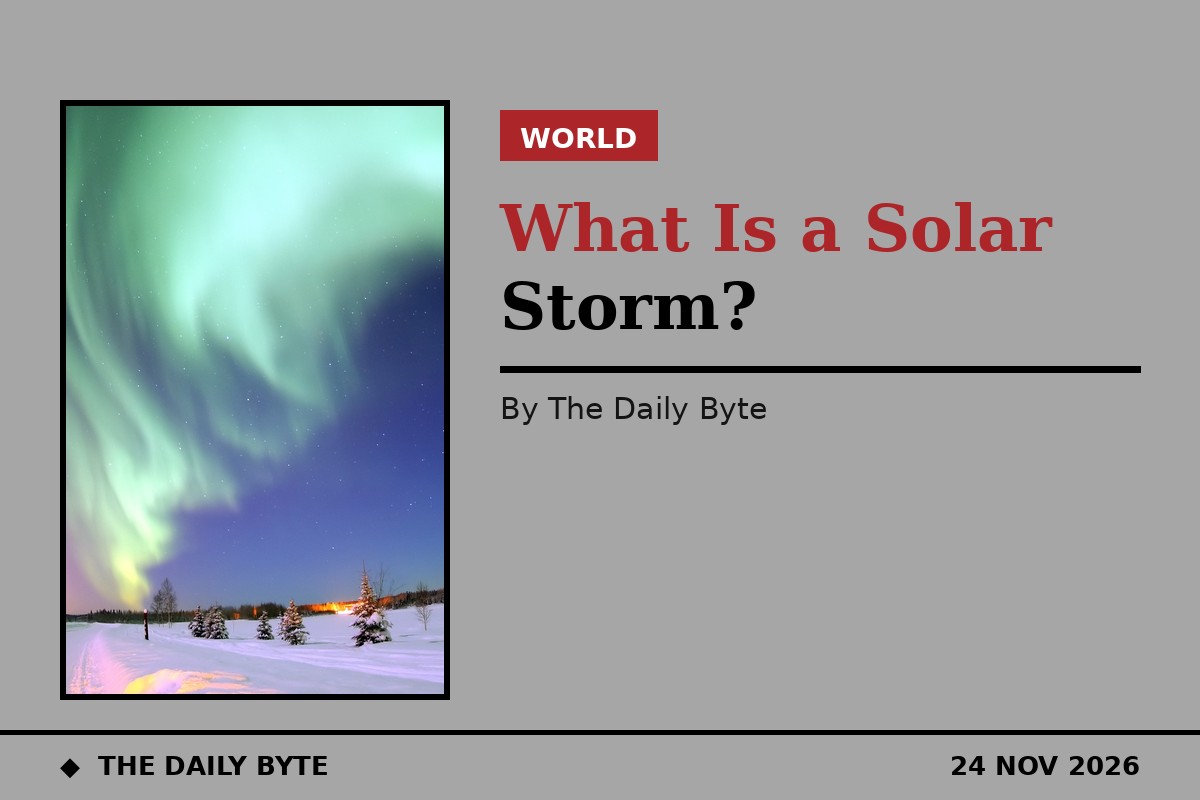
The photograph with this article shows the aurora over Alaska, where the lights are a regular sight in winter. It was taken by a United States Air Force photographer above Bear Lake near Eielson Air Force Base, and it is a reminder of what the storm actually looks like from the ground: not fire in the sky, but slow, green curtains of light moving across the stars. If the forecast for 27 and 28 November proves right, the lights will be brighter and further south than usual on those nights, but they will still be a high-latitude display, and cloud cover, moonlight and light pollution will matter as much as the storm itself.
What is happening on 24 to 28 November 2026
The current situation is a useful example of how space weather forecasting works in practice. On 24 November, conditions were quiet, and NOAA's three-day forecast expected them to stay that way through 26 November, with no G1 or greater storm expected and a maximum Kp of 3.67. That forecast covers only three days, so it says nothing about 27 and 28 November. For those dates, forecasters look further ahead, to the 27-day outlook and to reports from space weather watchers who track coronal holes.
According to a report published on 23 November, a coronal hole had rotated into an Earth-facing position, and forecasters expected the fast solar wind stream it releases to reach Earth around 27 November. NOAA's Space Weather Prediction Center was forecasting G1, minor, geomagnetic storm levels as likely on 27 and 28 November, with the planetary K-index expected to reach around 5 at its peak. The same report noted that NOAA's 27-day outlook, issued on 16 November, showed a largest Kp of 5 on 27 and 28 November, and that SpaceWeather.com had noted on 22 November that solar wind from this coronal hole should arrive around 27 November. Taken together, that is a consistent picture from more than one source: a minor storm is likely at the end of the week, not a severe one, and the main effect for most people will be a better chance of seeing the aurora at high northern latitudes.
It is worth being clear about what that forecast does not say. It does not say that a major storm is coming, or that power cuts are expected, or that the aurora will be visible from London. A G1 storm is the lowest rung of the scale, it happens about 1,700 times per solar cycle, and its listed effects are weak power grid fluctuations and aurora at high latitudes. The forecast could also change. The speed of the solar wind stream, the direction of its magnetic field, and the state of Earth's magnetosphere when it arrives will all decide how strong the disturbance turns out to be, and none of those can be known with certainty days in advance. The honest way to follow it is to check the three-day forecast as the dates approach, rather than treating a week-ahead outlook as a promise.
How to follow a solar storm
The best source for the forecast is NOAA's Space Weather Prediction Center, which publishes a three-day forecast, a 27-day outlook, and alerts when storm conditions are observed or expected. Its three-day forecast is a plain text page that gives the greatest observed Kp over the past 24 hours, the expected Kp for the next three days in three-hour blocks, and the percentage chances of solar radiation storms and radio blackouts. It is updated twice a day, and it is the document that other forecasters, journalists and aurora watchers work from. The centre also publishes its explanation of the G1 to G5 scale, which lists the Kp value, the average frequency per solar cycle, and the main effects at each level.
For the aurora specifically, the useful numbers are Kp and cloud cover. The higher the Kp, the further south the auroral oval extends, and the better the chance of seeing the lights from a given latitude. But Kp is a global average, not a local guarantee, and a high Kp means nothing under a cloudy sky. Aurora forecasts from the Space Weather Prediction Center give a 30-minute view of where the lights are likely to be visible, and they are the best guide on the night itself. The general rule is simple: get away from street lights, look north, give your eyes time to adjust to the dark, and be patient. Cameras often pick up the aurora before the naked eye does, because a long exposure gathers more light than the eye can, so a photograph that looks vivid may have looked faint in person.
What to do during a strong storm
For a G1 or G2 storm, the answer is nothing. Go outside and look at the sky if it is dark and clear. For a G4 or G5 storm, the advice is still modest, but it is worth taking seriously, because that is when infrastructure can be affected. Charge phones and other devices in advance. Keep a battery-powered radio and a torch with spare batteries. Do not rely on satellite navigation alone if you are travelling, and keep a paper map or an offline map on your phone. If you run equipment that depends on GPS timing, such as some industrial or financial systems, follow the guidance of your operator, who will have procedures for space weather events. None of this is emergency preparation for a disaster; it is the same kind of sensible readiness that applies to any severe weather warning.
It is also worth knowing what not to worry about. A solar storm will not give you radiation sickness, it will not make your phone explode, and it will not knock out every satellite at once. The effects are real but bounded, they fall mainly on systems that engineers monitor around the clock, and they are graded on a public scale so that everyone can see how serious a given storm is expected to be. The scale exists precisely so that a G1 forecast does not cause the same alarm as a G5 forecast, and so that a quiet forecast, like the one for 24 to 26 November, can be read for what it is: a statement that nothing is expected to happen.
Why solar storms matter more now than they used to
The Sun has not changed. What has changed is how much of modern life depends on the systems a solar storm can disturb. In 1859, the telegraph was the only electrical network of any size, and the Carrington Event damaged it but left daily life mostly untouched. Today, electricity grids, satellite navigation, aviation, shipping, banking and emergency communications all depend on equipment that sits in, or signals through, the space environment. A severe storm would not end civilisation, but it could disrupt those systems for hours or days, and the cost of that disruption would be measured in billions. That is why governments and grid operators take space weather seriously, why satellites carry shielding and backup systems, and why forecasters publish their outlooks in public.
Solar activity also rises and falls over a roughly 11-year cycle, from solar minimum, when sunspots are few and storms are rare, to solar maximum, when sunspots are many and storms are more frequent. The cycle does not produce storms on a schedule, and a large storm can occur at any point in the cycle, but the odds are higher near maximum. The current cycle, Solar Cycle 25, has been more active than some forecasters expected, which is one reason the May 2024 G5 storm, and the aurora photographs that came with it, attracted so much attention. None of that changes the forecast for this week, which is for a minor storm at most, but it explains why the subject is in the news so often: the Sun is busy, and more people are watching it than ever before.
A solar storm, then, is not a single event but a chain. It begins with magnetic energy on the Sun, travels through space as a cloud of plasma or a fast stream of solar wind, and ends as a disturbance in Earth's magnetic field, measured in Kp, graded from G1 to G5, and seen from the ground as the aurora. Most links in that chain are quiet most of the time. This week is a good example: quiet on 24 November, quiet through 26 November, and a minor disturbance possible on 27 and 28 November. If you live at high latitude and the sky is clear on those nights, look north. You may see the one part of a solar storm that needs no instruments at all.


