What Is a Statutory Declaration in the UK?
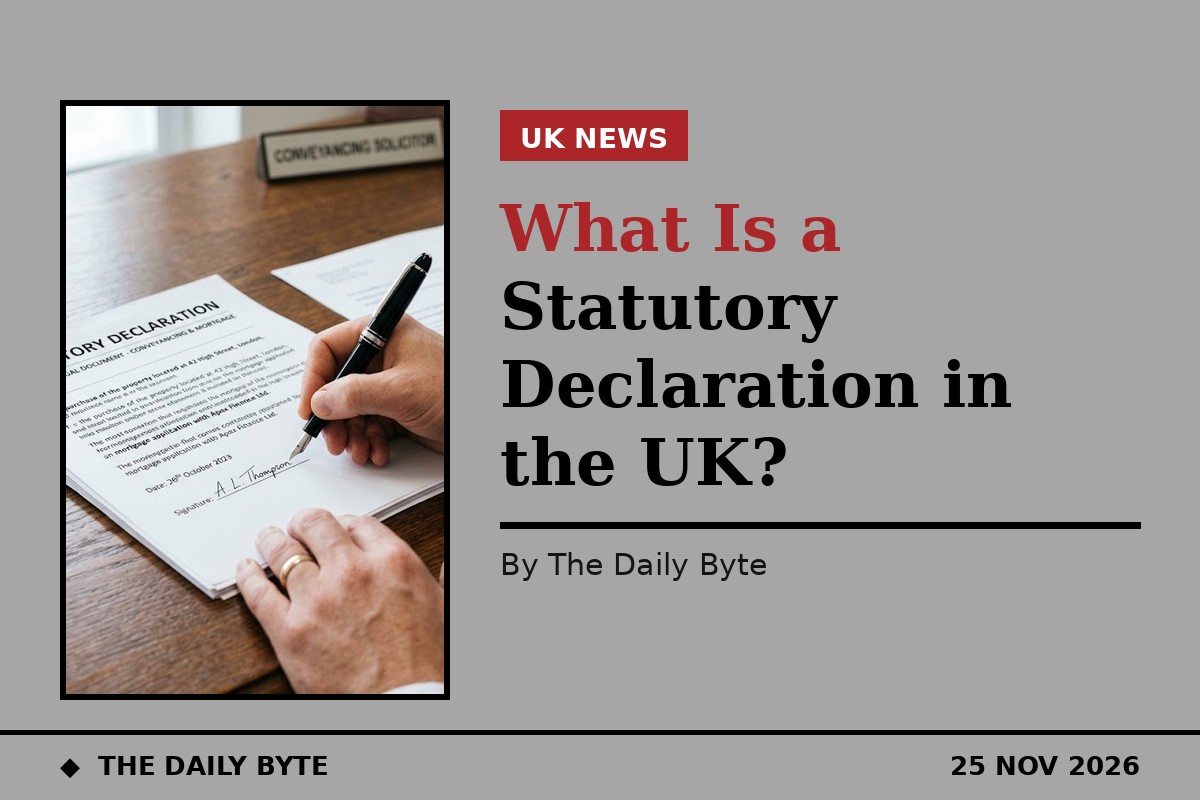
A statutory declaration is a formal written statement of fact that you solemnly declare to be true in front of an authorised witness, such as a solicitor. It is made under the Statutory Declarations Act 1835, and it carries serious legal weight: knowingly making a false statement in a statutory declaration is a criminal offence, punishable by up to two years in prison. It is the document organisations ask for when they need stronger evidence than a simple letter, but a sworn affidavit is not required.
You may come across statutory declarations when changing your name, applying for a Gender Recognition Certificate, dealing with HM Land Registry, challenging a penalty charge notice, or proving a fact where no certificate or official document exists. They are an everyday part of the legal system, and yet most people only discover what one is when an organisation tells them they need one. This guide explains what a statutory declaration is, when you need one, how to make one, who can witness it, and what it costs.
What is a statutory declaration?
A statutory declaration is a written statement in which the person making it — known as the declarant — solemnly declares that the facts in it are true. It is not sworn on a religious text, which is what distinguishes it from an affidavit. Instead, the declarant signs the document in the presence of an authorised person, who then signs and stamps it to confirm that the declaration was made before them.
The declaration must follow a set form. The Statutory Declarations Act 1835 sets out the wording that must be used, and it has barely changed in nearly two hundred years. In substance, the declarant says: "I, [full name], do solemnly and sincerely declare that [the facts]. And I make this solemn declaration conscientiously believing the same to be true, and by virtue of the Statutory Declarations Act 1835."
That wording matters. It is the wording that gives the document its legal force. A letter that says the same facts in ordinary language is not a statutory declaration, however honestly it is written. The declaration must use the statutory form, be signed in front of the right person, and be made voluntarily. Without those elements, it has no special status.
The Act itself was passed in 1835 to cut down the number of oaths people were required to swear. Before then, oaths were demanded for all kinds of routine administrative matters. The 1835 Act abolished many of those oaths and replaced them with a single form of solemn declaration. The same Act, and the same form of words, is still in force across the United Kingdom today.
When do you need a statutory declaration?
You need a statutory declaration when an organisation, a court or a government body asks for formal written evidence of a fact, and no better document exists. Common situations include:
- Changing your name. HM Passport Office accepts a statutory declaration, a deed poll or an affidavit as evidence of a change of name. A statutory declaration is often used where a deed poll is not suitable, or where an organisation specifically asks for one.
- Applying for a Gender Recognition Certificate. Every applicant for a Gender Recognition Certificate must make a statutory declaration as part of the application.
- Property transactions. HM Land Registry, mortgage lenders and conveyancers may ask for a statutory declaration where documents have been lost, where a fact about a property needs to be confirmed, or where a gift of money for a deposit needs to be formally declared.
- Challenging a penalty charge notice. Certain penalty charge notices, including some London bus lane and moving traffic penalties, are challenged at the Traffic Enforcement Centre using a form known as a PE3, which is a statutory declaration.
- Proving a fact where no certificate exists. For example, confirming a period of residence, confirming that a person is single for the purposes of marrying abroad, or confirming a relationship that is not recorded on any certificate.
- Citizenship and immigration applications. The Home Office may ask for a statutory declaration where additional evidence is needed in support of an application.
In many of these cases, the organisation asking for the declaration will provide its own form, or will tell you exactly what the declaration must say. Always check what is required before you start: a declaration in the wrong form may be rejected, and you may have to make a new one.
How do you make a statutory declaration?
Making a statutory declaration is a short, straightforward process, but the order of events matters. There are four steps.
1. Draft the declaration. Write the facts you are declaring in clear, numbered paragraphs. Include your full name, address and occupation. Use the wording required by the Statutory Declarations Act 1835. If the organisation asking for the declaration has provided a form, use it. If the wording is technical — for example, in a property transaction — a solicitor can draft or check it for you, although that will cost more than simply having a pre-drafted declaration witnessed.
2. Find an authorised witness. Contact a solicitor, a commissioner for oaths, a notary public or another authorised person, and arrange an appointment. Many high-street solicitors offer this service, and it usually takes ten to fifteen minutes.
3. Sign the declaration in front of the witness. This is the crucial step: you must not sign the declaration in advance. You must sign it in the witness's presence. The witness will confirm your identity, read the declaration with you, and ask you to declare that its contents are true. Bring photo identification, such as a passport or photocard driving licence, and any documents referred to in the declaration as exhibits.
4. The witness signs and stamps it. The witness signs the declaration, stamps it, and records the date and place, as required by section 5 of the Commissioners for Oaths Act 1889. From that moment, the declaration is a formal legal document.
One important rule: the solicitor acting for you in a transaction cannot witness your statutory declaration in that same matter. Under section 81(2) of the Solicitors Act 1974, you must use an independent solicitor — a different firm — where your own solicitor is acting for you in the purchase, sale or lease. This catches people out in conveyancing, where a lender asks for a declaration and the buyer's own solicitor cannot witness it.
Who can witness a statutory declaration?
In England and Wales, a statutory declaration must be made in front of a person authorised to administer oaths. The main categories are:
| Witness | Notes | |---|---| | Solicitor | Any solicitor with a current practising certificate; most high-street firms offer this | | Commissioner for oaths | A person appointed to administer oaths; many solicitors are also commissioners for oaths | | Notary public | A specialist lawyer who authenticates documents, often for use abroad | | Justice of the Peace | A magistrate; less commonly used for this purpose today | | Certain court officers | Including some officers of the courts |
The witness's job is not to check whether the facts in your declaration are true. They cannot know that. Their job is to confirm your identity, to make sure you understand what you are signing, to ensure you are signing voluntarily, and to record that the declaration was made before them. If you do not understand the declaration, or if it appears you are being pressured into signing it, the witness should not take it.
Outside England and Wales, a statutory declaration can also be made before a British consular officer or another authorised person, which is useful for people who need a declaration while they are abroad. In Scotland and Northern Ireland, the same 1835 Act applies, and declarations can be made before a solicitor, a notary public or a Justice of the Peace.
How much does a statutory declaration cost?
The fee for having a statutory declaration witnessed is fixed by law — and it is remarkably small. Under the Commissioners for Oaths (Fees) Order 1993, a commissioner for oaths must charge £5 for taking an affidavit, declaration or affirmation, for each person making it, and £2 for each exhibit referred to in the declaration and required to be marked. Those fees are inclusive of VAT where payable, and they have not changed since 1993.
That £5 is the statutory fee for the witnessing alone, where you arrive with a declaration already drafted. In practice, the total cost is often higher. If a solicitor drafts the declaration for you, checks the wording, or gives advice, they will charge for that work separately. Notaries are not subject to the £5 cap in the same way, and firms offering online video witnessing or same-day services charge their own fees, which can run to £100 or more. The £5 figure is the legal minimum for the witnessing act itself — not a cap on everything a firm might do around it.
It is worth knowing the £5 figure, because it tells you what the witnessing alone should cost at a high-street solicitor. If you are quoted a much higher fee for a simple witnessing of a declaration you have already drafted, ask what the extra charge covers. Some firms no longer accept walk-in non-clients for witnessing without opening a client file, which is one reason people are sometimes charged more than the statutory fee.
Statutory declaration vs affidavit vs witness statement
Statutory declarations are often confused with two similar documents. The differences matter, because using the wrong one can mean your evidence is rejected.
| Statutory declaration | Affidavit | Witness statement | |
|---|---|---|---|
| How it is made | Solemnly declared before an authorised witness | Sworn on oath, usually on a religious text, before an authorised witness | Signed with a statement of truth; no witness needed |
| Legal basis | Statutory Declarations Act 1835 | Oaths Act 1978 and court rules | Civil Procedure Rules, Part 32 |
| Where it is used | Administrative and non-court matters: passports, Land Registry, penalty notices | Court proceedings and formal legal matters | Civil and tribunal proceedings |
| False statement | Criminal offence under section 5 of the Perjury Act 1911 | Perjury, a criminal offence | Contempt of court |
The practical rule is simple: use the document the organisation or the court asks for. If a body asks for a statutory declaration, an affidavit will not do, and a witness statement will not do either. If a court asks for a witness statement, a statutory declaration is the wrong document. Where no specific document is requested, a statutory declaration is the right choice when an organisation needs formal, witnessed evidence of a fact outside court proceedings.
What happens if you lie in a statutory declaration?
Knowingly making a false statement in a statutory declaration is a criminal offence under section 5 of the Perjury Act 1911. The maximum penalty is two years' imprisonment, a fine, or both. That is the same level of seriousness as lying under oath in court, and it is the reason organisations treat statutory declarations as reliable evidence.
The offence requires the statement to be wilfully false — that is, the declarant must know the statement is untrue, or must make it not caring whether it is true or false. An honest mistake is not perjury, although it can still cause serious practical problems: a declaration containing a wrong fact may be rejected, a transaction may fall through, or an application may be refused. That is why it is important to check every fact in the declaration before signing it, and to correct anything you are unsure about rather than guessing.
It is also worth remembering that a statutory declaration does not prove that the facts in it are true. It proves that a named person solemnly declared them to be true, in front of a witness, on a particular date. The organisation receiving it may still check the facts, ask for supporting documents, or reject the declaration if it does not believe it. The declaration adds weight to your word; it does not replace evidence.
Does a statutory declaration expire?
There is no general expiry date for a statutory declaration. A declaration made correctly remains a valid record that the declarant made those statements on that date. But organisations often want a recent one. A bank, a lender or a government department may ask for a declaration made within the last few months, or may reject an old declaration and ask for a fresh one, particularly where the facts it records could have changed — for example, a declaration about marital status, residence or solvency. If you are asked for a declaration, check whether the organisation has a time limit, and make a new one if the old one is out of date for their purposes.
Frequently asked questions
Can I write my own statutory declaration? Yes. You can draft the declaration yourself, using the wording required by the Statutory Declarations Act 1835, and then take it to a solicitor, commissioner for oaths, notary public or Justice of the Peace to have it witnessed. The statutory fee for the witnessing alone is £5 per person, plus £2 per exhibit.
Is a statutory declaration the same as a deed poll? No, although both can be used to evidence a change of name. A deed poll is a legal document in which you declare that you are abandoning your old name and will use a new name for all purposes. A statutory declaration is a sworn statement of fact that can be used for many purposes, including name changes. HM Passport Office accepts either as evidence of a name change.
Do I need a solicitor to make a statutory declaration? You need an authorised witness, and a solicitor is the most common choice. You do not need a solicitor to draft the declaration — you can draft it yourself — but a solicitor can draft or check the wording if it is technical, for example in a property transaction.
Can my own solicitor witness my statutory declaration? Not where your solicitor is acting for you in the same matter. Under section 81(2) of the Solicitors Act 1974, the solicitor acting in your purchase, sale or lease cannot witness your declaration in that transaction. You must use an independent solicitor.
What happens if I sign the declaration before I see the witness? The declaration will not be valid. You must sign it in the witness's presence, so that the witness can confirm your identity and that you signed it voluntarily. If you have already signed it, the witness will ask you to sign a fresh copy in front of them.
Can I make a statutory declaration outside the UK? Yes. A statutory declaration can be made before a British consular officer or another authorised person outside the UK. Check with the organisation that needs the declaration whether it will accept one made abroad, and in what form.