What Is a Stock Market Correction? Explained
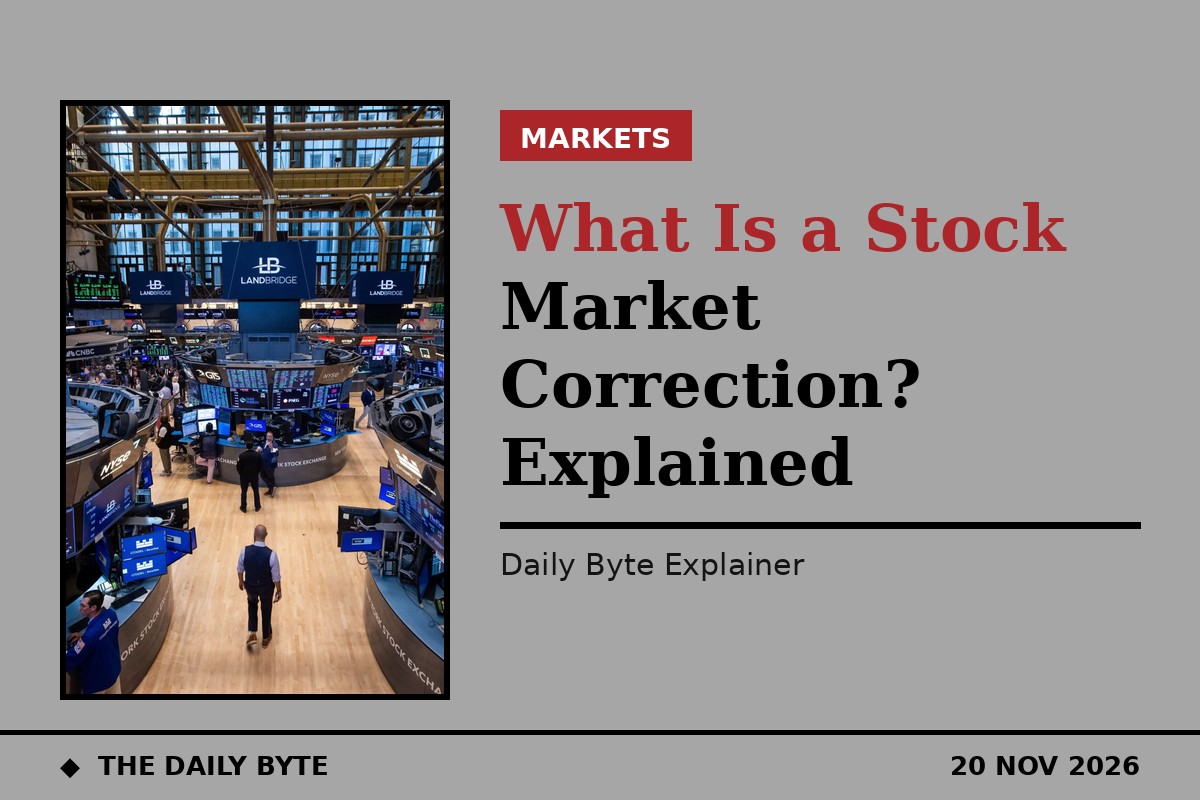
A stock market correction is a fall of at least 10% in a share, an index or another asset from its recent high, but less than 20%. It is the market's own word for a meaningful pullback: big enough to notice and to make headlines, but not so deep that it counts as a bear market. Corrections are a normal part of how stock markets work, and they have happened many times before, which is why investors search for this explanation every time share prices slide.
The reason the question is being asked so much in November 2026 is the sharp sell-off in chip and technology shares. The Nasdaq Composite entered correction territory on 5 November 2026, falling more than 10% below its record from the previous month, according to CNBC, and Nvidia, the world's best-known chipmaker, has fallen roughly 30% from its October high, according to the Motley Fool. Understanding what a correction is, and what it is not, is the first step to reading those headlines without panic.
What counts as a correction?
The definition is simple and numerical. A correction is a decline of 10% or more from a recent peak, as explained by Investopedia and the Wall Street Journal. It does not have to happen in a single trading session: losses can pile up over days, weeks or even months. What matters is how far the price has fallen from its recent high, not how fast it fell on any one day.
That 10% line is what separates a correction from an ordinary dip, which is a brief downturn inside a longer upward trend, and from a bear market, which begins when an asset falls more than 20% from its most recent high. A crash is different again: it is a sudden and very sharp drop in share prices, often on a single day or within a week. A correction can become a bear market if losses reach 20%, and it can include sharp single-day falls, but a single bad day on its own does not make a correction.
The distinction matters because the labels describe different things. A dip is routine noise. A correction is a recognised event that can last weeks or months. A bear market is a long, sustained decline. And a crash describes speed, not depth. As the Motley Fool puts it, you will not know a fall is a correction rather than the start of a bear market until it is officially over, because the label only becomes certain in hindsight.
Why do stock market corrections happen?
At the most basic level, a correction happens because investors are more motivated to sell than to buy. Hargreaves Lansdown puts it plainly: a market falls when there are more investors selling shares than buying them, lowering market demand. The deeper question is what changes investors' minds, and the answers are usually one or more of a familiar set of causes.
A slowing or shrinking economy is the most fundamental cause. If the economy is slowing or entering a recession, or investors expect it to slow, companies will earn less, so investors bid their shares down. Rising inflation has typically been bad news for the stock market, because higher costs for companies can eat into profits. Interest rates matter too: generally speaking, interest rates and shares have tended to move in opposite directions, because higher rates make borrowing more expensive for companies and make safer assets such as government bonds more attractive.
Investor sentiment plays a large part as well. During a long bull market, optimism and risk-taking can push prices above what company earnings justify, and a correction can simply be the market returning to more realistic levels. Fear works the other way: if investors think the market is going to fall, they stop buying, and sellers have to lower their prices to find takers. External shocks, such as a pandemic, a war or a political upset, can trigger the same reaction.
The November 2026 sell-off shows how several of these forces combine. On 5 November, chip stocks fell sharply after Democrats won both chambers of the US Congress, and investors feared a slower data-centre buildout, according to reports of the day. Nvidia fell about 9% that day, while AMD fell about 17% and Micron about 15%. The shares had already been sliding for a month: from 7 October to 5 November, Nvidia lost 23.5%, against a 5.7% fall for the S&P 500, according to Trefis. Doubts about whether huge spending on artificial intelligence would pay off, and the unexpected departure of Nvidia's chief executive Jensen Huang, added to the pressure, and by 16 November the shares were down roughly 30% from their October peak.
How long do corrections last?
Historically, corrections generally last around four months on average, according to NerdWallet, and a 2018 report from CNBC and Goldman Sachs cited by Investopedia found the average S&P 500 correction lasted only four months, with values falling around 13% before recovering. Some are much shorter, lasting weeks; others drag on for many months. Corrections are more common than many investors realise: there were 17 corrections in the S&P 500 between 1980 and 2020, according to Seeking Alpha.
That history is why many commentators describe corrections as a normal part of the market cycle rather than a sign that something is broken. Prices do not rise in a straight line, and a fall of 10% or more is the market's way of repricing risk. But averages hide a wide range of outcomes, and a correction that starts at 10% can deepen into a bear market, so no one can promise in advance how long a particular fall will last or how far it will go.
What does a correction mean for ordinary investors?
For people who hold shares or a pension invested in the stock market, a correction means the value of those investments has fallen, at least on paper. A fall of 10% turns £10,000 into £9,000, and a fall of 30%, such as Nvidia's slide from its October high, turns £10,000 into £7,000. It is also worth remembering the maths of recovery: if a share price falls by 30%, it needs an increase of more than 30% to get back to where it started, because the rise is measured from a lower base.
That is why the standard advice from investment guides is to avoid panic selling. Selling during a correction locks in the loss, while holding through it has historically meant waiting for a recovery, although past performance is no guarantee of future results and no investment is risk-free. Some investors see lower prices as a chance to buy, but that only works if the company or index recovers, and nobody can reliably predict the bottom. The practical steps most guides suggest are unglamorous: check that your investments are spread across different types of assets rather than concentrated in one company or sector, avoid borrowing to invest, and do not make decisions based on a single day's headlines.
This article is general information, not financial advice. Anyone making investment decisions should consider their own circumstances and, if needed, speak to a regulated financial adviser.
Correction, crash, dip and bear market: the difference
A dip is a brief downturn from a sustained longer-term uptrend, often only a few percent. A correction is a fall of at least 10%, but less than 20%, from a recent high. A bear market is a long, sustained decline of at least 20% from the market's most recent high. A crash is a sudden, very sharp drop, often on a single day or within a week, and it describes speed rather than a fixed percentage.
So the Nasdaq's fall of more than 10% from its October record on 5 November 2026 was a correction by definition, while Nvidia's roughly 30% fall from its October high is beyond correction territory for that single share, even though the wider market has not fallen that far. The two numbers describe different things: one share can fall much further than the market as a whole, and a single company can be in a bear market while the index is only correcting.
Frequently asked questions
What is a stock market correction? A fall of at least 10%, but less than 20%, in a share or an index from its recent high. It can build up over days, weeks or months.
Is a correction the same as a crash? No. A crash is a sudden, very sharp drop, often in a day or a week. A correction is defined by how far prices have fallen from their peak, not how fast they fell.
How long does a correction last? Historically, the average S&P 500 correction lasted about four months, with values falling around 13% before recovering, according to a 2018 CNBC and Goldman Sachs report. Some last weeks, others much longer.
Should I sell my shares during a correction? There is no single right answer, and this article is not financial advice. Selling locks in the loss, while holding has historically meant waiting for a recovery, but no recovery is guaranteed. Many guides suggest reviewing whether your investments are sensibly spread rather than reacting to one day's news.
How often do corrections happen? Often. There were 17 corrections in the S&P 500 between 1980 and 2020, so investors should expect them as a regular part of market life rather than a rare event.
Sources: Investopedia, market correction definition; Hargreaves Lansdown, market correction; Wall Street Journal, what is a market correction; Motley Fool, Nvidia down 32%, 16 November 2026.