What Is a Supermoon?
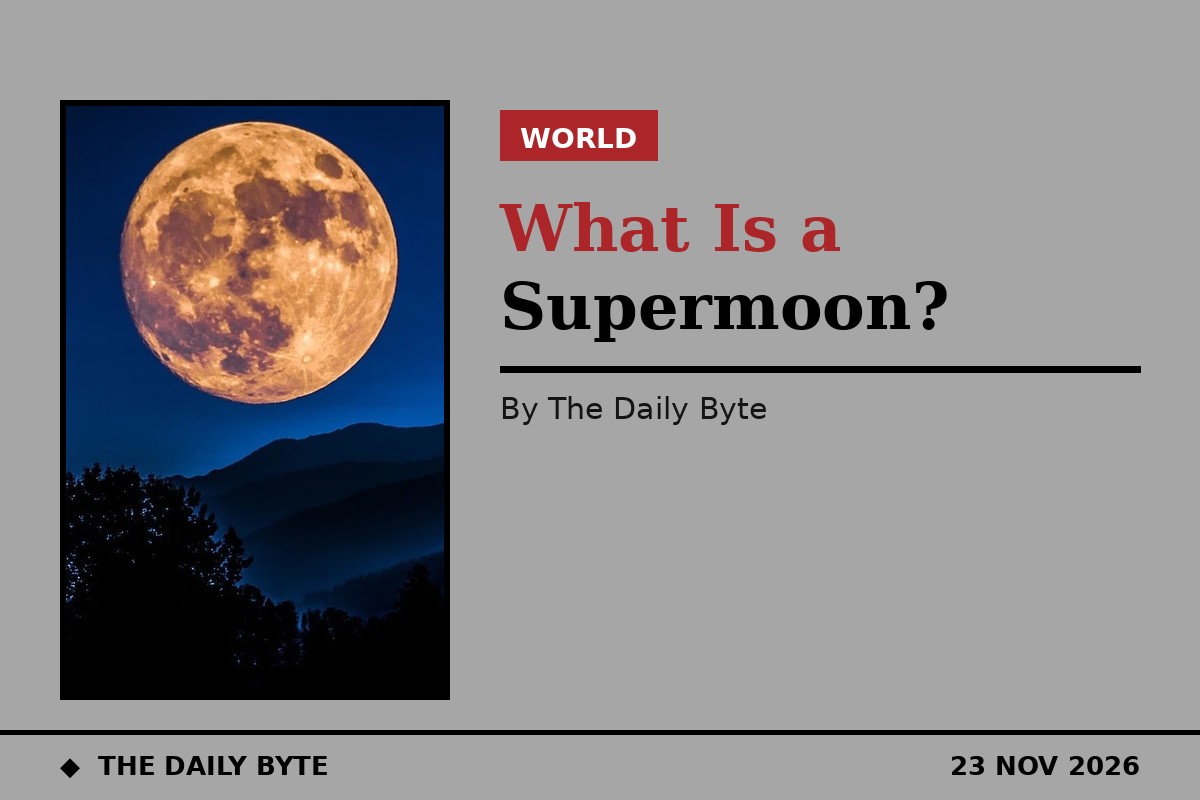
A supermoon is a full Moon that appears bigger and brighter than usual because the Moon is at, or very near, the closest point in its orbit to the Earth. It is not a different kind of Moon, and it is not a trick of the light: the Moon really is closer to us than it is on an average night, so it genuinely looks larger in the sky.
The question is being asked again today, Monday 23 November 2026, because the next supermoon is almost here. The November full Moon, known as the Beaver Moon, reaches its peak at 14:54 UTC on Tuesday 24 November, and it is the first of three supermoons in a row: December's Cold Moon follows on 24 December, and January's Wolf Moon on 22 January 2027. The December one will be the closest full Moon of the whole year, about 356,700 kilometres away. If you have looked up at a full Moon recently and thought it seemed unusually large, you were probably right, and this week is the time to look again.
The short answer
NASA's definition is straightforward: a supermoon occurs when a full Moon coincides with the Moon's closest approach to Earth in its elliptical orbit, a point known as perigee. The Moon does not orbit the Earth in a perfect circle. It travels on an ellipse, so during every orbit it drifts closer to us and then further away. When the moment of full Moon lines up with the close part of that orbit, we get a supermoon.
The effect is real but modest. At its closest, a full Moon can appear up to 14 percent bigger and 30 percent brighter than the faintest full Moon of the year, which is the one that falls when the Moon is furthest away. That is the figure NASA gives, and the Royal Observatory Greenwich in London gives the same one. Against an average full Moon the difference is smaller, about 7 percent bigger, which is why many people notice a supermoon without being able to say exactly what is different about it.
Why the Moon's distance changes
The Moon takes about 27.3 days to complete one orbit of the Earth, and on that journey it passes through two extremes. Its closest point, perigee, is on average about 363,300 kilometres from Earth, and its furthest point, apogee, is on average about 405,500 kilometres away. The gap between the two is more than 40,000 kilometres, which is wider than three Earths placed side by side.
The exact distances vary from month to month, because the Moon's orbit wobbles and is pulled around by the gravity of the Sun and the Earth. Some perigees are closer than others, which is why some supermoons are more super than others. The full Moon on 24 December 2026 will be about 356,700 kilometres away at the moment it is full, and perigee follows about seven hours later at roughly 356,650 kilometres, one of the closest approaches of the year. The Beaver Moon on 24 November is further out, at around 361,000 kilometres, which is why December's will look slightly larger still.
Full Moons can fall anywhere along the Moon's path, so most of them are neither especially close nor especially far. Only when the timing lines up do we get a supermoon, and that is why they happen only three or four times a year.
What actually counts as a supermoon?
Here is a surprise: supermoon is not an official astronomical term. The word was coined in 1979 by an astrologer, Richard Nolle, and astronomers adopted it later because the public liked it. Because it began as an astrological label rather than a scientific one, there is no single agreed definition of how close the Moon has to be.
The definition most often used, by NASA and the Royal Observatory Greenwich, is that a full Moon counts as a supermoon if it falls within 10 percent of its closest distance to Earth, in other words within 90 percent of perigee. Some astronomers prefer a stricter rule, counting only full Moons that come within about 360,000 kilometres. Under either definition, the full Moons of November and December 2026 qualify comfortably.
The more technical name is perigee syzygy. Syzygy is the alignment of three celestial bodies, in this case the Sun, the Moon and the Earth in a straight line, which is what a full Moon is. A supermoon is therefore a full Moon that happens at perigee, and the opposite, a full Moon at apogee, is called a micromoon. The smallest full Moon of 2026 was the Blue Moon on 31 May, about 406,100 kilometres away, and against that Moon the Christmas Eve supermoon will look about 14 percent wider and about 30 percent brighter.
Why supermoons come in runs
Supermoons rarely arrive alone. Because the Moon's perigee shifts only slowly, if one full Moon falls near perigee, the next one probably will too. That is why they appear in groups of three or four consecutive months, and why the end of 2026 brings three in a row: the Beaver Moon on 24 November, the Cold Moon on 24 December, and the Wolf Moon on 22 January 2027.
The pattern is set by two cycles running together. The Moon goes around the Earth roughly every 27.3 days, while the full Moon cycle, from one full Moon to the next, takes about 29.5 days. The two cycles drift in and out of step, so perigee and full Moon coincide for a few months, then drift apart again. For most of the year, perigee falls on some other phase of the Moon, and nobody notices it at all.
Why it is called the Beaver Moon
Full Moons have traditional names, and the November one is the Beaver Moon. The names come from lists popularised by the Old Farmer's Almanac in North America, drawing on Native American and colonial traditions. November was the month when beavers finished building their dams and lodges before the water froze, and when trappers set their traps for the winter fur harvest.
The November Moon is also sometimes called the Frost Moon, for the first hard frosts of the year. December's full Moon is the Cold Moon, named for the arrival of deep winter, and it is also called the Long Night Moon, because it falls near the winter solstice, when the nights are longest and the full Moon stays up longer than any other in the year. January's is the Wolf Moon, supposedly for the wolves heard howling in the coldest part of winter. The names are folklore rather than astronomy, but they are the reason the November supermoon is talked about as the Beaver Moon rather than simply the November full Moon.
The Christmas Eve supermoon
The most impressive of the three is still to come. December's full Moon reaches its peak at 01:28 UTC on Thursday 24 December 2026, Christmas Eve, and it is the closest full Moon of the year and the last supermoon of 2026. It will also be the highest full Moon of the year in the northern hemisphere: because the Sun sits at its lowest near the solstice, the full Moon, which always rides opposite the Sun, climbs higher in the sky and stays up for around 15 hours at mid-northern latitudes.
For readers in Britain, the night to plan around is Wednesday 23 December, when the Moon is already up by mid-afternoon and looks completely full, and it will still look full on Christmas Eve itself. The winter solstice falls on Monday 21 December, so the Cold Moon shines during some of the longest, darkest nights of the year, just two nights after the shortest day. The Geminid meteor shower, one of the best of the year, peaks on the nights of 13 and 14 December, so the run-up to Christmas offers two sky events in a fortnight.
How big will it really look?
Honest answer: bigger, but not dramatically. A supermoon is about 7 percent wider than an average full Moon, which is a difference most people would not pick out if the two were not side by side. The reason supermoons so often look enormous in photographs and in memory is the Moon illusion: when the Moon is low on the horizon, near buildings, trees or hills, the brain judges it against those familiar objects and perceives it as much larger than it looks high in an empty sky.
That gives a practical tip. The best time to look is at moonrise, when the Moon is just clearing the horizon, low, orange and apparently huge, with something in the foreground to set it against. For the Beaver Moon on 24 November, the Moon is full during the afternoon in Britain, so it will already be up as darkness falls, and the evenings of 23 and 24 November are both worth a look. No telescope or equipment is needed: a supermoon is best appreciated with the naked eye, from somewhere with a clear view of the horizon, away from street lights if you can manage it. Photographers should include a landmark or skyline in the frame, because a lone Moon against a black sky gives the camera nothing to measure it by.
Do supermoons affect tides, or anything else?
Supermoons do have one measurable effect on Earth: the tides. The Moon's gravity is the main force behind the tides, and when the Moon is closer, its pull is slightly stronger. A supermoon that coincides with a new or full Moon produces what are called perigean spring tides, which are a little higher than usual. In most places the difference is a few centimetres, noticeable to tide tables but not to anyone standing on a beach.
What supermoons do not do is cause earthquakes, volcanic eruptions, floods or other disasters. That claim circulates on social media every time a supermoon approaches, but NASA and seismologists point out that the extra gravitational pull is tiny, far smaller than the normal variation in tides, and there is no evidence of any link to earthquakes or extreme weather. Nor is there any scientific evidence that a supermoon affects people's mood, sleep or behaviour, beyond the fact that a bright Moon can make a bedroom lighter and disturb sleep if the curtains are thin.
There is one more thing a supermoon cannot do: it cannot be seen everywhere at once in the same way. The Moon is full at the same instant worldwide, 14:54 UTC on 24 November, but whether that falls in daylight or darkness depends on where you are. In Pakistan the full Moon falls at 19:54 local time on Tuesday evening, just after sunset, which is an ideal time to see it rising. In Britain it falls in the afternoon, so the finest views come at moonrise on the evenings either side.
How to watch the Beaver Moon
Seeing a supermoon needs no planning beyond knowing when to look up. The Beaver Moon is full on Tuesday 24 November 2026, and it will look full on the nights of Monday 23 and Tuesday 24 November. Find a spot with a clear eastern horizon, give your eyes a few minutes to adjust, and watch it rise. If the sky is cloudy, the Moon will still be nearly full the following night.
For many people this will be the first of three chances: the same trick of the calendar repeats on 24 December, when the Cold Moon will be the closest and highest full Moon of the year, and again on 22 January 2027, when the Wolf Moon closes the run. A full Moon that is a little closer than usual is a small thing, but it is also one of the few astronomical events that asks nothing of the watcher: no telescope, no ticket, no dark-sky reserve, just a clear sky and a few minutes outside after dark.
Sources: NASA Science, "Supermoons"; Royal Observatory Greenwich, "What is a supermoon?"; Smithsonian Magazine, "Look Up This Week to See November's Full Beaver Moon", 23 November 2026; CNN, "A stunning supermoon peaks this week", 23 November 2026.


