What Is a T Level? Explained
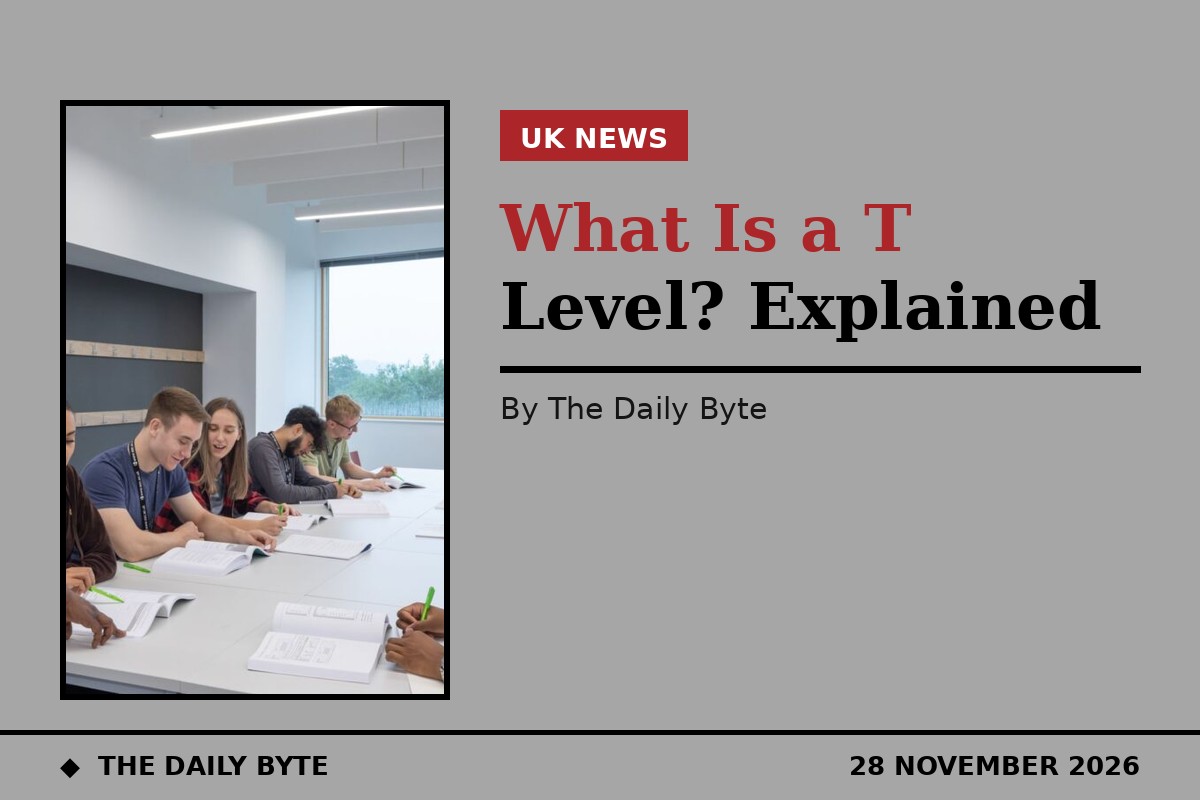
A T Level is a two-year technical qualification for 16 to 19-year-olds in England, taken after GCSEs as an alternative to A levels or an apprenticeship. One T Level is broadly equivalent in size to three A levels, but it is built around a single career area and includes a substantial industry placement with a real employer. T Levels started in September 2020, and there are now 21 T Levels available from schools and colleges across England. This guide explains who they are for, how they work, how they are graded, and what they can lead to.
Who are T Levels for?
T Levels are for students who have finished their GCSEs, know broadly which career area interests them, and would rather learn through a mix of classroom study and real workplace experience than through purely academic study. They are the main technical route for students who want a single large qualification, alongside apprenticeships for students who want to learn a specific occupation on the job and A levels for students who want to continue academic education. T Levels are available in England only. They are designed by employers and education providers working together, and approved by Skills England, so that what students learn matches what industry needs.
How is a T Level structured?
Every T Level has two mandatory parts: a technical qualification and an industry placement. The technical qualification has a core component, which teaches the knowledge and skills that apply across the occupations in that area, and an occupational specialism, which goes deeper into one occupation. Students spend around 80 per cent of their time in a learning environment and 20 per cent on placement. The government expects the typical course to involve between 1,100 and 1,300 classroom hours across the two years, plus the industry placement of at least 315 hours. Students also work towards attaining maths and English if they have not already achieved grade 4 at GCSE, as students do on other 16 to 19 programmes, but they are not required to achieve a grade 4 or a level 2 functional skills pass in order to pass their T Level.
What is the industry placement?
The industry placement is what sets T Levels apart from other classroom qualifications. Every student spends at least 315 hours, roughly 45 days, with an employer, focused on developing the practical and technical skills the occupation requires. Placements can last longer than the minimum, and can be taken as a block or spread across the course, often one or two days a week. The placement is part of the course, not a job, so there is no wage, unlike an apprenticeship, where a student is employed and typically spends 80 per cent of their time on the job and 20 per cent in the classroom. For T Level students, the placement is where classroom learning is tested against real work, and it is often where students make the contacts that lead to their first job.
How are T Levels graded?
T Levels are graded Pass, Merit, Distinction or Distinction*. The overall grade carries UCAS tariff points, which is how universities compare qualifications when they make offers. A Distinction* is worth 168 points, the same as three A levels at A*, a Distinction is worth 144 points, the same as three A levels at A, a Merit is worth 120 points, the same as three Bs, and a Pass is worth 96 points if the student scored C or above on the core, or 72 points if they scored D or E on the core. The points are awarded for the overall T Level grade. According to Prospects, 198 higher education institutions in England accepted T Levels for entry onto at least one of their courses as of July 2026, so a T Level can be a genuine route to university as well as to work.
What can you do after a T Level?
A T Level can lead to skilled employment, an apprenticeship, further technical study, or higher education. The 21 T Levels cover broad career areas, and the government's introduction uses education and early years as its example, where the core content includes safeguarding, health and safety and wellbeing. Because employers helped design the courses, the skills students leave with are the ones businesses say they need, which is why T Levels are presented as a head start into a career rather than simply another exam. Students who want to specialise further can move on to a higher apprenticeship, and students who want to study at a higher level can use their UCAS points to apply to university.
How is a T Level different from A levels, BTECs and apprenticeships?
The choice comes down to how you like to learn and what you want to do next. A levels are academic qualifications, usually three separate subjects studied in the classroom, and are the traditional route to university. An apprenticeship is a paid job with training: you are employed from day one, spend most of your time at work, and learn a specific occupation. A T Level sits between the two. Like A levels, it is mainly classroom-based, but like an apprenticeship it is built around one occupation and includes real experience with an employer. BTECs are another technical option, but a T Level is a single large qualification, roughly the size of three A levels, with a compulsory industry placement of at least 45 days built in. Students who want to earn a wage straight away are usually better suited to an apprenticeship; students who want a technical qualification with real workplace experience, while keeping the university door open, are the audience T Levels were made for.
How many T Levels are there and what subjects do they cover?
There are 21 T Levels available, covering broad career areas across the economy. The first T Levels launched in September 2020, and the range has grown since then. Each T Level is built around an occupational area, with a core that covers the knowledge common to that area and a specialism that focuses on one occupation within it. The government's guide for teachers notes that every T Level includes an industry placement of at least 45 days, and that the courses carry longer teaching hours than most current technical qualifications. Not every school or college offers every T Level, so students need to check which courses are available from providers near them. The government publishes a list of providers offering T Level courses, and colleges and schools advertise the T Levels they deliver.
How do you apply for a T Level?
You apply through the school or college that offers the T Level you want to study, in the same way you would apply for A levels or other post-16 courses. Entry requirements vary by provider and by subject, and providers will set out the GCSE grades they expect. Because T Levels are still relatively new compared with A levels, they are not offered in every subject area or by every provider, so it is worth checking availability early and having a back-up option. If you are unsure whether a T Level, an apprenticeship or A levels fit you best, your school's careers adviser can talk through the options, and the government's T Levels website carries information for students, parents and teachers.
Frequently asked questions
Are T Levels only available in England?
Yes. T Levels are an England-only qualification, offered by selected colleges, schools and other providers across England.
Do T Levels count for university?
Yes. T Levels carry UCAS tariff points, with a Distinction* worth 168 points, the same as three A levels at A*. As of July 2026, 198 higher education institutions in England accepted T Levels for entry onto at least one of their courses, but you should always check the entry requirements of the specific course you want.
Do you get paid on a T Level?
No. The industry placement is part of the course, not employment, so there is no wage. If earning a wage while you learn matters to you, an apprenticeship is the better option.
What if I did not get grade 4 in GCSE maths and English?
You will work towards attaining maths and English alongside your T Level, as students do on other 16 to 19 programmes, but you are not required to achieve a grade 4 or a level 2 functional skills pass in order to pass your T Level.
How long does a T Level take?
Two years, full-time. That includes roughly 1,100 to 1,300 classroom hours plus an industry placement of at least 315 hours, about 45 days, with an employer.


