What Is a Tail Strike? BA431 Heathrow Explained
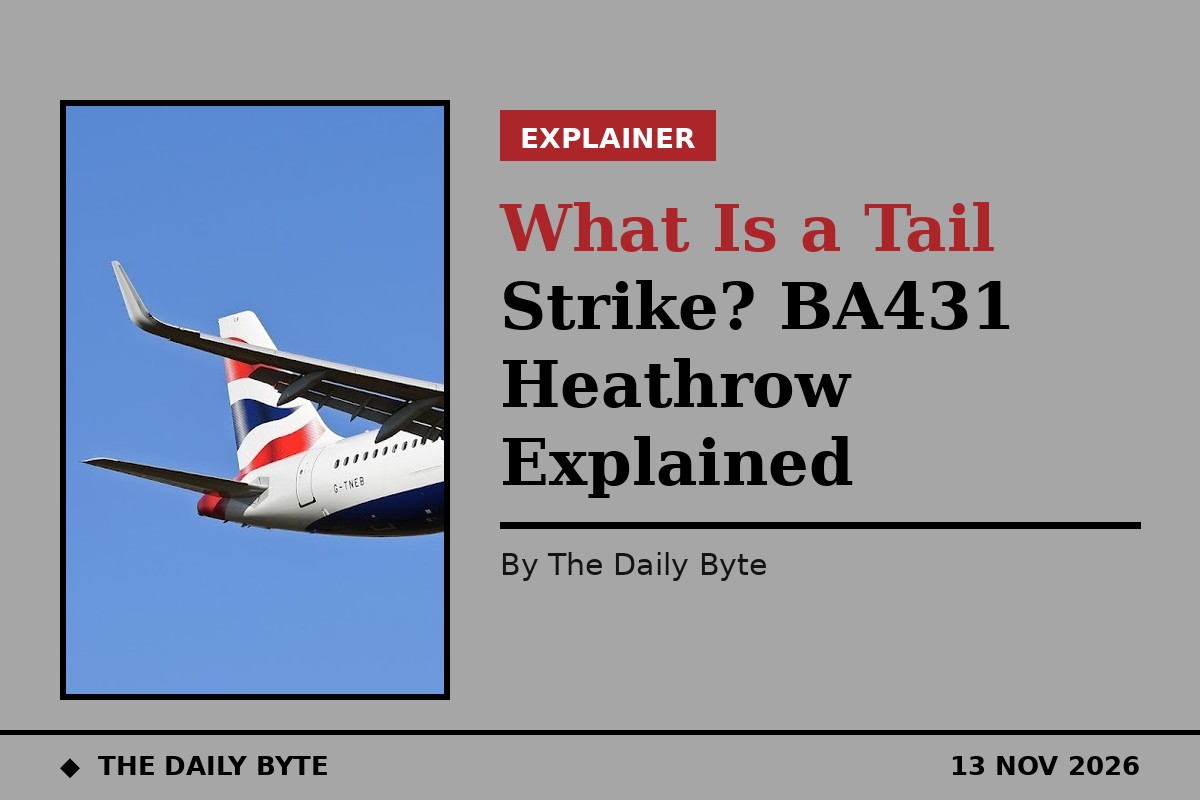
A tail strike is when the rear underside of an aeroplane touches the runway during take-off or landing, usually because the nose is pitched up too steeply. That is what happened to British Airways flight BA431 on Thursday 12 November 2026: the Airbus A321neo struck its tail on the runway twice as it tried to land at London Heathrow, the crew abandoned the landing and climbed away, and the aircraft landed safely on its second attempt. No injuries were reported, and the UK’s Air Accidents Investigation Branch (AAIB) is investigating.
The incident was caught on camera by the aviation livestream Big Jet TV, and the footage spread quickly online — which is why so many people are now asking what a tail strike is, how dangerous it is, and whether the aeroplane can fly again. This explainer answers those questions, explains why the stretched A321neo is more vulnerable than most airliners, and sets out what investigators will look at next.
What happened to BA431 at Heathrow?
British Airways flight BA431 was operating from Amsterdam Schiphol to London Heathrow on the morning of Thursday 12 November 2026. The aircraft was an Airbus A321neo registered G-TNEB, a single-aisle jet that can carry about 200 passengers. Flight-tracking data shows the aircraft left Amsterdam at 10.45am local time and made its first landing attempt at Heathrow at about 10.35am UK time, on runway 27L.
As the aircraft touched down, its tail struck the runway — not once, but twice. The pilots aborted the landing, performed a go-around, climbing away from the runway, and landed safely on their second attempt at about 10.50am. Passengers left the aircraft normally. British Airways said: “The aircraft landed safely, and we’re assisting the AAIB with its investigation and are legally unable to comment further at this stage.” The AAIB, which investigates civil aircraft accidents and serious incidents in the UK, was informed the same day.
The aircraft has been taken out of service for inspection and maintenance checks, and was tentatively scheduled to return to service on Saturday 14 November, depending on the extent of any damage found. That is standard practice after a tail strike: the aeroplane does not fly again until engineers have inspected the rear fuselage and confirmed it is safe.
What is a tail strike?
A tail strike happens when the tail, or more precisely the lower rear fuselage, of an aeroplane makes contact with the runway surface. It can happen on take-off, when the pilot rotates — raises the nose — too early or too sharply, and it can happen on landing, when the nose is flared up too much just before touchdown, or when the aircraft bounces and the pilot pulls back too hard during a go-around. In each case the geometry is the same: the aeroplane’s pitch angle, the angle of its nose relative to the horizon, exceeds the clearance available between the tail and the ground.
Modern airliners are designed with this risk in mind. The rear fuselage has a reinforced structure and, on many types, a tail skid or bumper that is meant to take the first contact. But a tail strike is never treated as trivial. The rear pressure bulkhead — the domed wall at the back of the pressurised cabin — sits close to the area that can be damaged, and any damage there must be found and repaired properly. Aviation history contains a grim reminder of why: a faulty repair to a tail-strike-damaged rear pressure bulkhead was a central factor in the Japan Airlines Flight 123 disaster in 1985, in which 520 people died. That accident is the reason regulators and airlines are so strict about inspecting and repairing tail-strike damage today.
Why is the Airbus A321neo especially vulnerable?
The A321neo is the longest version of Airbus’s single-aisle A320 family, at 44.51 metres long, and that extra length is the problem. The longer the fuselage behind the main landing gear, the less the nose can be raised before the tail touches the ground. According to an investigation report by Ireland’s Air Accident Investigation Unit (AAIU) into a Turkish Airlines A321neo tail strike at Dublin in October 2024, a tail strike will occur on the A321 at a pitch angle of 9.7 degrees when the main landing gear shock absorbers are fully compressed, and 11.2 degrees when they are fully extended. On the shorter A320 the equivalent figures are 11.7 and 13.5 degrees — a meaningfully larger margin.
Airbus has fitted the A321neo with features to reduce the risk, including a pitch-rate limitation function, a pitch-limit indicator on the pilots’ primary flight display, and a “PITCH PITCH” aural warning. But the AAIU report noted that the pitch-rate limitation is deactivated one second after take-off/go-around thrust is selected, and the pitch-limit indicator and aural warning are inhibited during a go-around — which means the protection is reduced at exactly the moment a rejected landing is under way. The manufacturer’s own statistical analysis, cited in the same report, found that about half of A321neo tail strikes happened on landing and half during a go-around or rejected landing, and none during a normal take-off.
None of this means the A321neo is unsafe. It is one of the most widely flown airliners in the world, and tail strikes remain rare. It does mean that pilots flying the type must manage pitch very carefully in the flare and the go-around, and that airlines and regulators pay close attention when one occurs. The AAIU also noted that the International Air Transport Association’s 2024 and 2025 annual safety reports cited tail strikes as the most frequently occurring non-fatal accident category — common enough to study seriously, but not normally a cause of injury.
What usually causes a tail strike?
Investigators look at a familiar set of factors, and it is important to stress that the cause of the BA431 incident has not yet been established — the AAIB has not published any findings, and speculation about what happened in the cockpit would be unfair and unreliable. In general, tail strikes on landing are associated with unstabilised approaches, an approach flown too slowly, too much or too little flare, a bounced touchdown followed by a sharp pull-back, or a go-around begun at very low height with a rapid pitch-up. On take-off, common factors include rotating at the wrong speed, rotating too quickly, an incorrect centre of gravity, or a mistrimmed stabiliser. Wind shear and gusts can also play a part.
The BA431 landing was filmed in calm, sunny conditions, according to aviation reporting of the Big Jet TV footage, so bad weather does not appear to be an obvious factor in this case — but that observation alone proves nothing about the cause, and only the AAIB’s examination of the flight data and cockpit voice recorders, together with the crew’s account, will establish what happened.
How dangerous is a tail strike?
For the people on board, a tail strike is usually frightening rather than dangerous. The passengers on BA431 landed safely on their second attempt and no injuries were reported, which is the normal outcome. The danger lies in what the strike can do to the aeroplane if it is not found and repaired: damage to the rear fuselage skin and structure, and in the worst case to the rear pressure bulkhead, can weaken the pressurised cabin. That is why the response is always the same — ground the aircraft, inspect it thoroughly, repair any damage to the manufacturer’s approved standard, and only then return it to service.
A tail strike is also expensive and disruptive. Even a light strike means days out of service, inspections, possible replacement of skin panels and structural parts, and a full engineering review. A heavy strike can keep an aircraft grounded for weeks. For an airline, the cost of the repair is usually far smaller than the cost of the disruption to its schedule.
Has this happened before?
Yes — tail strikes on A321neos have been reported several times in 2026 alone. A KLM Airbus A321neo suffered a tail strike while landing at Lisbon on 16 June 2026 and was grounded for inspection, with Dutch and Portuguese investigators expected to review the flight data. An IndiGo A321neo was grounded at Gorakhpur in India on 19 August 2026 after a suspected tail strike during landing, when post-flight checks found scratches and abrasion marks near the auxiliary power unit inlet in the tail section. And the Turkish Airlines A321neo that struck its tail at Dublin on 18 October 2024, during a go-around after a bounced landing, was the subject of the detailed AAIU report quoted above.
Each of those incidents ended with the aircraft landing safely and the aeroplane being inspected before it flew again. That pattern is reassuring, but it is also the reason investigators treat every tail strike seriously: the same event, with slightly different timing or slightly more force, could damage the pressure bulkhead.
What happens next for BA431?
The AAIB will now investigate. Its work typically involves downloading the flight data recorder and cockpit voice recorder, examining the damaged area of the aircraft, reviewing weather and air traffic control records, and interviewing the crew. The investigation can take months, and its report will set out what happened, why, and whether any safety recommendations are needed — for the airline, for Airbus, or for regulators.
For the aircraft itself, engineers will inspect the rear fuselage, the tail cone and the pressure bulkhead, and repair or replace anything that is damaged. Only when that work is complete and signed off will G-TNEB return to service, tentatively from Saturday 14 November. For passengers, the practical lesson is a simple one: a tail strike looks dramatic on video, and it is right that it is investigated, but the safety system worked as designed on BA431 — the crew recognised the problem, went around, and landed safely.
Frequently asked questions
What is a tail strike? It is when the rear underside of an aeroplane touches the runway during take-off or landing, usually because the nose is pitched up too steeply for the clearance available.
Were any passengers hurt on BA431? No injuries were reported. The aircraft landed safely on its second attempt and passengers left the aircraft normally.
Why did the BA plane hit its tail twice? That has not been established. The AAIB is investigating, and the cause will be set out in its report. The aircraft struck the runway twice during the first landing attempt before the crew went around.
Can the plane fly again after a tail strike? Yes, after inspection and any necessary repairs. G-TNEB was taken out of service and was tentatively scheduled to return on Saturday 14 November, depending on the damage found.
Is a tail strike a crash? No. A tail strike is a serious incident in which part of the aircraft contacts the runway, but the aircraft remains able to fly and land. It is investigated because of the possible structural damage, not because the aircraft has crashed.
Sources: Simple Flying: British Airways grounds Airbus A321neo after double tail strike during landing in London; Paddle Your Own Kanoo: Accident investigators called in after British Airways Airbus A321 suffers double tailstrike while trying to land at Heathrow; Energy Radio: BA plane’s tail hits Heathrow runway twice — AAIB investigating; Airportia / AAIU: Turkish Airlines A321neo tail strike at Dublin, October 2024.