What Is a Tailstrike? The BA Heathrow A321neo Incident and Why It Happens Explained
By The Daily Byte
·17 Nov 2026
·8 min read
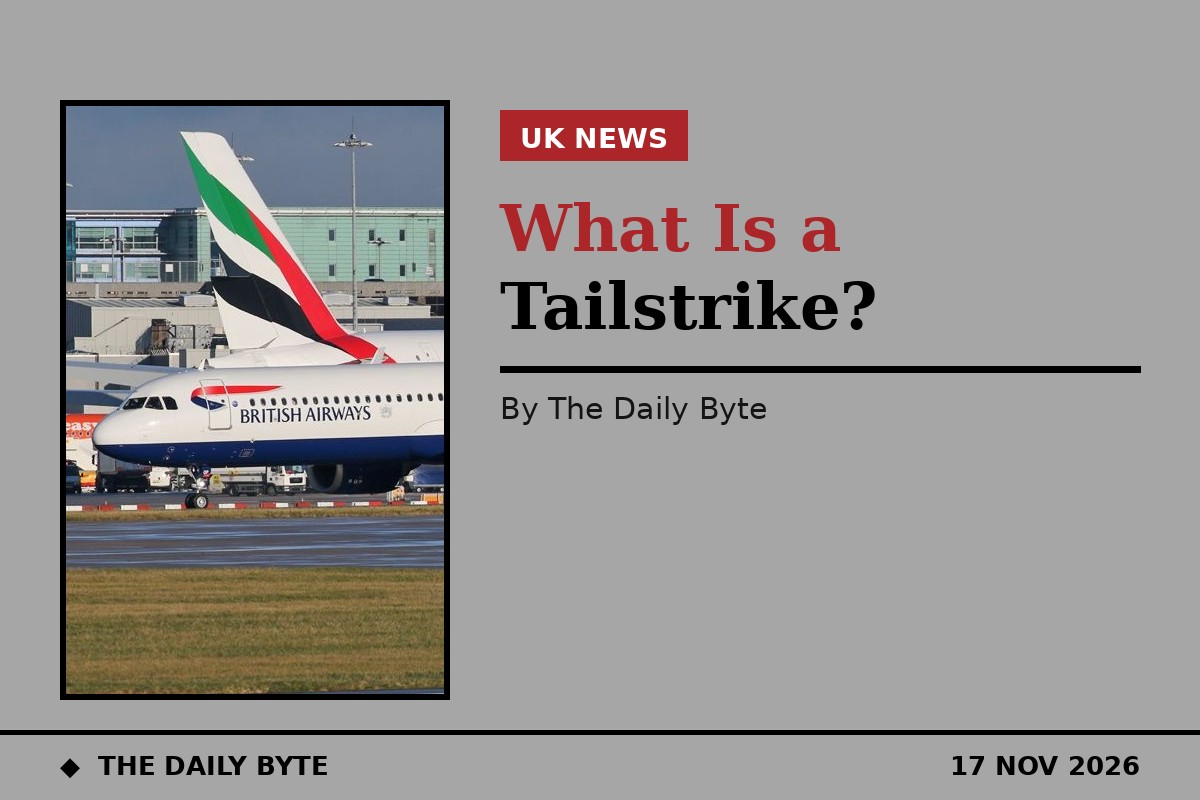
On Thursday 12 November 2026, a British Airways Airbus A321neo struck its tail on the runway during a landing attempt at London Heathrow Airport, climbed away, and landed safely on its second attempt. The incident was caught on a livestream and widely shared online, and it has prompted a familiar question: what is a tailstrike, how dangerous is it, and why does it happen? This explainer answers those questions, and explains what is known — and not yet known — about the Heathrow incident.
The direct answer is that a tailstrike happens when the rear underside of an aircraft touches the runway during take-off or landing. It is usually caused by the nose being raised too high, too early or too fast. It is uncommon, it rarely causes injuries, and the aircraft is taken out of service for inspection before it flies again.
## What happened at Heathrow on 12 November?
The aircraft was an Airbus A321neo registered G-TNEB, operating flight BA431 from Amsterdam Schiphol to London Heathrow. Its first landing attempt was on runway 27L, the southern runway, at about 10:35 in the morning. Footage from the aviation livestream channel Big Jet TV appears to show the aircraft touching down, bouncing and pitching upwards, with the underside of its tail contacting the runway twice before it climbs away. The footage has been widely described as a "double tail strike", although investigators have not yet publicly confirmed whether there were two separate contacts.
The crew abandoned the landing and performed a go-around, climbing away and positioning for another approach. The aircraft touched down safely on the same runway about 14 or 15 minutes later, at about 10:49 or 10:50, according to flight-tracking reports. No injuries have been reported, and passengers were able to leave the aircraft normally.
British Airways said: "The aircraft landed safely, and we're assisting the AAIB with its investigation and are legally unable to comment further at this stage." The AAIB is the UK Air Accidents Investigation Branch, the body that investigates civil aircraft accidents and serious incidents. The aircraft was taken out of service for engineering inspection. Early reporting identified Saturday 14 November as a tentative return-to-service date, but as of 15 November British Airways had not publicly confirmed the extent of any damage or a definitive return date. No cause has been given.
## What exactly is a tailstrike?
When an aircraft lands, the pilot raises the nose — a manoeuvre called the flare — so that the main landing gear touches down first and the aircraft settles onto the runway. If the nose is raised too far, the tail drops too low and the rear fuselage scrapes along the runway. The same thing can happen on take-off if the aircraft is rotated, or pitched up, too early or too aggressively, before it has enough speed to lift off cleanly.
A tailstrike is not the same as a crash. The aircraft is still flying, or still rolling, and the contact is usually brief. But it is a serious event for the aircraft itself. The rear fuselage is a pressurised structure, and a scrape can damage the skin, the frames underneath it and the auxiliary power unit area. Even a light scrape must be inspected, because damage that is not visible from the outside can weaken the structure. That is why any aircraft involved in a tailstrike is grounded until engineers have examined it.
Tailstrikes are relatively uncommon. Data from the International Air Transport Association's 2025 Annual Safety Report, cited in reporting on the Heathrow incident, shows about six reported tail strikes per million flights per month. Double tail strikes, in which the tail touches the runway twice during a single landing attempt, are rarer still.
## Why is the A321neo particularly vulnerable?
The Airbus A321neo is the longest version of the A320 family. At 44.5 metres long, it is about seven metres longer than the A320, and its tail sits closer to the ground when the nose is raised. That means the margin for error during the flare is smaller: a pitch angle that would be safe on a shorter aircraft can bring the A321neo's tail into contact with the runway. Pilots are trained to manage this, and the aircraft's flight systems include protections, but the geometry of the aircraft makes it less forgiving of an over-flare or a bounced landing.
A bounced landing can make things worse. If an aircraft touches down firmly and bounces back into the air, the pilot must decide quickly whether to continue the landing or go around. If the nose is raised sharply during that second touchdown, the tail can strike. The Heathrow footage appears to show the aircraft bouncing before the tail contacts the runway, but the AAIB has not published a finding, and it would be wrong to attribute a cause before its investigation is complete.
Weather is often asked about after such incidents. A weather report from Heathrow at 10:20 on the morning of the incident, about 15 minutes before the first touchdown, recorded light rain. Neither British Airways nor the AAIB has linked the tailstrike to the weather, and the Met Office recorded north-westerly winds with gusts up to 18 mph at Heathrow that morning. Wind, rain, runway condition and pilot technique are all factors investigators will consider, but none has been identified as the cause.
## What did the AAIB say on the same day?
The Heathrow incident happened on the same day the AAIB published its final report on a separate tailstrike at Heathrow: a DHL Airbus A300 freighter that struck its tail during a bounced landing on 12 October 2025. In that case, the AAIB found that a pitch increase during the bounced landing, compounded by the effect of the ground spoilers extending, caused the tail strike. Both crew members were uninjured, but the aircraft stayed at Heathrow for several months and was eventually assessed as beyond economical repair and retired.
The DHL case is a useful reminder of why tailstrikes are taken seriously even when nobody is hurt. The damage can be extensive, repairs can take months, and in some cases the aircraft is never returned to service. That does not mean the same outcome is expected for G-TNEB: every incident is different, and the extent of the damage to the British Airways aircraft has not been made public.
## What happens to the aircraft now?
The AAIB investigation will follow its usual course. Investigators will examine the flight data recorder and cockpit voice recorder, interview the crew, inspect the damage to the aircraft, and review the weather, the runway and the air traffic control recordings. The AAIB's role is to determine what happened, why it happened and whether there are lessons for aviation safety. It does not apportion blame, and it does not publish its findings until the investigation is complete. That can take months.
In the meantime, engineers will inspect G-TNEB. A tailstrike inspection typically involves examining the rear fuselage skin and structure, checking for cracks or deformation, and inspecting the tail skid or bumper if the aircraft is fitted with one. Minor damage can be repaired and the aircraft returned to service. More serious structural damage can mean a longer repair, or, as in the DHL case, retirement.
## Should passengers worry?
Tailstrikes almost never injure passengers. The aircraft remains controllable, the crew can go around and land normally, and the damage is to the airframe rather than to the cabin. In the Heathrow incident, the crew did exactly what they are trained to do: they recognised that the landing was not going as planned, abandoned it, and came back for a safe second attempt. The fact that the incident was filmed and shared widely makes it look dramatic, but the outcome — a safe landing, no injuries, and an aircraft grounded for inspection — is the system working as designed.
## Frequently asked questions
**What is a tailstrike?** When the rear underside of an aircraft touches the runway during take-off or landing, usually because the nose was raised too high.
**What happened to BA431?** British Airways flight BA431, an Airbus A321neo registered G-TNEB, struck its tail during a landing attempt at Heathrow on 12 November 2026, went around, and landed safely about 15 minutes later. No injuries were reported.
**Is a tailstrike dangerous?** It rarely causes injuries, but it can seriously damage the aircraft's rear fuselage, so the aircraft is always grounded for inspection.
**Why did it happen?** The cause has not been established. The AAIB is investigating, and no finding has been published.
**What is a go-around?** When the crew abandon a landing attempt, climb away and come back for another approach. It is a routine safety manoeuvre.
**How common are tailstrikes?** About six reported tail strikes per million flights per month, according to the International Air Transport Association's 2025 Annual Safety Report.
Sources: PEOPLE, reporting the British Airways statement and the AAIB investigation; Travel Radar and Aerospace Global News on the flight details and the AAIB probe; the AAIB's final report on the DHL Airbus A300 tail strike at Heathrow, published 12 November 2026.