What Is a Tariff? How Tariffs Work Explained
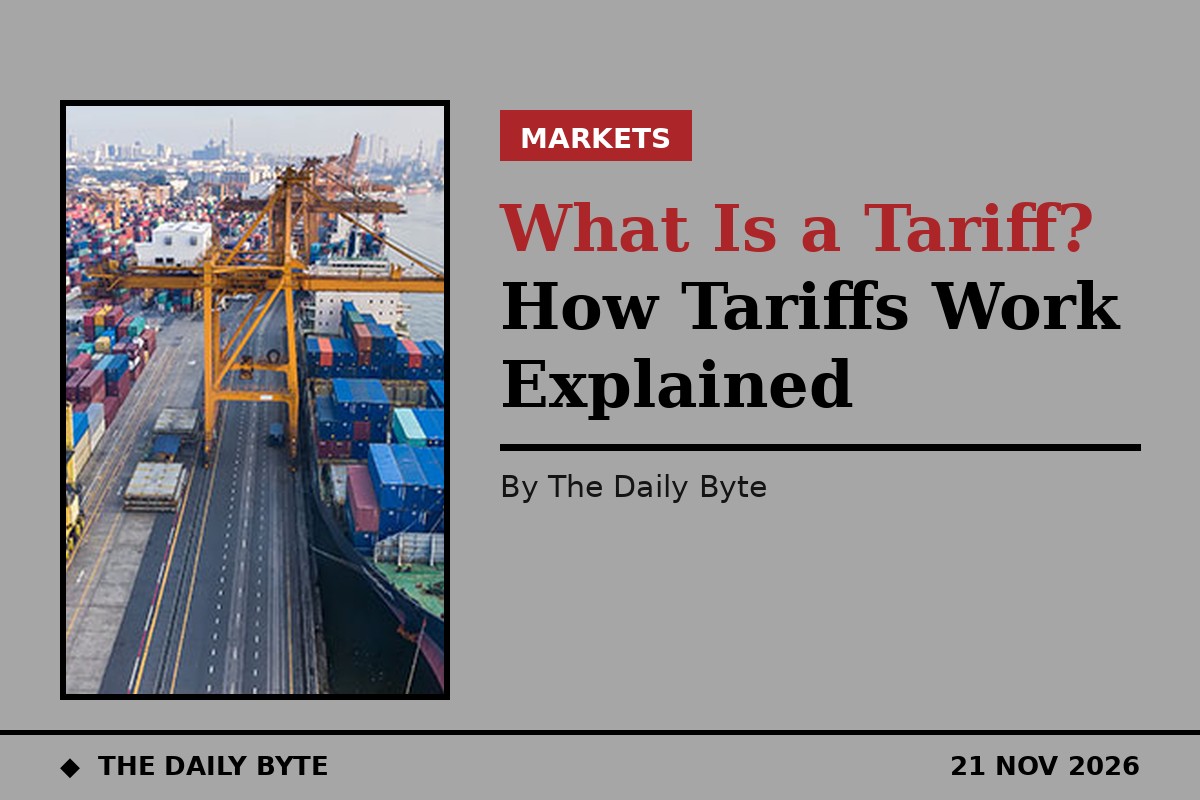
A tariff is a tax that a government charges on goods crossing its border, almost always on imports. When a business brings a product into a country, it pays the tariff to that country's customs authority before the goods can be sold. The tax raises the price of the imported product, which is the whole point: tariffs are used to protect domestic industries from foreign competition, to raise government revenue, to retaliate against what a government sees as unfair trade practices, and to correct trade imbalances. They are one of the oldest tools in economic policy, and in 2026 they are back at the centre of world trade, after the United States imposed a wave of new tariffs in President Donald Trump's second term.
Tariffs sound simple, a tax at the border, but the details matter. Who pays, how much is charged, and what happens to prices depend on the type of tariff, the product, where it comes from, and the trade agreements in force. This explainer sets out what a tariff is, the forms it takes, who actually bears the cost, and the international rules that limit how far governments can go.
What is a tariff, in simple terms?
A tariff, also called a customs duty or import duty, is a tax imposed by a government, or in the European Union by the European Commission, on goods entering a country or customs union. It is collected at the border by the customs authority: in the United Kingdom that is HM Revenue and Customs, and in the EU it is the customs authority of each member state, with 75 per cent of the duties collected going to the EU budget.
The importer pays the tariff, and the importer is usually a domestic business, a wholesaler, retailer or distributor bringing goods into the country, not the foreign company that made them and not the government of the exporting country. That is a common misunderstanding. The cheque is written by the firm that imports the goods. What happens next is the important part: the importer often passes the extra cost along the supply chain, raising the price the retailer charges, which means consumers often bear the ultimate burden even though they never deal with customs themselves.
Tariffs can also apply to exports, though export tariffs are much less common and are mostly used by developing countries to raise revenue. In practice, when people talk about tariffs they almost always mean import tariffs, and this explainer focuses on those.
The three main types of tariff
There are three main ways a tariff can be calculated. The most common is the ad valorem tariff, from the Latin for on value: a fixed percentage of the value of the imported good. A 5 per cent tariff on a car valued at 20,000 pounds produces a duty of 1,000 pounds. Its protective effect stays constant if the price of the good changes, because the duty rises and falls with the value.
The second type is the specific tariff: a fixed fee per unit of the imported good, regardless of its value. A tariff of 10 pounds per imported bicycle applies whether the bicycle is a budget model or a high-end racing bike. Specific tariffs are simple to calculate and administer, but their protective effect shrinks as prices rise, because the fixed fee becomes a smaller share of the price. The United States, for example, has long levied a 51 cent specific tariff on every imported wristwatch.
The third type is the compound tariff, which combines the two: a fixed fee per unit plus a percentage of the value. A tariff of 50 pence per kilogram plus 3 per cent of the value on imported cheese is a compound tariff. It gives a minimum level of protection through the fixed element while also capturing a share of the value of higher-priced goods. Some tariffs combine a specific and an ad valorem charge on the same product, which is sometimes called a two-part tariff.
A related tool is the tariff-rate quota. Under this system a set quantity of a product can be imported at a lower, or zero, tariff rate, and anything above that quantity is taxed at a much higher rate. For example, 10,000 tonnes of sugar might be imported at a 1 per cent tariff, while any sugar imported above 10,000 tonnes is taxed at 50 per cent. Tariff-rate quotas are common in agriculture, where governments want to allow some imports while still shielding domestic farmers.
Why do governments impose tariffs?
Governments use tariffs for several overlapping reasons. The first is protection: by making imports more expensive, a tariff shields domestic producers from foreign competition and can support local jobs. A tariff on imported steel makes domestically produced steel more competitive, even if it is more expensive to make. The second reason is revenue. Tariffs are one of the oldest sources of government income, because it is relatively simple to place customs officials at a border and collect a fee on goods that enter.
The third reason is retaliation. A government may raise tariffs in response to tariffs imposed on its own exports, or to punish what it sees as unfair practices such as dumping, where a product is exported at a price below its normal value, or subsidised exports. Tariffs can also be imposed on a reciprocal basis, where a country levies duties that match the tariffs other countries impose on its exports. The fourth reason is leverage: tariffs, or the threat of them, can be used as a bargaining tool in international affairs. The ICAEW notes that President Trump has sought to use tariffs in this way, including threatening tariffs on countries opposed to his plans to bring Greenland under US control.
Finally, tariffs can be used to correct a trade imbalance, making imports more expensive in order to reduce a deficit with a particular country. Economists disagree sharply about whether any of these aims are achieved in practice, and about whether the costs, higher prices for consumers and businesses that rely on imported materials, outweigh the benefits.
How is the tariff on a product worked out?
To establish the tariff that applies to a particular shipment, three things are usually needed: the goods' commodity code, their country of origin, and the date of import. Most countries base their commodity codes on the international Harmonized System, which standardises the first six digits of the code worldwide. The United States publishes its rates in the Harmonized Tariff Schedule, the UK runs an online Trade Tariff service, and the EU uses a database called TARIC.
Country of origin generally depends on where goods were grown, produced or sufficiently processed under the applicable rules of origin. Simply storing or forwarding goods through another country does not normally change their origin, so the country of origin can differ from the country the goods were dispatched from. That matters because the tariff rate can vary by origin, and because reduced or zero tariffs may be available under trade agreements, provided the goods meet the relevant rules of origin and evidence requirements. It is also important to check for quotas, duty suspensions and additional duties, such as anti-dumping duties, which can apply on top of the standard tariff.
What do tariffs do to prices and the economy?
When a tariff is imposed, the domestic price of the imported good rises. Domestic producers of the same good benefit, because they can sell more at a higher price, but domestic consumers lose, because they pay more and buy less. The government gains revenue equal to the tariff multiplied by the number of units still imported. That is the textbook picture, and the real-world effects are broader and harder to predict.
One common effect is an increase in the prices of imported goods, as companies pass the extra costs on to their customers, which can feed into overall inflation. Industries that rely on imported materials can suffer: a tariff on imported steel raises costs for car makers and builders who buy that steel. Other effects include reduced or diverted trade volumes, as buyers switch to suppliers in countries with lower tariffs, supply chain disruptions, and changes in consumer behaviour. The uncertainty itself is costly. Sudden tariff hikes, pauses and threats of escalation disrupt supply chains and complicate long-term planning, which is why businesses facing the current US tariff policy have been advised to diversify suppliers, review contracts for price-adjustment and change-in-law clauses, and hold extra inventory of tariff-sensitive goods.
That uncertainty is a central feature of tariffs in 2026. The US tariff policy has been marked by sudden changes, and the ICAEW notes that it can take time for tariff databases to be updated to reflect the current situation, so businesses must check the rate in force on the date of import rather than relying on a figure published weeks earlier.
How do international rules limit tariffs?
Tariffs are regulated by the World Trade Organization, which has 166 members accounting for around 98 per cent of world trade. Its rules are set out in agreements including the General Agreement on Tariffs and Trade, known as GATT. Each member has a schedule listing, line by line, the maximum tariff rates, or bound rates, it has agreed not to exceed for each product. Members may charge lower rates in practice, known as applied tariffs, but they are prohibited from exceeding the bound rates. If a member wants to raise a bound rate, it must negotiate with other members, typically offering compensatory concessions.
A central principle is most-favoured-nation treatment, set out in Article I of GATT 1994: any advantage, such as a lower applied tariff, granted to one WTO member must be extended unconditionally to all other members. That is why tariffs imposed on one country but not on others, or rates above the bound level, are controversial. Lower-than-MFN tariffs are allowed in limited cases, including customs unions such as the EU, free trade agreements such as the US-Mexico-Canada Agreement, and preferential treatment for developing countries.
There are also exceptions. Article XX of GATT allows measures necessary to protect public morals, human, animal or plant life or health, and measures relating to the conservation of exhaustible natural resources. Article XXI covers national security, permitting measures necessary to protect a member's essential security interests, though the scope of that provision has long been debated. The United States invoked Article XXI to justify tariffs on steel and aluminium imports, citing national security, an action many other WTO members viewed as economically protectionist rather than security-related.
The WTO also allows trade remedies, which are additional duties imposed to protect domestic industries against unfair practices or sudden surges in imports. Anti-dumping duties apply where a product is exported at a price below its normal value, typically the price in the exporter's domestic market, and an investigation has shown that the dumping is causing material injury to the domestic industry. Countervailing duties offset subsidies granted by foreign governments. Safeguards are emergency actions against an unforeseen surge in imports, and must be limited to what is necessary to prevent serious injury; in principle they may not last longer than four years, although an extension of up to eight years is permitted in limited circumstances.
Why are tariffs in the news in 2026?
Tariffs dominate trade news because the United States has imposed tariffs on more than 60 countries, including India and China, citing national security grounds, and has used tariffs as a tool of political leverage as well as an economic instrument. A central point of contention is that many of these tariffs appear to breach WTO obligations, particularly the most-favoured-nation principle and bound tariff commitments, and critics argue that this erodes trust in the rules-based global trading order. Supporters of the policy argue that tariffs protect American industry and give Washington leverage in negotiations.
For everyone else, the practical question is the same one this explainer started with: a tariff is a tax at the border, paid by the importer, usually passed on in higher prices. Whether it protects jobs or simply raises costs depends on the product, the rate, and how trading partners respond, which is why tariffs remain one of the most argued-over subjects in economics, and why they are likely to stay in the headlines for as long as governments keep reaching for them.