What Is a Tariff and How Does It Work?
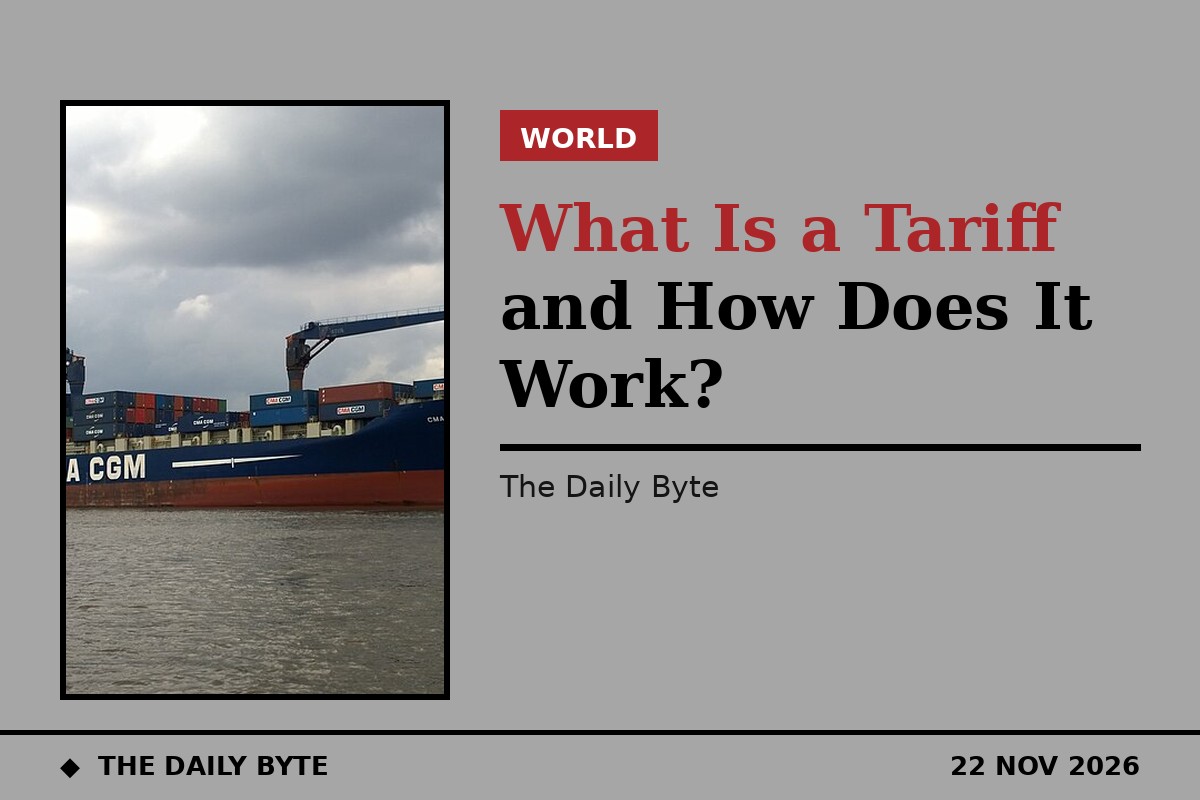
A tariff is a tax that a government charges on goods when they cross its border, most often on imports. The business that brings the goods into the country, the importer, pays the tariff to the customs authority before the goods can be released. Tariffs are set as a percentage of the value of the goods, as a fixed amount per unit, or as a combination of the two. They raise money for the government, they can make imported goods more expensive than similar goods made at home, and they are one of the oldest tools of trade policy. This guide explains how tariffs work, who actually ends up paying for them, why governments use them, and how they differ from other border charges.
What is a tariff, in simple terms?
Think of a tariff as a toll on trade. When a shipment arrives at a port or border, customs officers check what the goods are, where they came from, and what they are worth. The tariff is then charged according to the country's tariff schedule, a published list that sets a rate for each type of product. The importer pays the charge to the customs authority. In the UK, that authority is HM Revenue and Customs, HMRC. In the European Union, it is the customs authority of the member state where the goods enter, with most of the duties collected going to the EU budget. The goods are then free to be sold inside the country, but the tariff has already added to their cost.
Tariffs apply to goods, not to most services. A tariff on steel, for example, is charged when steel crosses the border. A tariff does not normally apply to a service supplied across a border, such as software support, although governments have debated taxing digital trade. Tariffs are also different from the sales taxes charged at the border, such as VAT, which apply to domestic and imported goods alike. A tariff is specific to imports, and it is set by trade policy rather than by general tax policy.
The three main types of tariff
The most common type is the ad valorem tariff, which is a percentage of the customs value of the goods. A 10 per cent ad valorem tariff on goods worth £100 adds £10. A specific tariff is a fixed amount per unit, regardless of value, for example £2 per kilogram of a product, or £50 per tonne. A compound tariff combines the two, for example 5 per cent of the value plus £1 per kilogram. Ad valorem tariffs are the most common because they rise automatically with the price of the goods, but specific tariffs are used where value is hard to pin down or where the government wants to charge by quantity.
The rate that applies to a particular shipment depends on three things: the product's classification, its origin, and the date of import. Classification uses the Harmonised System, an international system of codes that puts every traded product into a category. Origin is the country where the goods were made or substantially transformed, not necessarily the country they were shipped from. The date matters because tariff rates change, and the rate in force on the day the goods are declared is the one that applies.
Who actually pays a tariff?
This is the question most people ask, and the answer has two parts. Legally, the importer pays. The importer of record is the business named on the customs declaration, and it writes the cheque to the customs authority. But the economic cost, the question of whose income or purchasing power actually falls, can be shared. Economists call this the incidence of the tariff, and they stress that knowing who writes the cheque tells you very little about who bears the burden.
An importer faced with a new tariff has several options. It can raise the price it charges its customers, passing the cost on. It can absorb the cost by accepting a smaller profit margin. It can negotiate a lower price from its foreign supplier, so the supplier effectively shares the cost. It can switch to a supplier in a country with a lower tariff, redesign its supply chain, or buy less of the product. Which of these happens depends on competition, contracts, the availability of substitutes, exchange rates, and timing. If buyers have no alternative and keep buying the same quantity even at a higher price, they absorb more of the cost. If the foreign supplier cannot easily sell elsewhere, it is more likely to cut its price and absorb the cost itself. In most real cases the burden is split between the importer, the supplier, and the final buyer, in proportions that are hard to predict in advance.
A worked example
Take a simple example. A UK retailer imports 1,000 jackets from a supplier abroad. Each jacket is valued at £50, so the shipment is worth £50,000. If the tariff is 10 per cent ad valorem, the importer pays £5,000 to HMRC when the goods arrive. The retailer now needs £55,000 to land the jackets, before shipping, warehousing, and its own margin. If it passes the whole tariff on, the price of each jacket rises by £5. If it absorbs the tariff, its profit on the shipment falls by £5,000. If it negotiates the supplier down to £45 a jacket, the shipment costs £45,000, the tariff falls to £4,500, and the supplier has effectively paid part of the tariff through a lower price. In practice the outcome is usually a mixture of all three, and it may take months for the full effect to show in shop prices.
Why do governments use tariffs?
Governments use tariffs for several reasons, and the same tariff can serve more than one purpose. The first is revenue. For centuries tariffs were one of the main sources of government income, and they still matter for some developing countries, although in large economies they are now a small share of total tax revenue. The second is protection. A tariff raises the price of imported goods, which can give domestic producers a price advantage and protect jobs in industries the government wants to keep. The third is retaliation. A government may raise tariffs on another country's goods in response to what it sees as unfair trade practices, or as leverage in a negotiation. The fourth is correcting a trade imbalance, by discouraging imports and encouraging domestic production. Supporters argue that tariffs protect strategic industries and national security. Critics argue that they raise prices for consumers, protect inefficient firms, and invite retaliation that harms exporters.
Bound rates, applied rates and trade deals
Under the rules of the World Trade Organization, the WTO, each member commits to a maximum tariff for each product, called the bound rate. A member can charge less than the bound rate, and the rate it actually charges is called the applied rate. A member must not normally charge more than its bound rate, although trade remedies, such as anti-dumping duties, can allow higher charges in specific cases. The WTO has 166 members, accounting for around 98 per cent of world trade, and its agreements include the General Agreement on Tariffs and Trade, GATT, which sets out the rules and provides a way to settle disputes between members.
Trade agreements can lower tariffs below the standard rate. Under a free trade agreement, two or more countries agree to charge little or no tariff on each other's goods, provided the goods meet rules of origin that prove they were genuinely made in one of the partner countries. A preferential rate may also be available under a preference programme for developing countries. The rate that applies to your shipment therefore depends not only on the product, but on where it was made and whether a trade agreement covers it.
Tariffs, quotas and embargoes: what is the difference?
Tariffs are one of several tools governments use at the border, and they are often confused with the others. A quota limits the quantity of a product that can be imported, rather than taxing it. An embargo bans trade with a particular country or in particular goods altogether. Sanctions are broader measures, often financial as well as trade-based, imposed to pressure a government or group. A tariff does not ban anything; it makes the import more expensive. That is why tariffs are described as a price measure, while quotas and embargoes are quantity measures.
What tariffs mean for prices and businesses
For consumers, the main effect of a tariff is higher prices on imported goods, and sometimes on domestic goods too, because domestic producers facing less competition can raise their own prices. For businesses that import, tariffs are a direct cost that must be planned for, and sudden changes can disrupt supply chains that were built around the old rates. For exporters, tariffs imposed by other countries are a barrier to selling abroad. For governments, tariffs are revenue and leverage, but they can also trigger retaliation: when one country raises tariffs, its trading partners often raise theirs in return, which can reduce trade overall. That is why tariff changes are watched so closely by markets, and why they feature so often in the news.
Frequently asked questions
What is a tariff? A tariff is a tax charged by a government on goods when they cross its border, usually on imports. The importer pays it to the customs authority, and it is normally a percentage of the goods' value, a fixed amount per unit, or a combination of both.
Who pays a tariff, the exporter or the importer? The importer legally pays the tariff to customs. The economic cost, however, can be shared between the importer, the foreign supplier, and the final buyer, depending on prices, contracts, competition and the availability of substitutes.
What is an ad valorem tariff? An ad valorem tariff is stated as a percentage of the accepted customs value of the goods. A 10 per cent tariff on goods worth £100 adds £10. It is the most common type of tariff.
What is the difference between a bound rate and an applied rate? A bound rate is the maximum tariff a WTO member has committed not to exceed for a product. The applied rate is the tariff actually charged, which can be lower than the bound rate, and may be lower still under a trade agreement.
Do tariffs apply to services? Tariffs normally apply to goods, not services. Services supplied across borders are generally not subject to tariffs, although governments have debated how digital trade should be treated.
Tariffs are simple in concept and complicated in practice, because the rate depends on the product, its origin, and the agreements in force on the day of import. For the rules that apply to a specific shipment, the ICAEW guide to tariffs explains how to find the tariff in force and what it depends on, and Pinsent Masons' guide to navigating international trade tariffs sets out who pays, how tariffs are collected, and how WTO rules limit them.


