What Is a Tariff? How Tariffs Work Explained
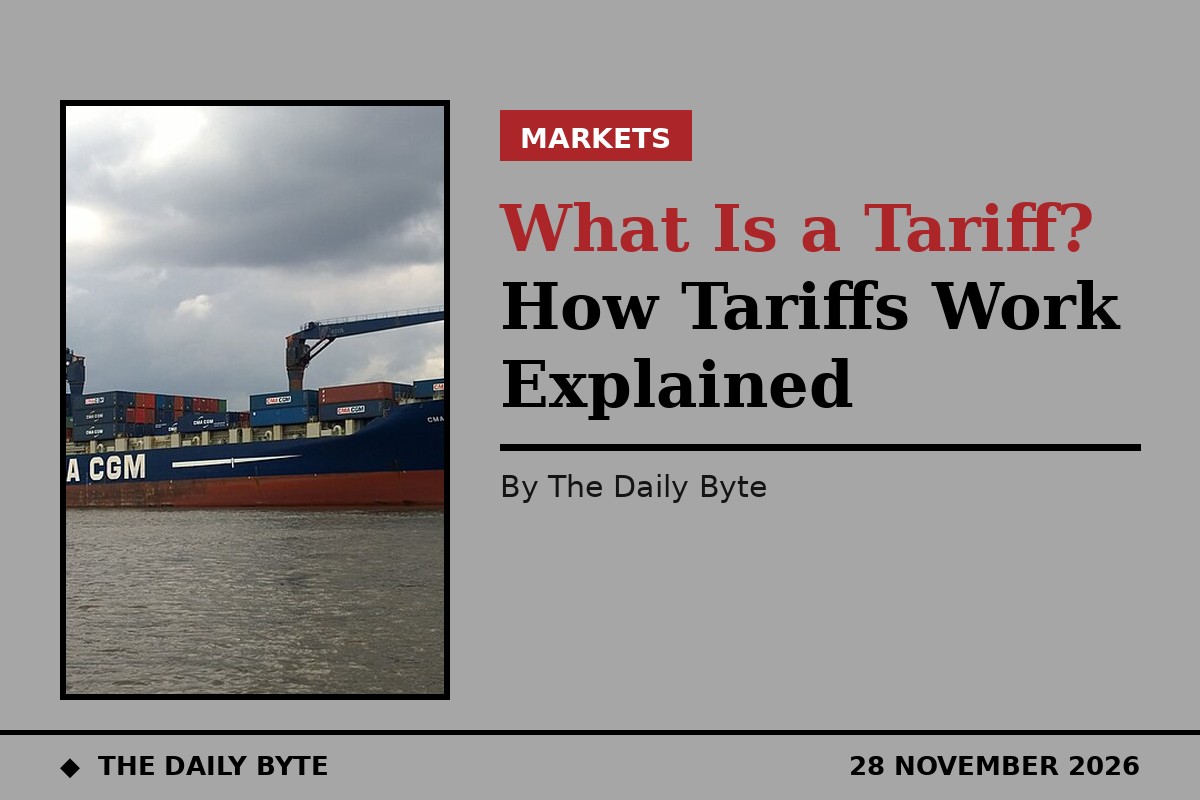
A tariff is a tax that a government charges on goods when they cross its border, most often on imports. The company bringing the goods into the country pays it to that country's customs authority, not the country that made the goods. That single fact sits at the centre of almost every argument about tariffs, including the trade fight that has dominated American politics through 2025 and into November 2026.
Tariffs are among the oldest tools in economic policy. Governments have used them for centuries to raise money, shield local producers from foreign competition, and put pressure on other countries. They fell out of fashion in much of the world as trade was liberalised after the Second World War, but they returned to the centre of debate when the United States imposed sweeping duties in 2025, saw them struck down in court in 2026, and then began rebuilding them under different laws. This explainer sets out what a tariff is, how one works in practice, who really pays, and why the argument matters now.
What is a tariff?
A tariff, also called a customs duty or import duty, is a tax levied on goods that cross a national border. The most common kind is an import tariff: a charge applied when a product enters a country from abroad. There are also export tariffs, charged on goods leaving a country, although these are rare, and the United States Constitution forbids them. Transit duties, once charged on goods simply passing through a country on their way elsewhere, have largely disappeared.
Tariffs are set by governments. In most countries the power to set them rests with the legislature, although presidents and prime ministers can often impose them in defined circumstances, for example on national security grounds or in an economic emergency. The World Trade Organization (WTO) sets rules for how its members use tariffs, including maximum rates, known as bound rates, that countries have agreed not to exceed for particular goods.
It helps to keep tariffs separate from other taxes. A tariff applies only to goods crossing a border. Value added tax or sales tax applies to goods and services sold inside a country, whether they were made there or imported. A tariff is also different from a quota, which limits how much of a product can be imported, and from an embargo, which bans imports outright.
How does a tariff work?
The mechanics are straightforward. A government sets a tariff rate for a particular product coming from a particular country. When the goods arrive at the border, the importer declares them to the customs authority, the duty is calculated, and the importer pays it before the goods are released.
Take a simple example. A British retailer imports $10,000 worth of steel tools from abroad, and the importing country applies a 25 per cent tariff on those tools. The importer owes $2,500 in duty to the customs authority, on top of the $10,000 it paid the supplier. The tools now cost the retailer $12,500 before transport, warehousing and its own margin. If the retailer wants to keep its profit margin, it must either charge customers more, accept a smaller profit, or find a cheaper supplier in a country that faces a lower tariff or none at all.
That chain of choices is the whole point of a tariff. By making the imported product more expensive, the tariff gives domestic producers of similar products room to compete, even if their own costs are higher. Whether that is a good idea depends on who you ask, and it is the subject of the next sections.
Customs authorities collect the duty. In the United States the importer pays US Customs and Border Protection, part of the Department of Homeland Security. In the United Kingdom the duty is collected by HM Revenue and Customs (HMRC). In the European Union each member state's customs authority collects duties, with most of the revenue going to the EU budget.
What are the different types of tariffs?
Not all tariffs are calculated the same way. The main types are set out below.
| Type | How it is calculated | Example |
|---|---|---|
| Ad valorem tariff | A percentage of the value of the imported good | A 25 per cent duty on imported steel |
| Specific tariff | A fixed fee per unit, regardless of value | $5 per tonne of imported cement |
| Compound tariff | A percentage plus a fixed fee | 10 per cent plus $2 per unit |
| Tariff-rate quota | A low or zero rate up to a set quantity, then a higher rate above it | The first 100,000 tonnes at 0 per cent, then 20 per cent |
Ad valorem tariffs are the most common. Specific tariffs are used where the value of a good is hard to pin down or where the aim is to guarantee a minimum level of protection. Tariff-rate quotas are often used for farm products, where governments want to allow some imports while still protecting domestic farmers.
Tariffs can also be described by their purpose. A protective tariff is designed mainly to shield domestic producers. A revenue tariff is designed mainly to raise money for the government, and is usually applied to goods that are not made at home, so there is no domestic industry to protect. In practice most tariffs do a bit of both.
Who pays a tariff?
The importer pays the tariff. That is the part of the story on which economists, trade lawyers and customs authorities agree. A company importing goods from abroad pays the duty to its own country's treasury when the goods cross the border. The exporting country does not pay it, and the foreign producer does not pay it directly.
What happens next is where the argument begins. An importer that has just paid a duty has three broad options: absorb the cost and accept lower profits, pass it on to customers through higher prices, or try to push the cost back onto the foreign supplier by negotiating a lower price. In practice the cost is usually shared, but studies of the 2025 US tariffs found that much of the cost was passed on to domestic businesses and consumers in the form of higher prices, rather than being absorbed by foreign producers.
That is why the claim that another country "pays" a tariff is misleading. The legal payer is the domestic importer. The economic burden — who ends up worse off — is spread along the supply chain, and it very often lands, at least in part, on the shoppers and businesses buying the finished product.
Why do governments impose tariffs?
Governments give four main reasons, and they often overlap.
First, protection. A tariff makes foreign goods more expensive, which can help a domestic industry survive against cheaper imports. Supporters argue this saves jobs and keeps skills and production capacity at home. Critics reply that it also keeps prices high and shields inefficient firms from competition.
Second, revenue. Tariffs are a source of government income. In the nineteenth century they were one of the main ways the US government raised money. Today they are a small share of revenue in most advanced economies, but the sums involved can still be large: the US Treasury collected about $240 billion in tariff revenue between 2 April 2025, when the sweeping reciprocal tariffs took effect, and the months that followed.
Third, leverage. A tariff, or the threat of one, can be used as a bargaining tool in trade negotiations, to press another country to lower its own barriers or change a policy. The 2025 and 2026 US tariff rounds have been used in exactly this way, with lower rates offered to countries that reach a deal.
Fourth, national security. Governments argue that some industries, such as steel, aluminium, semiconductors or pharmaceuticals, are too important to depend on foreign suppliers. The US has used Section 232 of the Trade Expansion Act of 1962, a national security provision, to impose duties on steel, aluminium, copper, cars, pharmaceuticals and other products.
What do tariffs do to prices and the economy?
The effects of a tariff are felt in several directions at once, which is why economists argue about them so fiercely.
For consumers, the most direct effect is higher prices. If a tariff raises the cost of an imported washing machine, television or car part, shoppers either pay more or buy something else. When tariffs cover a wide range of everyday goods, the effect shows up in the general cost of living.
For domestic producers that compete with imports, a tariff can mean higher sales, more work and better wages. A steelmaker shielded from cheap foreign steel may keep a plant open that would otherwise close.
For exporters and the wider economy, the picture is less favourable. Other countries often retaliate with tariffs of their own, which hurts exporters. Supply chains get more expensive and more complicated, because many modern products cross borders several times while they are being made. And if tariffs push up costs across the economy, they can weigh on growth even while they protect particular industries.
For the government, tariffs bring in revenue, but that revenue comes from its own importers and consumers rather than from abroad. The net effect depends on how much trade falls, how much prices rise, and what the government does with the money it collects.
Tariffs in the news in 2026
Tariffs have rarely been out of the headlines since 2025, and the story changed sharply in 2026. The timeline below covers the main developments.
| Date | Development |
|---|---|
| 2 April 2025 | The US imposes sweeping reciprocal tariffs on imports from nearly every trading partner, a day President Donald Trump calls "Liberation Day" |
| August 2025 | The US Court of Appeals for the Federal Circuit rules 7 to 4 that the emergency law used for the tariffs does not authorise them |
| 20 February 2026 | The US Supreme Court rules 6 to 3, in Learning Resources, Inc. v. Trump, that the International Emergency Economic Powers Act does not give the president power to impose tariffs |
| 24 February to 24 July 2026 | The administration imposes a temporary 10 per cent surcharge under Section 122 of the Trade Act of 1974, which caps such duties at 150 days |
| July 2026 onwards | New duties under Section 301 of the Trade Act of 1974, tied to forced-labour enforcement, take over at 10 or 12.5 per cent, alongside sector duties under Section 232 |
| 25 November 2026 | The US Trade Representative proposes a new round of Section 301 duties on goods from 14 trading partners, including China, the EU, Japan, India and Vietnam |
The Supreme Court's February 2026 ruling was a major setback for the administration. Writing for the majority, Chief Justice John Roberts said the emergency statute, a 1970s law that does not mention the word "tariffs", did not authorise the president to impose duties. The court did not order refunds or create a mechanism for them, and importers have had to file claims; by August 2026, Customs had returned about $100 billion of the duties that were struck down, according to reporting of the refunds.
The administration then rebuilt the tariff wall on different legal foundations. Section 301, unlike the emergency law, expressly authorises tariffs, which makes it harder to challenge in court. The new round proposed on 25 November 2026 would impose duties of up to 35 per cent on Vietnam, 25 per cent on India, 20 per cent on China and 15 per cent on the European Union, with public hearings scheduled for 25 January 2027. According to analysis by Yale University's Budget Lab, the proposals would lift the average statutory US tariff rate from 11.4 per cent to 13.9 per cent early in 2027, close to the 13.8 per cent in force before the Supreme Court ruling.
India's government said on 27 November that a trade deal with the United States was close to completion, after Washington offered to cap tariffs on Indian goods at 17 per cent if an agreement is reached. The episode shows how tariffs now work as both a tax and a negotiating tool: the rate a country ends up paying can depend on whether it strikes a deal.
Do tariffs work?
That depends on what they are meant to achieve. As a way of raising revenue, they work: the money arrives. As a way of protecting a specific industry, they can work for a time, keeping a plant open or a workforce employed. As a way of bringing down the overall cost of living, or of making an economy richer as a whole, most economists are sceptical, because the higher prices paid by consumers and the retaliation from trading partners tend to outweigh the gains to the protected industry.
Supporters reply that the textbook argument misses the point: that a country may reasonably pay a price to keep industries it regards as strategic, to reduce dependence on a rival, or to force a trading partner to the negotiating table. The events of 2025 and 2026 have given both sides fresh evidence, and the argument is far from settled.
What is settled is the basic mechanism. A tariff is a tax on imports, paid by the importer at the border. Everything else — who ends up bearing the cost, whether jobs are saved or lost, and whether the policy succeeds — follows from that.
Frequently asked questions
Do foreign countries pay US tariffs?
No. The importer — the American company bringing the goods in — pays the duty to US Customs and Border Protection. Some of that cost may be passed on to consumers in higher prices, and some may be pushed back onto foreign suppliers through lower prices, but the foreign government does not pay the tariff.
Are tariffs the same as VAT or sales tax?
No. VAT and sales tax apply to goods and services sold inside a country, whether they were made there or imported. A tariff applies only when goods cross a border into the country.
Can tariffs be refunded?
Sometimes. When a tariff is found unlawful, importers can claim back what they paid, but there is no automatic refund. After the Supreme Court struck down the 2025 emergency tariffs, importers had to file claims, and the refund process has been slow and contested.
Why are tariffs in the news again in November 2026?
Because the US Trade Representative proposed a new round of duties on 25 November 2026, covering 14 trading partners, under Section 301 of the Trade Act of 1974. The proposal follows the Supreme Court's February 2026 ruling against the earlier emergency tariffs and is the latest step in rebuilding the US tariff regime on different legal ground.
Sources: Britannica, "What Are Tariffs and How Do They Work?"; World Economic Forum, "What are tariffs — and how do they work?"; Pinsent Masons, "Navigating international trade tariffs"; reporting of the US Supreme Court ruling in Learning Resources, Inc. v. Trump and of the US Trade Representative's 25 November 2026 Section 301 proposals.


