What Is a Tsunami?
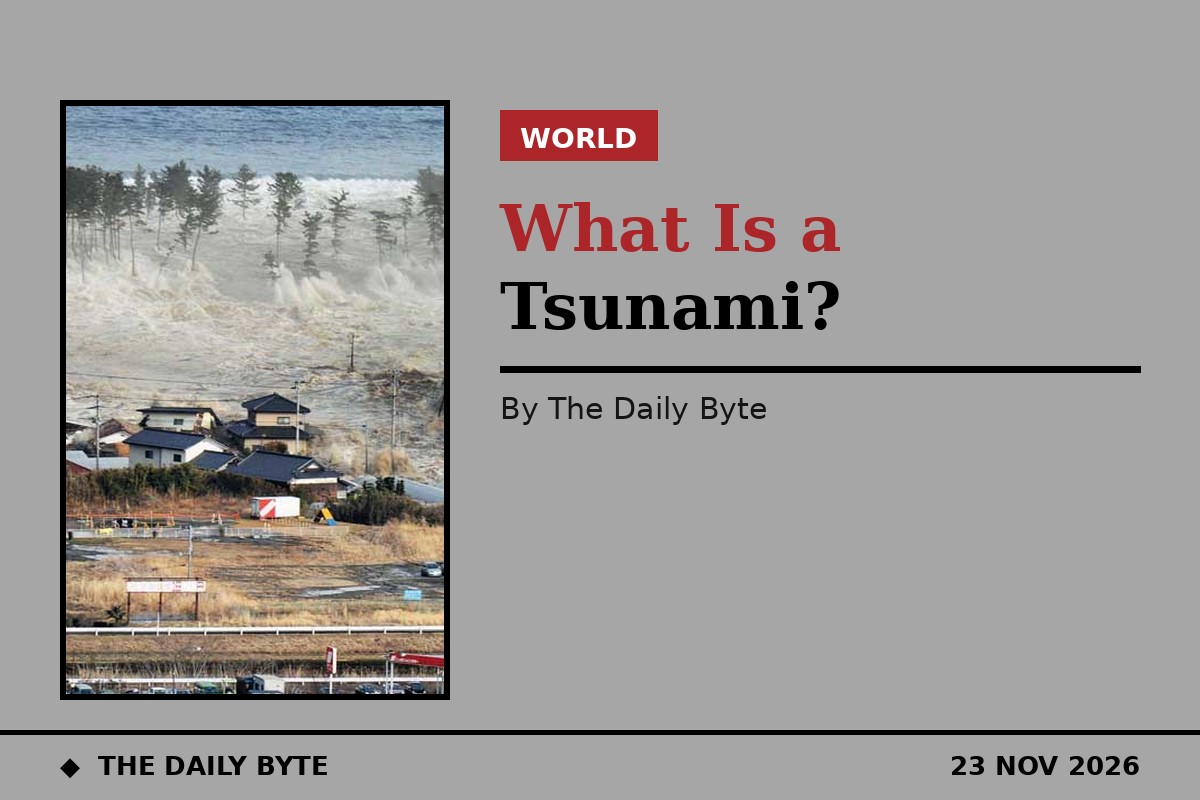
A tsunami is a series of giant ocean waves, usually set off by a large earthquake under the sea. Unlike ordinary wind-driven waves, which only disturb the surface, a tsunami moves the whole column of water from the sea floor to the surface, and it can cross an entire ocean before it runs ashore. That is what makes it so dangerous: by the time it arrives, it is not a single wave but a train of surges that can flood the coast for hours.
The question is being asked again today, Monday 23 November 2026, after a morning of undersea earthquakes in the Pacific. A magnitude 6.5 earthquake struck the Vanuatu region at 02:41 UTC, at a depth of about 614 kilometres, and the Pacific Tsunami Warning Center issued a statement at 02:47 UTC saying there was no tsunami threat from the quake. Hours later, a magnitude 5.4 earthquake in the Banda Sea was felt near Darwin in northern Australia, and the Joint Australian Tsunami Warning Centre said there was no tsunami threat to Australia either. Two days earlier, on 21 November, a magnitude 7.2 earthquake off Indonesia's Maluku province also produced no tsunami. Each of those bulletins sent people searching for the same thing: what exactly a tsunami is, and when an earthquake can cause one.
The short answer
The United States National Oceanic and Atmospheric Administration, NOAA, defines a tsunami as a series of giant waves caused by earthquakes or volcanic eruptions under the sea. The word comes from Japanese: tsu means harbour and nami means wave. In Japanese fishing villages, the waves were named for the way they appeared without warning in the harbour, even when the sea offshore had looked calm.
The key point is that a tsunami is not one wave. It is a wave train, a series of waves that can arrive minutes or even an hour apart, and the first is often not the largest. The waves are also far longer than ordinary waves: the distance from one crest to the next can be hundreds of kilometres, which is why a tsunami behaves more like a fast-rising tide than like a breaking surf wave when it reaches the shore.
What causes a tsunami?
Most tsunamis are caused by large earthquakes at subduction zones, places where one of the Earth's tectonic plates is being forced beneath another. When the plates slip suddenly, a huge section of the sea floor can lurch upwards or downwards by several metres. That vertical movement shoves the water above it out of place, and the displaced water spreads outwards as a tsunami.
Not every undersea earthquake does this. The earthquake has to be large, usually magnitude 7 or above, shallow enough to move the sea floor, and it has to shift the ground vertically rather than sideways. That is why the three earthquakes of 21 to 23 November 2026 caused no tsunami: the magnitude 7.2 Maluku quake was about 125 kilometres deep, and the magnitude 6.5 Vanuatu quake was deeper still, at about 614 kilometres, far too deep to lift the sea floor. A deep earthquake can be felt over a wide area, but it barely disturbs the water.
Earthquakes are not the only cause. A large underwater landslide can displace water in the same way, and so can a volcanic eruption. In January 2022 the eruption of the Hunga Tonga volcano in the South Pacific sent tsunami waves across the Pacific, reaching as far as Peru and Japan. The largest wave run-up ever measured, about 524 metres up a hillside at Lituya Bay in Alaska in 1958, was caused by a landslide triggered by an earthquake, when a huge mass of rock crashed into the bay.
How a tsunami travels across the ocean
In deep water a tsunami is almost invisible. Its height may be less than a metre, and a ship passing over it might not notice anything at all. What is remarkable is its speed. The speed of a tsunami depends on the depth of the ocean rather than on the distance from the source, and in deep water it can travel at up to about 800 kilometres per hour, as fast as a jet plane, in NOAA's words.
Because the wave is so long, the whole ocean depth is involved in its motion. As it approaches the coast and the water gets shallower, the front of the wave slows down while the water behind it keeps coming. The wave is squeezed: it grows taller, its wavelength shortens, and its speed falls. This process, called shoaling, is what turns a barely noticeable swell in the open ocean into a wall of water at the shore.
That is also why a tsunami can strike places thousands of kilometres from the earthquake. The waves from the 2004 Indian Ocean tsunami reached the coast of East Africa hours after the earthquake, and the 2011 tsunami in Japan sent waves right across the Pacific to the west coast of the Americas.
What happens when it reaches land
When a tsunami reaches shallow water it does not usually arrive as a single curling breaker like a surfing wave. It more often arrives as a sudden, powerful surge, or as a rapid rise in sea level that keeps rising far beyond the normal high-tide mark. The water can rush inland for kilometres over flat ground, sweeping away buildings, vehicles and trees, and then drain back to the sea with equal force, dragging debris with it.
The height the water reaches on land is called the run-up, and it can be far greater than the wave's height offshore. In 2004, survey teams measured a run-up of 51 metres at Lhoknga in Indonesia. In 2011, the waves that struck north-eastern Japan reached run-ups of around 40 metres in places. Even a run-up of a few metres is enough to destroy wooden houses and flood a coastal town.
Sometimes the sea draws back before the waves arrive, exposing the sea floor where water stood minutes earlier. This drawback is one of the clearest natural warnings of a tsunami, and it has lured curious onlookers onto the exposed beach in past disasters, with fatal results. The safe response is the opposite: move inland and uphill at once, and do not wait to see the wave.
Tsunami, tidal wave and storm surge: what is the difference?
A tsunami is often called a tidal wave, but oceanographers discourage the name, because tides have little to do with it. Tides are caused by the gravitational pull of the Moon and the Sun, and they rise and fall on a regular daily cycle. A tsunami is caused by a sudden displacement of water, and it can arrive at any state of the tide.
A storm surge is different again. It is a rise in sea level caused by a storm: strong winds push water towards the coast, and low air pressure lets the sea surface bulge upwards. Storm surges are the deadliest part of tropical cyclones and of the winter storms that batter northern Europe, but they are driven by weather, they build up over hours, and they can usually be forecast days ahead. A tsunami gives far less warning, because the earthquake that causes it may be only minutes away.
A rogue wave, meanwhile, is a single unusually large wave in the open ocean, thought to be caused by wind and currents combining. It is a hazard to ships, but it is not a tsunami and it does not flood the coast.
The deadliest tsunamis in living memory
The deadliest tsunami in recorded history struck on 26 December 2004. A magnitude 9.1 earthquake off the coast of Sumatra, Indonesia, ruptured a stretch of fault more than 1,000 kilometres long and sent waves across the Indian Ocean. About 227,898 people were killed, according to Encyclopaedia Britannica's count, across 14 countries, from Indonesia and Thailand to Sri Lanka, India and Somalia. Indonesia suffered the worst, with around 167,000 deaths. There was no warning system in the Indian Ocean at the time, and many coastal communities had no idea what was coming.
The second deadliest of the modern era struck Japan on 11 March 2011. A magnitude 9.1 earthquake off the north-east coast, the most powerful ever recorded in Japan, generated waves that reached up to around 40 metres in places and travelled as far as 10 kilometres inland. About 18,500 people were left dead or missing, and the flooding knocked out the cooling systems at the Fukushima Daiichi nuclear power plant, causing the world's worst nuclear accident since Chernobyl. The waves arrived within minutes in the nearest towns, which is why Japan's warning system is built for speed.
Pakistan has its own history with tsunamis. On 28 November 1945, a magnitude 8.1 earthquake off the Makran coast, in what is now Balochistan, generated a tsunami that killed about 4,000 people along the coasts of Pakistan and Iran, according to NOAA's historical tsunami database. It is a reminder that the Arabian Sea is not immune, even though damaging tsunamis there are rare.
How the world watches for tsunamis
The 2004 disaster changed how the world monitors tsunamis. The Pacific already had a warning system, run from Hawaii by the Pacific Tsunami Warning Center, which was set up in 1949 after a tsunami killed more than 160 people in Hawaii. After 2004, similar systems were built for the Indian Ocean, the Atlantic and the Mediterranean, and a network of deep-ocean buoys was expanded to detect the waves themselves.
The buoys, known as DART stations, sit on the sea floor and measure tiny changes in water pressure. When a tsunami passes overhead, they send an alert by satellite within minutes. Warning centres combine that data with seismic readings to decide what to tell coastal authorities, and the messages are graded: an information statement, like the ones issued on 23 November 2026 for the Vanuatu and Banda Sea quakes, means an earthquake has been evaluated and no tsunami threat has been found; a watch, advisory or warning means a threat is possible or confirmed, and people in the named areas should move to high ground.
But technology has limits. A tsunami generated close to shore can arrive within minutes, before any official warning can be issued. That is why the natural signs matter so much: strong shaking that makes it hard to stand, a sudden withdrawal of the sea, or a loud roar from the ocean are all reasons to move to high ground immediately, without waiting for a message.
What to do if a tsunami is coming
The advice from warning centres is simple, and it is the same everywhere in the world. If you are near the coast and you feel a strong earthquake, or you see the sea suddenly recede, move to high ground or inland as quickly as you can, on foot if the roads are blocked. Do not wait for an official warning, do not go to the beach to watch, and do not return until the authorities say it is safe, because tsunami waves can keep arriving for hours and a later wave can be larger than the first.
If you are in a boat, the advice is the opposite: head for deep water, where a tsunami is low and harmless, rather than staying near the harbour. And if you receive a warning while you are inland, stay away from the coast and from river estuaries, which can channel the water far upstream.
That is the lesson of the bulletins issued on 23 November 2026. Most undersea earthquakes do not cause a tsunami at all, and the warning centres said so plainly within minutes. But the reason those bulletins exist, and the reason they are issued so quickly, is that when a tsunami does come, the difference between knowing and not knowing is measured in lives.
Sources: NOAA Ocean Service, "What is a tsunami?"; Pacific Tsunami Warning Center tsunami information statement, 23 November 2026; Joint Australian Tsunami Warning Centre bulletin, 23 November 2026; Encyclopaedia Britannica and NOAA NCEI Global Historical Tsunami Database for the 2004 and 2011 death tolls.


