What Is a V5C Logbook? UK Guide Explained
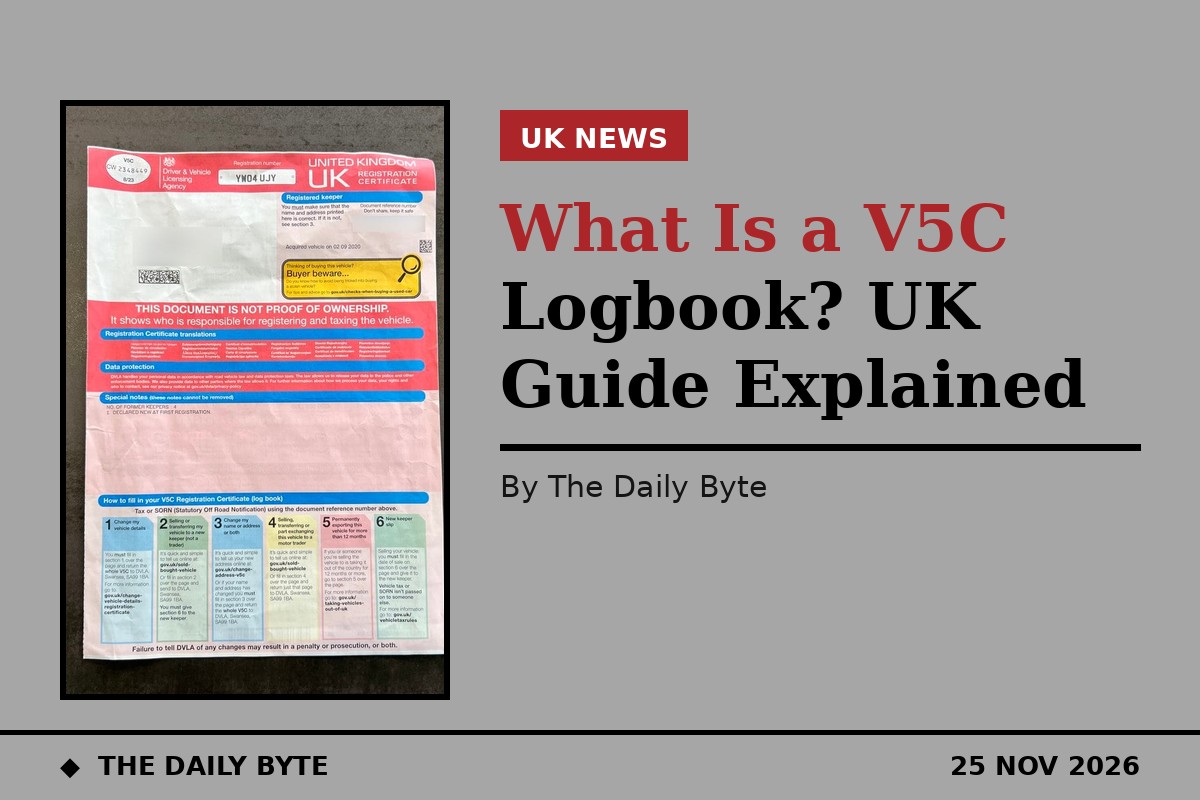
A V5C, usually called the logbook, is the vehicle registration certificate issued by the Driver and Vehicle Licensing Agency (DVLA) for a vehicle registered in the United Kingdom. It records who the DVLA has down as the vehicle's registered keeper, together with the vehicle's key details, including its registration number, make and model, colour, engine size and vehicle identification number (VIN). It is the document a buyer asks to see before handing over money for a used car, and the document a seller uses to tell the DVLA about a change of keeper. Yet the most important thing to understand about it is what it is not: as the red banner across the front of the document says, it is not proof of ownership.
What is a V5C?
The V5C is the DVLA's official record of a vehicle's registration. Every registered vehicle has one, and the DVLA sends it to the registered keeper at the address it has on record. The registered keeper is the person responsible for the vehicle in the eyes of the DVLA: the person who must tax it, or declare it off the road with a Statutory Off Road Notification (SORN), and who must tell the DVLA when the keeper's name or address, or the vehicle's details, change.
The keeper and the legal owner are not always the same person. If you buy a car on hire purchase or a personal contract plan, you will usually be the registered keeper while the finance company owns the car until the final payment is made. That distinction matters, because the V5C only ever shows the keeper. Ownership is shown by other paperwork, such as a bill of sale or a receipt, so it is worth keeping evidence of a purchase even when the V5C is in your name.
Keep the logbook somewhere safe at home, not in the car. If a thief takes the car with the V5C inside, it is much easier for them to sell the car on as if it were theirs.
What information does a V5C show?
The front of the current V5C shows the vehicle's registration number, the registered keeper's name and address, the date the vehicle was acquired, and an 11-digit document reference number at the top. It also carries a yellow box warning buyers to check the vehicle's history before buying, and the statement that the document is not proof of ownership.
| Detail on the V5C | What it tells you |
|---|---|
| Registration number | The number plate the vehicle is registered under |
| Registered keeper | Name and address of the person responsible for registering and taxing the vehicle |
| Date of first registration | When the vehicle was first registered, which should fit its age |
| Make, model and colour | The vehicle's identity, to check against the car itself |
| VIN and engine number | The unique 17-digit vehicle identification number and the engine number |
| Engine size, fuel type, CO2 emissions | Technical details, including the tax class |
| Number of former keepers | How many registered keepers the vehicle has had before |
| Document reference number | The 11-digit number used for the DVLA's online services |
The V5C also carries special notes, which cannot be removed. These can record, for example, that the vehicle was declared new at first registration, or that it has a non-transferable registration mark. The six numbered sections at the bottom of the document explain how to fill it in for different situations: changing vehicle details, selling or transferring to a new keeper, changing a name or address, selling to a motor trader, permanently exporting the vehicle, and the new keeper slip.
Is a V5C proof of ownership?
No. A V5C records the registered keeper, the person responsible for the car, not the legal owner. The DVLA has warned that many drivers wrongly believe it proves ownership, and criminals take advantage of that confusion. A car can have outstanding finance, be stolen, or be subject to an insurance write-off even when the V5C is genuine, because the logbook says nothing about finance, mileage or accident history.
That is why the V5C is only one part of the picture when buying a used car. A separate vehicle history check is needed to find out about recorded damage and write-offs, mileage discrepancies, outstanding finance, ownership changes and theft records. The DVLA's own free vehicle enquiry service shows the tax and MOT status and the last V5C issue date, and the MOT history service shows recorded mileage and test failures.
What does a V5C look like?
The current version, issued since 15 April 2019, is red with multi-coloured numbered blocks at the bottom of the front cover. Inside, the green new keeper slip, known as the V5C/2, goes to the buyer, and a yellow section is for sales to a motor trader. If there are no coloured blocks on the cover, you have an older-style logbook. There are two older versions: the original blue design, and an older red design without the coloured blocks. Both red versions are valid.
The blue version dates from 2004. A large quantity of blank blue V5Cs were stolen in 2006, and the DVLA finished replacing them with red ones in 2012. A blue V5C is not automatically fake, but it is a warning sign, which is why the DVLA advises buyers to ask the seller to swap it for a red one before handing money over.
A genuine V5C has a "DVL" watermark in the paper, visible when it is held up to the light. Its serial number should also be checked: if it falls between BG8229501 and BG9999030, or between BI2305501 and BI2800000, the V5C might be stolen, and the police should be called when it is safe to do so.
When do you need your V5C?
You need your V5C, or part of it, to sell or buy a car, to tax it or make a SORN, to scrap or export it, and to change your name, address or the car's details. You do not need to carry it while driving, and you do not need it to drive the car. If the police ask to see your documents, you usually have seven days to take them to a police station.
A new keeper can tax the vehicle with the 12-digit reference on the green new keeper slip, and a current keeper can use a recent tax reminder. Without the slip, a new keeper cannot tax the car until a new V5C arrives by post. You cannot view your V5C online: the logbook is a paper document, and the DVLA posts it. What you can see online is the vehicle's record, including its tax and MOT status.
How to get a replacement V5C
If your V5C is lost, stolen, damaged or destroyed, you can order a replacement from the DVLA online, by phone or by post. Only the registered keeper can request one, and there is no same-day service, so the online route is the fastest.
| Route | When to use it | Cost | Usual wait |
|---|---|---|---|
| Online | Registered keeper, no details need changing | £25 | 5 to 7 working days |
| By phone (0300 790 6802) | Registered keeper, no details need changing | £25 | 5 to 7 working days |
| By post (form V62) | Details need changing, or no V5C was received for a new vehicle | £25 | About 4 weeks |
To apply online or by phone you need the vehicle's registration number, its VIN or chassis number, and the name and postcode registered on the V5C. Since September 2024, the DVLA's online service lets you apply for a replacement V5C and tax the vehicle in the same session. The replacement is posted to the address the DVLA has on record, so if you have moved, update your address first. Contact the DVLA if the replacement has not arrived after two weeks. If you have not received your V5C after six weeks and you have not notified the DVLA, you will have to pay £25 to get a replacement. Fees are not refunded, even if you later find the original.
To apply by post, download and complete form V62, and send it to DVLA, Swansea, SA99 1DD, with a cheque or postal order for £25 payable to DVLA, Swansea. If you bought a second-hand car and have not received your V5C within four weeks, you can tell the DVLA and get a V5C using the V62 form.
How to update your V5C
You must tell the DVLA when your address, name or vehicle details change, so it can issue a new V5C showing the update. Changing your address is free and can be done online with your registration number, logbook reference number and new UK address; a new V5C is usually sent within five days. You can be fined up to £1,000 if you do not tell the DVLA when you move.
For changes to the vehicle itself, such as its colour or engine size, fill in the vehicle details section of the logbook and post it to the DVLA. On the new-style logbook, address and name changes go in section 3 and vehicle detail changes in section 1; on the older style, use section 6 for name and address and section 7 for vehicle details. A name change by post can take up to six weeks.
Checking a V5C before buying a used car
Before handing over money for a used car, check the logbook line by line against the car, the seller and the story you have been told. Only accept an original V5C, not a photocopy. Check that the registration number matches the number plates, that the make, model and colour match the car, and that the VIN on the document matches the VIN on the car in at least two places, such as under the bonnet, at the base of the windscreen, on the door shut or in the floor. A VIN that is hard to read, has fresh paint over it, shows file marks, or sits on a plate that looks recently fitted is a red flag: a cloned car may carry a genuine-looking V5C from another vehicle.
Check that the name and address on the V5C match the seller's photo ID and the address where you are viewing the car; viewing at the seller's home is the best way to verify this. If the seller says they are selling for a friend or relative, do not pay until the registered keeper is present or the story can be verified. Compare the number of former keepers with the advert: if an advert says one owner but the V5C shows four previous keepers, ask for an explanation. Check the issue date against the DVLA's free vehicle enquiry, and look for import, kit car or rebuilt vehicle notes, which affect value and insurance.
Finally, check the MOT history. If the recorded mileage or colour does not match the car, or the mileage pattern does not fit, walk away. A cheap price is exactly when the V5C needs more scrutiny, not less.
Selling a car: what to do with the V5C
When you sell privately, tell the DVLA online using the 11-digit document reference number from your latest V5C, give the buyer the green new keeper slip, and destroy the rest of the document. If you sell by post, fill in section 2 on the new-style logbook, or section 6 plus the declaration in section 8 on the older style, and give the buyer the green slip. When selling to a dealer or scrapping the car, use the yellow motor trade section. The buyer should then receive a new V5C by post, usually within five to seven working days if the sale was reported online, or within four weeks if it was reported by post. If you sell or transfer a vehicle without a logbook, tell the DVLA by post instead. Before you pay as a buyer, the seller should fill in the new keeper section with you, and you should get a receipt showing both names and addresses, the registration number, the VIN, the price paid and the date and time.
Frequently asked questions
Can I change the registered keeper online? Yes. For a private sale, the seller tells the DVLA online using the 11-digit reference number from the latest V5C, gives the buyer the green new keeper slip and destroys the rest. The buyer then gets a new V5C by post.
Can I view my V5C online? No, not the logbook itself. The free GOV.UK vehicle enquiry shows tax and MOT status and the last V5C issue date. A DVLA driver and vehicles account also shows your vehicles' tax and MOT details.
Can you drive without a V5C? Yes. You do not need to carry it. You do need vehicle tax, insurance and, in Great Britain, a valid MOT once the car is three years old.
How do I get a V5C for my car? If you bought it used, the DVLA posts a new one once the sale is reported. If it does not arrive within four weeks, apply with form V62. A new car is usually registered by the dealer, but you can apply for a logbook yourself with form V55/4.
Should I keep my V5C in the car? No. Keep it safe at home. If a thief takes the car with the V5C inside, it is much easier for them to sell it on as if it were theirs.
What if the seller has an old blue V5C? Ask the seller to replace it with the red version before you pay any money. A blue V5C is not automatically fake, but blank blue certificates were stolen in 2006, so the DVLA advises buyers to have it swapped first.


