What Is a Virus?
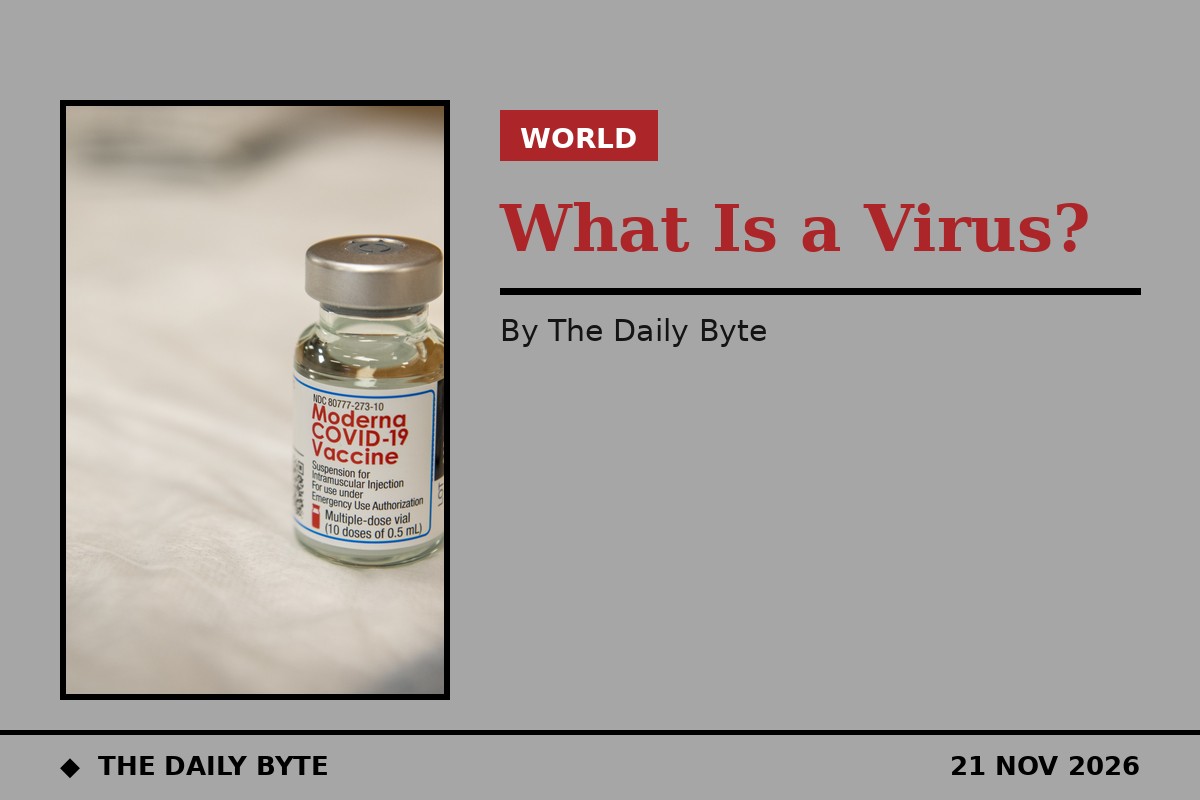
A virus is a tiny infectious particle made of genetic material — either DNA or RNA — wrapped in a protective protein coat. It cannot feed itself, make energy or reproduce on its own. To multiply, a virus must get inside a living cell and hijack that cell’s machinery, turning the cell into a factory that makes more viruses. That dependence is what makes viruses different from every other germ that makes people ill.
Viruses are everywhere: in the air, in water, in soil, and inside almost every living thing, from humans and animals to plants and bacteria. Most of them never infect people at all. The ones that do cause illnesses ranging from the common cold to flu, Covid-19, measles and HIV. Scientists still argue about whether viruses count as alive. They carry genes and they evolve, but they have no cells, no metabolism and no way to copy themselves without a host, so most biologists describe them as sitting halfway between living and non-living.
What is a virus made of?
Every virus particle, called a virion, is built from just two essential parts. The first is its genome, the genetic instructions written in DNA or RNA, which tell a host cell how to build more viruses. The second is the capsid, a shell of protein that protects the genome while the virus travels between cells. Some viruses add a third part: a fatty envelope stolen from a previous host cell, studded with spike proteins that help the virus grip its next target.
Viruses come in many shapes — rods, spheres, and geometric forms with twenty sides — but all of them are far too small to see with an ordinary microscope. Most measure between about 20 and 400 nanometres across, and even the largest are under a micrometre. Hundreds of them would fit across the tip of a human hair. They were invisible to science until the electron microscope arrived, which is one reason they were so mysterious for so long.
How does a virus infect a cell?
Infection follows the same five steps for almost every virus. First comes attachment: proteins on the virus surface latch onto a matching receptor on a host cell, like a key fitting a lock. Because each virus fits only certain receptors, each virus can infect only certain kinds of cell — cold viruses, for example, infect only cells of the upper airways. Second is entry, as the virus slips inside the cell or injects its genetic material through the cell wall. Third is replication: the viral genome takes over the cell’s protein-making machinery and orders it to build copies of the virus instead of doing the cell’s normal work.
Fourth is assembly, as the new genomes and protein coats are put together into fresh virus particles. Fifth is release: the new particles leave the cell to infect others. A single infected cell can release hundreds to thousands of new viruses, and each of those can infect another cell, which is why an infection can spread through the body so quickly.
Some viruses take a slower route, called the lysogenic cycle. Instead of forcing the cell to make copies straight away, the viral genome hides inside the host cell’s own DNA and is copied quietly each time the cell divides. A trigger such as stress can later switch it back to active copying, and the cell bursts, releasing the new particles. Herpes viruses, which can hide for years between flare-ups, work this way.
Some viruses you will have heard of
| Virus | Illness it causes |
|---|---|
| Rhinovirus | The common cold |
| Influenza virus | Flu |
| SARS-CoV-2 | Covid-19 |
| Measles virus | Measles |
| Varicella-zoster virus | Chickenpox and shingles |
| HIV | AIDS |
| Ebola virus | Ebola virus disease |
Virus vs bacterium: what is the difference?
People often confuse viruses with bacteria, but they are built in fundamentally different ways. A bacterium is a complete single-celled living organism: it has its own machinery for feeding, growing and dividing, and it can reproduce on its own. A virus has none of that. It is a parcel of instructions that must borrow a living cell to do anything at all.
| Virus | Bacterium | |
|---|---|---|
| Made of cells? | No — genetic material in a protein coat | Yes — a single living cell |
| Can it reproduce alone? | No — needs a host cell | Yes — divides by itself |
| Typical size | 20 to 400 nanometres | About 500 to 5,000 nanometres |
| Killed by antibiotics? | No | Yes, in most cases |
| Examples | Flu, Covid-19, measles | Strep throat, tuberculosis |
The difference matters for treatment. Antibiotics attack the machinery of bacterial cells, and because a virus has no such machinery, antibiotics do nothing against viral infections. Taking antibiotics for a cold or flu will not help and can encourage antibiotic resistance. Viral infections are treated instead with antiviral drugs, which interfere with specific steps of the viral life cycle, and prevented with vaccines.
How do viruses spread?
Viruses travel in many ways, depending on the virus. Respiratory viruses such as flu and Covid-19 spread in droplets and fine aerosols when an infected person coughs, sneezes, talks or breathes. Others spread by touch, on hands and surfaces. Some, such as norovirus, spread through contaminated food and water. Others need a go-between: West Nile virus travels in mosquito bites, and HIV spreads through blood and other body fluids. A few spread from animals to people, which is how Ebola and new strains of flu have reached humans.
Not every exposure leads to illness. Whether a virus takes hold depends on the dose, the route it enters by, and the state of the person’s immune system. That is also why the same virus can cause no symptoms in one person and serious illness in another.
How were viruses discovered?
Viruses were discovered by elimination. In 1892 the Russian botanist Dmitri Ivanovsky was studying tobacco mosaic disease, which mottles and stunts tobacco plants. He passed sap from sick plants through a fine porcelain filter that trapped every known bacterium — and the filtered sap still caused the disease. Something smaller than a bacterium was at work. In 1898 the Dutch scientist Martinus Beijerinck repeated the experiment and concluded the agent was a new kind of infectious thing, which he called a “contagious living fluid”. The word virus itself comes from the Latin for poison.
For decades nobody could see a virus at all. In 1935 the American chemist Wendell Stanley crystallised tobacco mosaic virus, showing it was made of chemicals like any other substance, yet still infectious. The first electron-microscope pictures followed in the late 1930s, and only then did the strange, geometric shapes of viruses become visible. Ivanovsky is now credited as the founder of virology.
How does the body fight a virus?
The body’s first defences are physical: skin, mucus and stomach acid block most invaders before they start. Once a virus gets inside a cell, the immune system takes over. Infected cells sound an alarm with signalling molecules, and white blood cells move in. Some kill infected cells directly; others, the B cells, make antibodies that stick to the virus’s surface proteins and stop it entering new cells. After the infection clears, memory cells remain, so the immune system recognises the same virus faster next time.
Vaccines work by giving the immune system a safe preview. They present a harmless piece of the virus, or instructions to make one, so the body builds antibodies and memory cells without suffering the disease. When the real virus arrives, the defence is already trained. That is why vaccines are the most effective tool medicine has against viral disease, from measles and polio to Covid-19 and flu.
Frequently asked questions
Are viruses alive? Most scientists say no, or not quite. Viruses have genes and evolve, but they have no cells, no metabolism and cannot reproduce without a host cell. They are usually described as sitting between living and non-living.
Can antibiotics kill a virus? No. Antibiotics attack bacterial cells, and viruses have no bacterial machinery to attack. Antiviral drugs and vaccines are the tools for viral infections.
Can you catch the same virus twice? Sometimes. Immunity can fade over time, and some viruses change their surface proteins, as flu does every year. Others, such as measles and chickenpox, usually give lifelong immunity after one infection or vaccination.
Do all viruses make people ill? No. Most viruses infect other organisms, and many that infect people cause no symptoms. Some viruses that infect bacteria, called bacteriophages, are even being studied as a way to fight bacterial infections.
Sources: the US National Human Genome Research Institute’s fact sheet on genomics and virology; Cleveland Clinic’s guide to viruses; the MSD Manual’s overview of viral infections; and the history of virus discovery from Biology LibreTexts. A virus is a small package of instructions with no life of its own — dangerous only because living cells do exactly what it tells them.


