What Is a Vote of No Confidence? UK Rules Explained
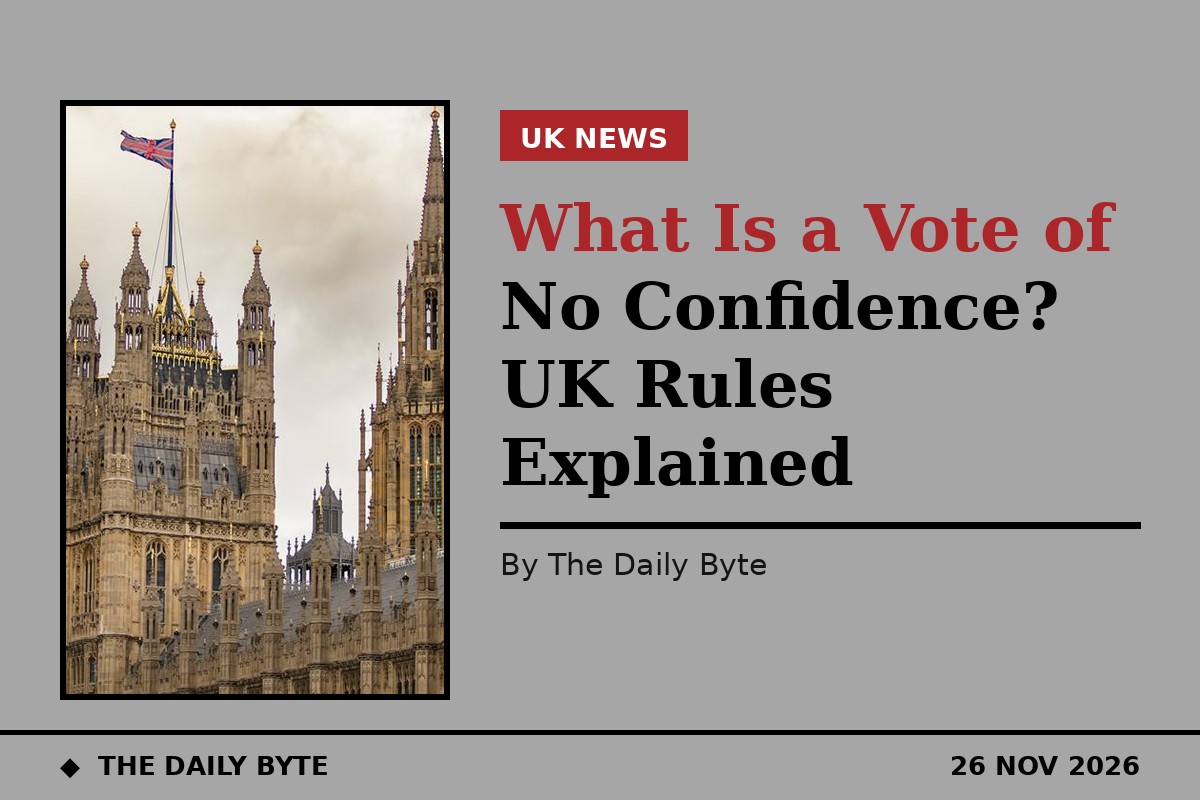
A vote of no confidence is a vote in the House of Commons declaring that MPs no longer have confidence in the government. If the motion passes, the government is expected to resign or to seek a general election, because a government that cannot command the support of the elected House cannot govern. It is one of the most powerful tools Parliament has, and also one of the rarest: the last time a government lost such a vote was in 1979. This guide explains what a vote of no confidence is in the UK, how one happens, what follows if it passes, and how it differs from a party's own internal leadership vote.
What does confidence mean in Parliament?
The UK government stays in office only as long as it has the confidence of the House of Commons. That means it must be able to command a majority in the Commons on the matters that matter. The Institute for Government, an independent think tank, explains that governments do not have to keep proving they hold confidence, but they are expected to resign or seek an election if they clearly lose it. Confidence is the foundation of the relationship between the government and Parliament: the government is formed from the majority in the Commons, and its authority to govern depends on keeping that majority's support.
Confidence is not just about a single vote. It is a constitutional convention, a long-standing rule of political behaviour that is not written down in a single law. Conventions guide how political actors are expected to behave, and they have long been a central part of how the government and Parliament relate to each other. The House of Commons is the elected chamber, so it is the Commons, not the House of Lords, whose confidence the government must hold.
How does a vote of no confidence happen?
A vote of no confidence is usually tabled by the leader of the opposition. The motion is worded in the form: That this House has no confidence in His Majesty's Government. By long-standing convention, when the opposition tables such a motion, the government finds time for it to be debated, usually the next day. The debate is followed by a vote, and if a majority of MPs who vote back the motion, it passes.
The government can also put the question the other way round, by tabling a vote of confidence in itself. And confidence can be tested without an explicit motion at all. Big set-piece votes, such as the King's Speech at the start of a parliamentary session or the Budget, are treated as implied votes of confidence: if the government cannot win a vote on such a core part of its programme, it suggests the Commons may not have confidence in the government as a whole. The government can also designate a particular vote as a matter of confidence, telling MPs that it regards the result as a test of whether it can continue in office.
What happens if a vote of no confidence passes?
If the motion passes, the government is expected to resign or to seek a dissolution of Parliament and a general election. That is the convention, and it has been confirmed by Parliament's own committees: the Public Administration and Constitutional Affairs Committee said that the effect of a vote of no confidence is to remove the government's authority to govern, and that by convention the government then either resigns and a new administration is formed, or seeks a dissolution and a general election.
What actually happens depends on the politics of the moment. The prime minister could resign, allowing another government to be formed from the existing Parliament if it can command a majority. Or the prime minister could ask the monarch for a dissolution, triggering an early general election so voters can choose a new Commons. Since the repeal of the Fixed-term Parliaments Act, which is explained below, there is no automatic timetable: the response is a matter of convention and political judgement rather than a fixed legal process. That is also why a defeat on an ordinary vote does not have the same effect. Governments lose votes on bills and amendments and carry on; only a vote that is understood to be about confidence carries this consequence.
The Fixed-term Parliaments Act and its repeal
For most of modern history, the rules around confidence votes were entirely a matter of convention. That changed in 2011, when the Fixed-term Parliaments Act set out a formal process. Under that Act, a motion of no confidence had to be passed in a specific form, and the Commons then had 14 days to pass a vote of confidence in the same or an alternative government. If it could not do so within 14 days, a general election would be held.
The Fixed-term Parliaments Act was repealed by the Dissolution and Calling of Parliament Act 2022, and the rules reverted to the system that existed before 2011. The Institute for Government explains that the 14-day process no longer has effect, and confidence motions are once again governed by convention. The repeal also restored the prime minister's power to ask the monarch to dissolve Parliament and call an election. Older guides and news reports that still describe the 14-day rule are out of date, and should not be relied on.
When was the last vote of no confidence?
Successful votes of no confidence are extremely rare. The last time a government lost one was on 28 March 1979, when the minority Labour government of James Callaghan was defeated by a single vote, 311 to 310. The defeat led to a general election, which the Conservatives won. Since 1945, there have been three votes of confidence and 23 votes of no confidence in the Commons, and only the 1979 vote succeeded in bringing a government down.
The most recent opposition confidence vote was held on 16 January 2019. The government of Theresa May had just lost the vote on its Brexit withdrawal agreement by 230 votes, the largest defeat in modern parliamentary history, and the opposition tabled a motion of no confidence the same evening. The Commons debated the motion for six hours and rejected it by 325 votes to 306, so the government stayed in office. The episode shows why opposition leaders use the motion sparingly: a failed motion can strengthen the government by demonstrating that it still commands a majority, and it can unite a divided ruling party against a common challenge.
Why are votes of no confidence so rare?
There are good reasons why a vote of no confidence is a weapon of last resort. First, it can only succeed when the government is weak: a minority government, a government with a small majority, or a government split by internal divisions. A government with a comfortable majority will win the vote easily, and the opposition will have spent its political capital for nothing. Second, as noted above, a failed motion often helps the government, rallying its own MPs behind it. Third, tabling the motion forces every MP to take a public position, which can be uncomfortable for MPs in the governing party who are unhappy with the government but do not want to bring it down.
For those reasons, opposition leaders usually table a motion only when they believe they have a real chance of winning, or when the political moment demands it, such as after a historic defeat on a flagship policy. The 2019 vote is a good example: the government had just suffered the largest Commons defeat ever, so the opposition had little choice but to test confidence, even though the arithmetic was against it.
A Commons vote is not a party leadership vote
A vote of no confidence in the government should not be confused with a party's internal vote of no confidence in its leader. Those are separate processes, run by the parties themselves under their own rules. In the Conservative Party, for example, a leadership confidence vote is triggered when enough Conservative MPs write to the chair of the backbench 1922 Committee saying they no longer have confidence in the leader. The Commons Library notes that the threshold was reportedly raised to one third of Conservative MPs after Kemi Badenoch became leader in November 2024, having previously been 15%. The exact figure is a matter for the party's own rules, which are not published, so it can change without any change in the law.
Other parties have their own procedures, and they differ from each other and from the Commons process. The key distinction is who is being tested and who is doing the voting. A Commons vote of no confidence tests whether the government commands the support of the whole House, and it is voted on by MPs of all parties. A party leadership vote tests whether a leader commands the support of their own MPs, and it is voted on only by that party's MPs. Losing a party leadership vote removes the leader; losing a Commons vote removes the government.
Frequently asked questions
Q: What is a vote of no confidence in the UK? It is a vote in the House of Commons declaring that MPs no longer have confidence in the government. If it passes, the government is expected to resign or seek a general election.
Q: Who can table a vote of no confidence? Usually the leader of the opposition. By convention, the government finds time for the motion to be debated, normally the next day.
Q: What happens if the government loses a vote of no confidence? By convention, the prime minister resigns, allowing a new government to be formed, or asks the monarch to dissolve Parliament so a general election can be held.
Q: When did a government last lose a vote of no confidence? On 28 March 1979, when James Callaghan's government was defeated by one vote, 311 to 310. The most recent vote, on 16 January 2019, was defeated by 325 to 306 and the government stayed in office.
Q: Does the 14-day rule still apply? No. The 14-day process came from the Fixed-term Parliaments Act 2011, which was repealed by the Dissolution and Calling of Parliament Act 2022. Confidence votes are now governed by convention again.
Q: Is a party leadership confidence vote the same thing? No. A party vote tests whether a leader has the support of their own MPs under the party's own rules. A Commons vote tests whether the government has the support of the whole House, and can bring the government down.
Sources: Institute for Government, Confidence motions and parliament; House of Commons Library, Leadership elections: Conservative Party; UK Parliament, motion of no confidence debate, 16 January 2019.


