What Is a White Paper? UK Government Explained
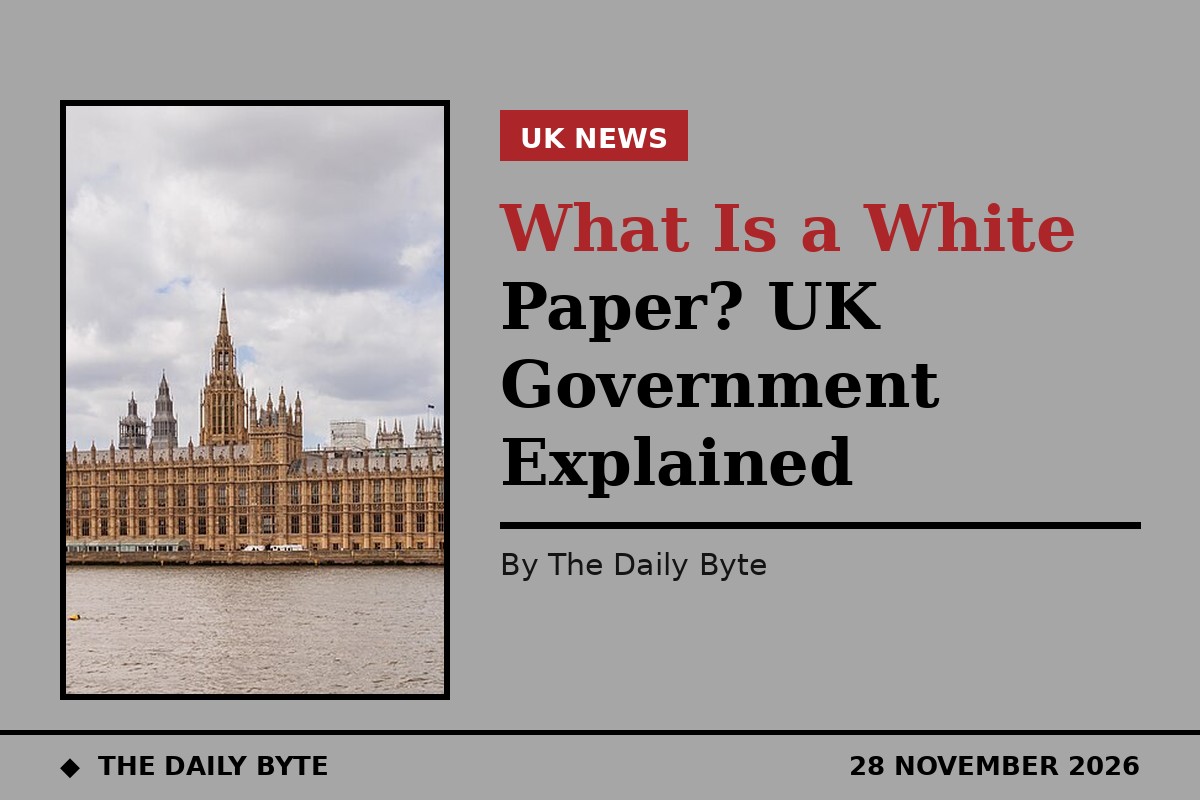
A white paper is a formal statement of UK government policy. It sets out, in detail, what the government intends to do on a particular issue, often including proposals for new laws, and it is usually published before a Bill is put before Parliament.
White papers are issued by the government department responsible for the subject. They are the clearest public signal of what legislation the government plans to bring forward, but a white paper is not itself a law. Nothing in it takes effect until Parliament passes a Bill.
What is a white paper?
UK Parliament describes white papers as documents "issued by the Government as statements of policy" that "often set out proposals for legislative changes, which may be debated before a Bill is introduced". Some white papers also invite comments from the public.
The name comes from history: the documents were once bound in white covers, unlike other parliamentary papers. Today they are published online, usually on GOV.UK, and each one carries a "Cm" number, showing it is a Command Paper presented to Parliament by the government.
A white paper typically explains the problem the government wants to solve, the evidence behind its thinking, the policy it has chosen, and the legislation it proposes. It is written by the department concerned, for example the Home Office for immigration policy or the Department for Education for schools policy, and it is introduced to the House of Commons by the Secretary of State responsible for that department.
What is the difference between a white paper and a green paper?
A green paper comes earlier in the process. Parliament describes green papers as documents that set out proposals "which are still at a formative stage" for discussion, often presenting several options for debate.
A white paper follows once the government has made up its mind. As the accountancy body ACCA puts it in its guide to Parliament, a white paper is "a statement of intent regarding the bringing forward of legislation, where the government is fairly definite in what it thinks is required". A green paper asks what people think; a white paper states what the government has decided to do.
Not every policy goes through both stages. A government can publish a white paper without a green paper first, and it can also consult in other ways. The two documents are steps on the same road, not a fixed pair.
How does a white paper become law?
A white paper is only one step on the way to a new law. The usual sequence is:
- A green paper may be published first, setting out options for consultation.
- A white paper then sets out the government's firm proposals.
- Government lawyers draft a Bill based on those proposals.
- The Bill is debated, amended and voted on in the House of Commons and the House of Lords.
- If Parliament approves it, the Bill receives Royal Assent and becomes an Act.
A white paper may itself be debated in Parliament, but that debate does not make it law. Proposals in a white paper can also change, or be dropped altogether, before a Bill appears. A white paper is a statement of intent, not a guarantee.
Why do white papers matter?
White papers matter because they show what the government is planning before legislation is drafted. They give the public, businesses, charities and Parliament a chance to read the detail, respond to it and prepare for change.
They also shape news coverage and public debate. When a government publishes a white paper on a major subject, such as immigration, energy, housing or health, the document itself becomes the reference point for everything that follows. In recent years, white papers have covered subjects ranging from immigration to planning, energy and welfare reform.
For anyone following UK politics, a white paper is worth reading in full rather than relying on headlines. The document sets out the reasoning, the evidence and the exact proposals, which is where the detail that affects people's lives is found.
Frequently asked questions
Is a white paper a law? No. A white paper is a statement of government policy and a set of proposals. Only a Bill passed by Parliament and given Royal Assent becomes law.
Can the public respond to a white paper? Some white papers invite comments, and Parliament notes that some "may invite comments". Anyone can read a white paper on GOV.UK and raise concerns with their MP.
Where can I read a white paper? White papers are published on GOV.UK by the responsible department, and listed in Parliament's publications. Each carries a "Cm" Command Paper number.
What does "Cm" mean on a white paper? "Cm" stands for Command Paper. It is the series number given to papers presented to Parliament by the government.
Sources: UK Parliament, "White & Green Papers"; ACCA, "Guide to Green and White Papers".


