What Is an Aircraft Carrier? How It Works
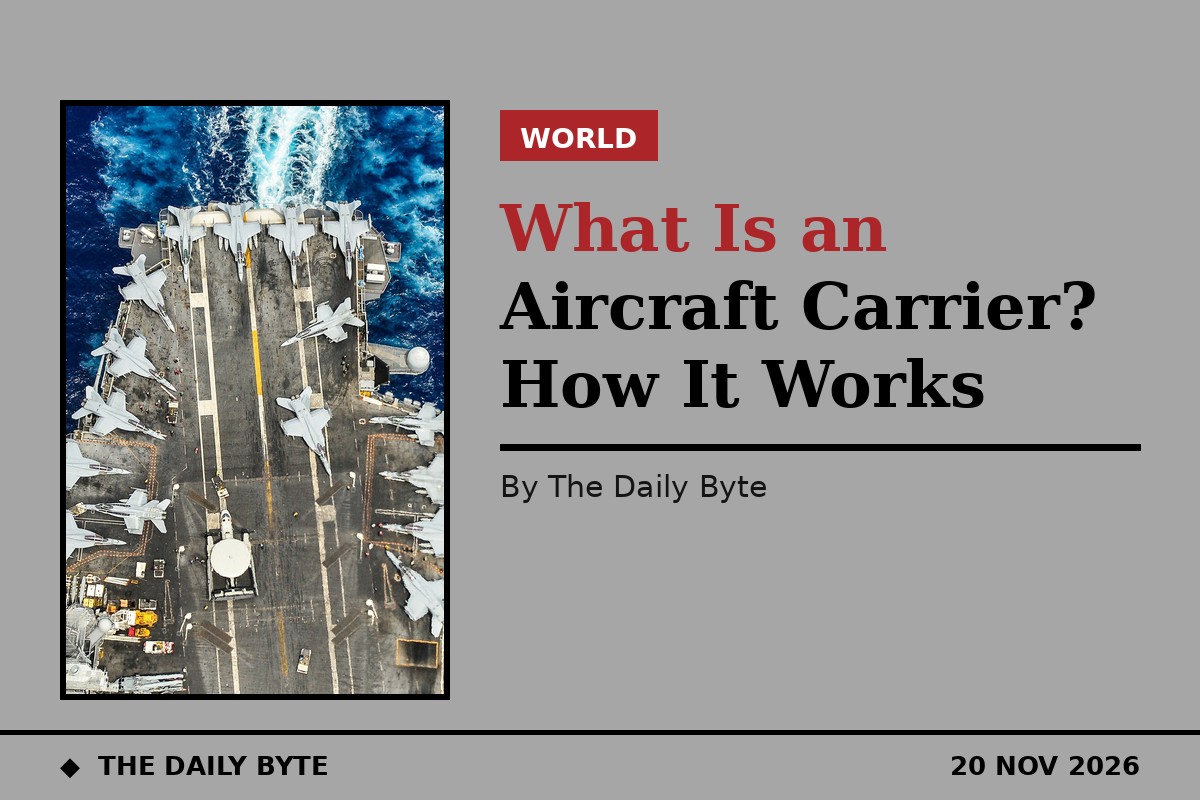
An aircraft carrier is a warship built around a full-length flight deck, a floating airbase that lets fighter jets take off and land far from any land runway. The United States Navy operates 11 of them, all nuclear-powered, and they are the largest warships in service anywhere in the world. They are in the news again in November 2026, with the USS Theodore Roosevelt reported to be the third American carrier in the Middle East, so it is worth understanding what these ships are and what they actually do.
A carrier's power does not come from its own guns, which are modest and defensive. It comes from the 60 or more aircraft it carries, and from the group of escort ships that sail with it. Together they form a carrier strike group: a self-contained force that can operate for months, thousands of miles from home, without needing permission to use anyone else's airbase.
How do planes take off and land at sea?
A carrier's flight deck is only about 1,092 feet long on the largest American ships, far too short for a jet to take off or land in the normal way. For take-off, aircraft are attached to a catapult that accelerates them from a standstill to flying speed in about two seconds. Older ships use steam catapults; the newest class, the Gerald R. Ford class, uses an electromagnetic system called EMALS, which launches aircraft more smoothly and can handle a wider range of weights, from heavy strike fighters to light drones.
Landing is even harder. The pilot aims for a small patch of a moving deck and catches one of several steel arresting wires stretched across it with a hook under the tail. The wire stops the aircraft in about 100 metres. The landing area is angled away from the rest of the deck, so an aircraft that misses the wires can simply power up and take off again for another attempt instead of crashing into parked jets.
What is on board a US carrier?
The backbone of the American fleet is the Nimitz class: ten nuclear-powered carriers commissioned between 1975 and 2009, with the lead ship, USS Nimitz, now nearing retirement. The newer Gerald R. Ford class is replacing them, with the first ship in service since 2017. Both classes are about 333 metres long with a flight deck about 77 metres wide, displace roughly 100,000 tonnes at full load, and are driven by two nuclear reactors that push them above 30 knots. The reactors give them effectively unlimited range, and a Nimitz-class ship can operate for about 20 years between refuellings.
| Feature | Nimitz class | Gerald R. Ford class |
|---|---|---|
| Ships in service | 10 | 1, with more building |
| Length | 1,092 feet (333 metres) | 1,092 feet (333 metres) |
| Displacement | About 97,000 tonnes full load | About 100,000 tonnes |
| Crew including air wing | About 5,000 to 5,200 | About 4,500 |
| Aircraft | 60 or more | More than 75 |
| Launch system | Steam catapult | Electromagnetic (EMALS) |
The aircraft are the point of the ship. A typical carrier air wing has about 65 to 70 aircraft in nine squadrons: F/A-18E/F Super Hornet strike fighters, the stealthy F-35C, EA-18G Growler electronic warfare jets that jam enemy radar, E-2D Hawkeye early-warning aircraft with their distinctive radar dome, and helicopters and transport aircraft that move people and supplies. Roughly 3,000 to 3,200 sailors run the ship itself, with about 1,500 more in the air wing.
What is a carrier strike group?
A carrier almost never sails alone. It is the centre of a carrier strike group, normally made up of the carrier and its air wing, two to four guided-missile destroyers, sometimes a cruiser, sometimes an attack submarine, and a supply ship that refuels and restocks the group at sea. The whole formation holds roughly 5,000 to 7,500 people and is commanded by a rear admiral embarked on the carrier.
The escorts exist mainly to protect the carrier. Their radars and missiles are the first line of defence against enemy aircraft, missiles, drones and submarines, while the carrier's own weapons are a last resort. The destroyers can also launch cruise missiles at targets ashore. The supply ship is just as important: it lets the group stay at sea for months without returning to port, taking on fuel, food and munitions while under way.
Why do countries want aircraft carriers?
The main reason is power projection: a carrier lets a country put dozens of combat aircraft off another country's coast without asking any other government for an airbase. That makes it a tool of deterrence as much as of war. Sending a carrier strike group to a region is one of the clearest signals a government can send, which is why carrier movements are watched so closely and reported as news in their own right.
Carriers also do work that has nothing to do with fighting. After earthquakes, tsunamis and hurricanes, they have delivered food, water and medical help, used their helicopters to reach cut-off areas, and generated electricity and fresh water for shore. They take part in maritime security patrols and in joint exercises with allies, which is one reason even countries that rarely fight wars still invest in them.
Which countries have aircraft carriers?
The United States is far ahead, with 11 large nuclear-powered carriers. Britain operates two carriers of the Queen Elizabeth class, France operates one nuclear-powered carrier, the Charles de Gaulle, and China operates three. Several other navies operate smaller carriers or helicopter carriers, and more are building them, but none matches the size, the nuclear endurance or the size of the air wing of an American supercarrier.
That gap is also a cost gap. A single Ford-class carrier costs well over 10 billion dollars to build, and the aircraft, escorts and crews cost far more again. Only a handful of countries judge that price worth paying, which is why the sight of a carrier strike group still counts as a statement about a country's reach.
Frequently asked questions
How fast can an aircraft carrier go? American carriers can exceed 30 knots, about 56 kilometres per hour. Their exact top speed is classified, but their nuclear reactors let them sustain high speed for long periods without refuelling.
How long can a carrier stay at sea? The reactors run for about 20 years between refuellings, so the ship itself is rarely the limit. Food, aviation fuel and munitions are the real constraints, and those are topped up by supply ships while the carrier keeps operating.
Can an aircraft carrier be sunk? Any warship can be damaged if a weapon gets through, and modern anti-ship missiles are a genuine threat that navies take seriously. But a carrier is protected in layers: its aircraft and escort ships engage threats far away, its own defences engage what gets closer, and it can move hundreds of miles in a day, which makes it a hard target to find and hit.


