What Is an IPO? Initial Public Offering Explained
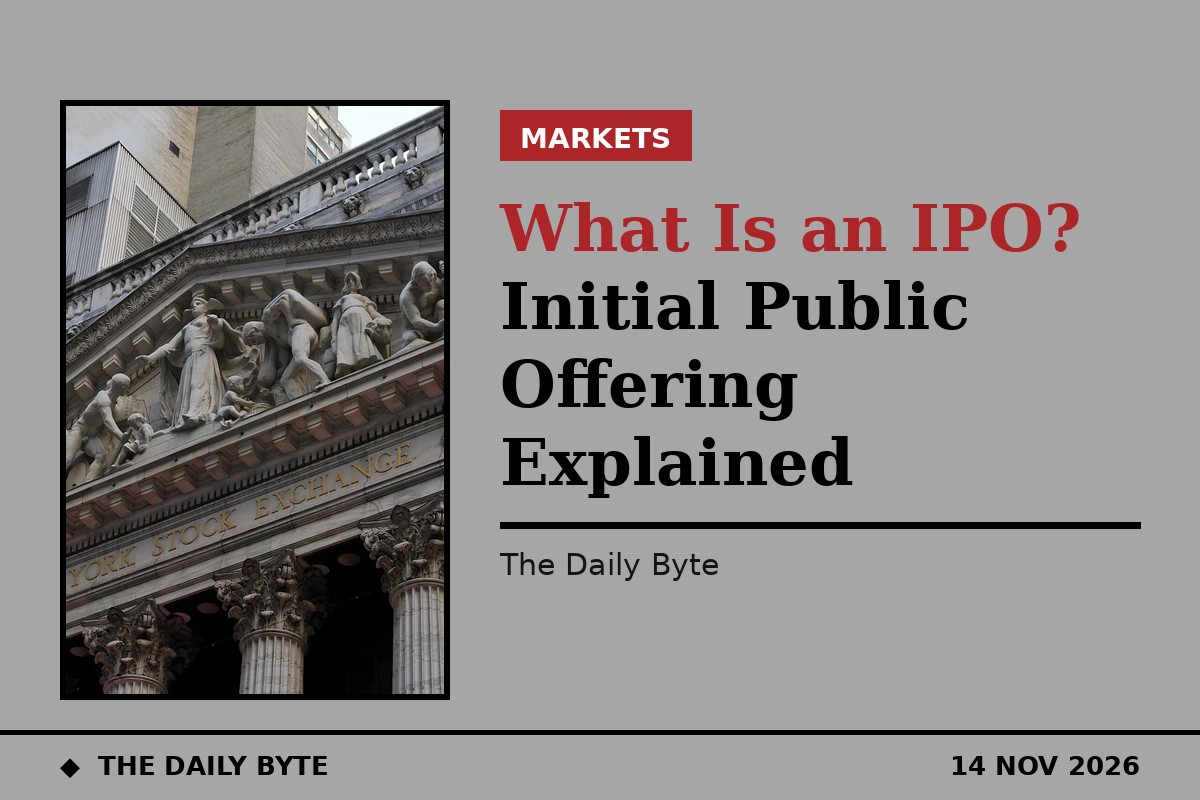
An initial public offering, or IPO, is the first time a private company sells shares of its stock to the general public. Until that moment, the company is owned by its founders, employees and private investors; after an IPO, anyone with a brokerage account can buy a piece of it on a stock exchange. The process is tightly regulated: in the United States, a company may not lawfully offer or sell shares unless the transaction has been registered with the Securities and Exchange Commission (SEC) or an exemption applies, and the company must publish a detailed prospectus describing its business, its finances and its risks. The biggest IPO of 2026 is putting all of this in the headlines right now, after Anthropic, the maker of the Claude artificial intelligence assistant, set a price range of $70 to $78 a share for its market debut.
IPOs matter far beyond the stock market. They are how fast-growing companies raise large sums to fund expansion, how early investors and employees turn paper wealth into real money, and how ordinary savers get their first chance to own a slice of a company they already know. They are also, the SEC warns, risky and speculative investments by their nature. This explainer sets out what an IPO is, how one works step by step, how the price is set, how ordinary investors can take part, and what the Anthropic listing shows about the process in practice.
What does IPO stand for?
IPO stands for initial public offering. The word initial is doing important work: it is the first offering of shares to the public, the moment a company crosses from private to public ownership. Before an IPO, a company's shares are held by a small group — founders, staff, venture capital firms and other private backers — and they cannot be freely bought and sold on an exchange. After an IPO, the shares are listed on a stock market such as the New York Stock Exchange or Nasdaq, and they trade openly every business day.
The company itself does not disappear into the market. Its management team stays in charge, its offices and products stay the same, and its existing shareholders usually keep most of their shares. What changes is the ownership structure and the scrutiny. A newly public company must publish quarterly and annual financial statements, disclose major events, and answer to thousands — sometimes millions — of outside shareholders. As the SEC's investor bulletin puts it, an IPO helps to establish a trading market for a company's shares, and the new public company is required on an ongoing basis to disclose information to the public, including its quarterly and annual financial statements on Forms 10-Q and 10-K.
It is worth distinguishing an IPO from other ways a company can reach the stock market. In a direct listing, a company lists its existing shares without selling new ones, so it raises no fresh money. In a merger with a special purpose acquisition company, or SPAC, a private company joins an already-listed shell company. An IPO is the traditional route: the company sells new shares, raises new capital, and lists at the same time.
How does an IPO work, step by step?
An IPO is a long project, not a single event. For a large company, the work typically takes many months, and involves investment bankers, lawyers, accountants and the market regulator. The broad sequence is the same in most big listings.
First, the company appoints underwriters. These are investment banks that manage and sell the IPO for the company. They advise on the timing, the valuation and the structure of the deal, and they organise the sale of the shares. In a large offering there is usually a syndicate of banks, with one or two lead banks — known as bookrunners — coordinating the work. For Anthropic's listing, Goldman Sachs and Morgan Stanley are the representatives of the underwriters.
Second, the company files a registration statement with the SEC, typically using Form S-1. The heart of that statement is the prospectus, the offering document that describes the company, the terms of the IPO and the other information an investor may use when deciding whether to invest. The SEC's staff reviews the filing to monitor compliance with disclosure requirements, and the review often results in revisions. Amendments to the S-1 are labelled S-1/A. Anthropic's price range appeared in Amendment No. 2 to its Form S-1, accepted by the SEC on 10 November 2026. The filings are public, and anyone can read them through the SEC's EDGAR database.
Third, the company goes on a roadshow. Executives and their bankers meet institutional investors — pension funds, mutual funds, insurers and other large buyers — to present the business and gauge demand. The underwriters collect indications of interest: how many shares each investor would like to buy, and at what price. This builds the order book that later shapes the final price.
Fourth, the SEC declares the registration statement effective, which means the company may proceed to consummate its IPO. It is important to understand what this does and does not mean. The SEC's staff will not declare a registration statement effective if it has reason to believe the disclosure is incomplete or inaccurate in any material respect — but the declaration of effectiveness is not an approval of the merits of the IPO, and it is not an indication that the information disclosed is complete or accurate. Responsibility for complete and accurate disclosure lies with the company.
Fifth, the offering is priced. The underwriters use the indications of interest they have gathered to recommend a price, and the company ultimately determines it. The final prospectus, usually filed as a 424B3 or 424B4 document on EDGAR, includes the final offering price that was not available in the preliminary prospectus.
Sixth, the shares begin trading on the chosen exchange. From that day on, the price is set by buyers and sellers in the open market, and the company joins the daily cycle of reporting, analyst coverage and shareholder scrutiny that comes with being public.
What is in an IPO prospectus?
The prospectus is the single most important document in an IPO, and the SEC's bulletin urges investors to read it because it provides information on the terms of the securities as well as disclosure about the company's business, financial condition, management and other matters that are key to deciding whether the offering is a good investment. Several sections deserve particular attention.
The prospectus summary gives a short version of the whole document, including the company's business, its strategy, its plans for using the money raised and its financial condition, plus the terms of the IPO itself. Risk factors identifies the risks that management believes could significantly affect the business, its operations or performance, or an investment in the shares — and in a large technology IPO this section can run to dozens of pages. Use of proceeds specifies what the company plans to do with the money it raises. Anthropic, for example, says it intends to use the money for general corporate purposes, including computing power and infrastructure, and about $3.8 billion of tax withholding on certain restricted stock units.
Other sections cover dividend policy, the dilution that new investors face compared with the price earlier shareholders paid, management's discussion and analysis of the financial results, a description of the business and its competitors, biographical information on directors and executives, and the audited financial statements with the auditor's opinion. The cover page also details how many shares are being sold by selling shareholders, if any — existing holders who are cashing in part of their stake. In Anthropic's offering, 23,648,646 of the 825 million Class A shares on offer are being sold by existing holders, and the proceeds from those shares go to the selling shareholders, not to the company.
How is the IPO price set?
There is no formula that produces the correct price for an IPO. As the SEC explains, the offering price is determined by a mix of market conditions, analysis and negotiation, and competing interests affect the result. The company wants the highest price possible, because the higher the offering price, the more capital it can raise. The underwriters also have an interest in a high price, partly because their compensation is typically a percentage of the offering price. But the underwriters are also responsible for selling the shares, so they want a price that is attractive to the client-investors buying them.
Underpricing — setting the price below what the market will pay — creates a discount for the first investors, increases demand and helps the underwriters sell all of the available shares. It can also produce a sharp rise, or pop, on the first day of trading. That pleases the investors who bought in, but it can leave the company feeling short-changed, because it might have raised more capital at a higher initial price. Overpricing has the opposite problem: shares that fall once trading begins, leaving the first buyers nursing losses.
The valuation analyses behind the price look at the company's revenues, customers and financial results, while the order book shows how much demand exists at different prices. Investors should remember the SEC's warning: the offering price reflects a negotiated estimate of the company's value, it may bear little relationship to the trading price of the shares, and it is not uncommon for the closing price shortly after the IPO to be well above or below the offering price.
How can ordinary investors buy IPO shares?
There are two ways the general public can invest in a new public company, according to the SEC. The first is to take part in the IPO itself, buying at the offering price. That usually requires being a client of an underwriter involved in the deal, and in practice underwriters distribute most IPO shares to their institutional and high net-worth clients, such as mutual funds, hedge funds, pension funds and insurance companies. For the typical investor, the SEC says, being able to buy directly in a popular IPO is a unique opportunity.
The second way — and the more common one for individual investors — is to buy the shares when they are resold in the public market in the days following the IPO, by placing an order with a broker. Some large offerings now set aside a slice for retail investors. Anthropic says it currently expects allocations to retail investors, in the United States and in other countries, to represent up to 20 percent of the Class A shares in its offering, depending on demand, and it anticipates offering a portion through Charles Schwab, Fidelity, Robinhood, Trade-PMR, SoFi and E*TRADE from Morgan Stanley, including on their online platforms, at the IPO price. Even so, the filing does not guarantee an allocation, and most investors who do not receive one will have to wait until the shares start trading.
Anyone tempted by pre-IPO offers outside this process should be cautious. The SEC has warned separately about scams offering the chance to buy shares before an IPO, and its bulletin stresses that being well informed is critical — reading the prospectus, asking questions, and verifying information against independent sources.
What are the risks of buying IPO shares?
IPOs carry specific risks that do not apply to established listed companies in the same way. A new public company typically has no prior reporting history, so the information available to judge it often exists only in the prospectus. Early trading can be volatile because the supply of shares available to trade is limited: on the first day, generally only the shares sold in the IPO can trade, while shares held by founders, early investors and employees are often restricted or covered by lock-up agreements that stop them selling for a set period. Anthropic's directors, officers and holders of substantially all of its stock face lock-ups of up to 180 days, or up to 365 days for the seven co-founders and some large holders.
Underwriters can also support the trading price in the first few days with certain trading activities, including buying the company's shares, often to keep the price from falling too far below the offering price. Once that support ends, the stock price may fall significantly below the offering price. The SEC's bulletin is blunt on this point: purchasing shares in the market immediately following an IPO can be risky, and the offering price may bear little relationship to the trading price that follows. As with any investment, the price can go down as well as up, and a newly listed company has no track record as a public business to reassure buyers.
Anthropic's IPO: the biggest listing of 2026
The Anthropic IPO is the largest market event of the year and a live illustration of every step described above. Anthropic, a Delaware public benefit corporation led by chief executive Dario Amodei, is the developer of the Claude family of artificial intelligence models. Its amended S-1, filed on 10 November 2026, set a price range of $70 to $78 a share for 825 million Class A shares, of which Anthropic itself is selling 801,351,354 and existing holders are selling 23,648,646. The company has applied to list on the Nasdaq Global Select Market under the ticker ANT.
At the top of the range, the offering would raise $64.35 billion before underwriting discounts — about $62.51 billion for Anthropic and about $1.84 billion for the selling stockholders. If the underwriters exercise their option to buy a further 123,750,000 new shares, the total could reach $74 billion. At the $74 midpoint, Anthropic estimates net proceeds from the new shares and a concurrent private placement at about $84.6 billion, or about $93.7 billion if the extra-share option is exercised in full.
That concurrent private placement is itself striking: Google, Nvidia, AMD, Broadcom, Micron, Microsoft and TSMC Partners have agreed to buy an aggregate $26 billion of non-voting Class N shares at the IPO price, including about $10 billion each from Google and Nvidia at the midpoint. The filing gives no pricing or first-trade date, although news reports citing people familiar with the deal have pointed to pricing around 18 November and a first trade around 19 November. Those dates are reported, not confirmed, and the filing leaves the timetable blank. One detail underlines how carefully the founders have guarded control: a single Class F share, to be held by a vehicle of the co-founders, will carry 50.1 percent of the voting power on most matters, making Anthropic a controlled company on Nasdaq.
| Anthropic IPO term | Detail |
|---|---|
| Price range | $70 to $78 per Class A share |
| Shares on offer | 825 million (801.4 million new, 23.6 million from existing holders) |
| Gross proceeds | $57.75 billion to $64.35 billion; up to $74 billion with the underwriters' option |
| Exchange and ticker | Nasdaq Global Select Market, ANT |
| Lead underwriters | Goldman Sachs and Morgan Stanley |
| Concurrent private placement | $26 billion of Class N shares, including about $10 billion each from Google and Nvidia |
| Valuation | About $1 trillion on shares outstanding at the top of the range; up to about $1.4 trillion fully diluted, according to Reuters |
| Pricing and first trade | Not set in the filing; reports point to about 18 and 19 November |
Whether the listing lives up to its billing will be decided in the market, not in the filing. What is certain is that the mechanics — registration, prospectus, roadshow, pricing, listing — are the same ones that have governed IPOs for decades, and that the questions any investor should ask are the same ones the SEC has been urging for years: read the prospectus, understand the price, and know the risks before buying.
Frequently asked questions
What is an IPO in simple terms? An IPO is when a private company sells shares to the public for the first time and lists them on a stock exchange, so anyone can buy and sell them. The company raises money, and its shares gain a public market price.
Do you need a lot of money to invest in an IPO? Not necessarily. Buying after listing costs the price of one share plus any broker fee, but getting shares at the IPO price itself is usually limited to clients of the underwriting banks, and popular IPOs are often oversubscribed.
Is an IPO a good investment? It can be, but the SEC warns that IPOs are risky and speculative by nature. Prices can rise sharply or fall steeply in the first days of trading, and a new public company has no track record as a listed business. The prospectus is the essential reading before deciding.
What is the difference between an IPO and a listing? An IPO sells new shares to raise capital and lists them at the same time. A direct listing only lists existing shares, raising no new money, while a SPAC merger takes a private company public by combining it with an already-listed shell company.
When is the Anthropic IPO? Anthropic's amended filing of 10 November 2026 sets a $70 to $78 price range for 825 million shares, to list on Nasdaq as ANT. The filing sets no pricing or trading date; reports citing people familiar with the deal point to pricing around 18 November and a first trade around 19 November, but those dates are not confirmed. SEC Investor Bulletin: Investing in an IPO | Invezz: Anthropic IPO price range set at $70–$78