What Is AQI and What Do the Levels Mean?
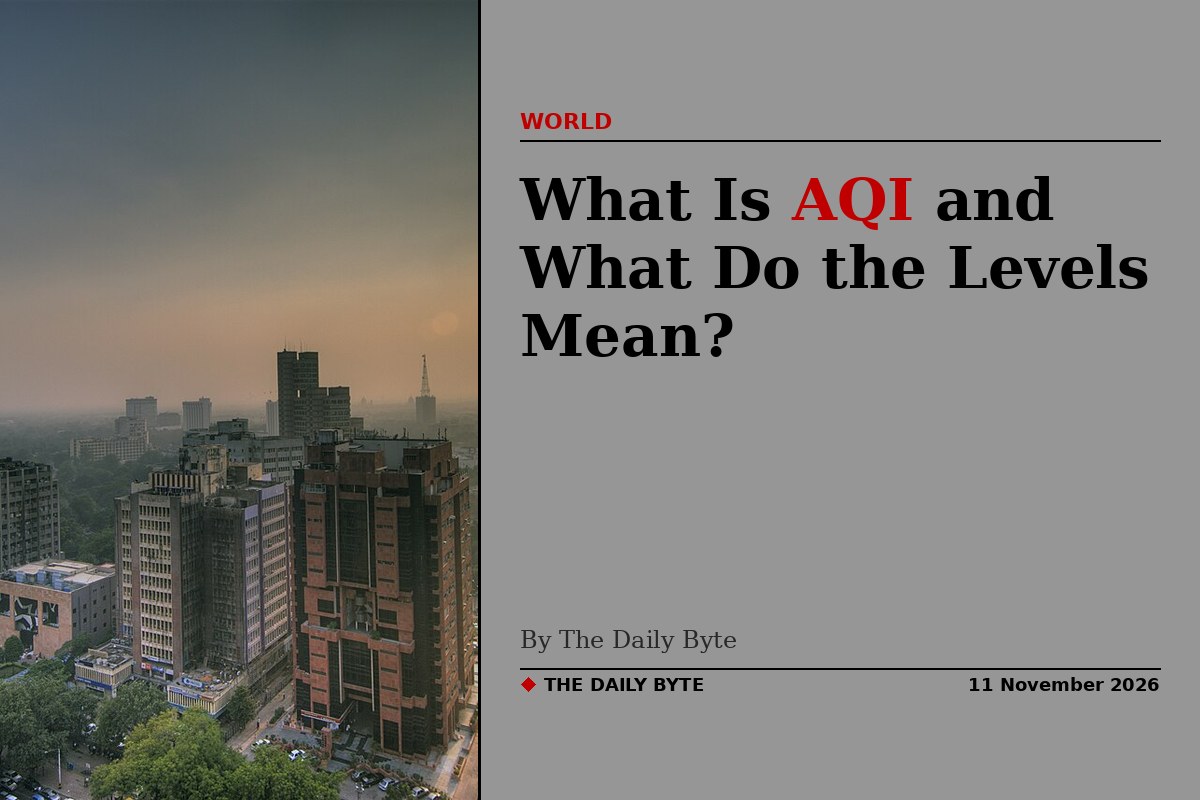
AQI stands for Air Quality Index. It is a single number that sums up how clean or polluted the air is in a place at a given time, and what that means for your health. The higher the number, the worse the air. The catch is that the scale you are reading matters, because the United States, the United Kingdom and India do not use the same one, so the same air can produce very different numbers depending on where you look it up.
The question is being asked widely this week because Delhi's air has turned hazardous after Diwali, with doctors advising people who can to leave the city temporarily until conditions improve. Delhi's average reading stood at 299 on Wednesday morning, 11 November, on India's scale, one point below the "very poor" threshold, after 307 on Tuesday and 376 on Monday, according to the Central Pollution Control Board. To make sense of a number like that, you need to know which scale it is on, which pollutant is driving it, and what the health advice is at that level.
What does AQI stand for?
AQI stands for Air Quality Index. In the United States it is the Environmental Protection Agency's tool for reporting outdoor air quality, published through its AirNow service. It takes measurements of several pollutants and converts them into one number on a colour-coded scale, so that anyone can tell at a glance whether the air is safe to breathe.
The US system is built around a simple anchor point. An AQI value of 100 generally corresponds to the level of the short-term national air quality standard set to protect public health. Values at or below 100 are generally thought of as satisfactory. When values go above 100, air quality is unhealthy, at first for certain sensitive groups of people, and then for everyone as the number climbs higher. That is why a reading of 101 is not just a little worse than 100: it is the point at which the official advice starts to change.
How does the US AQI scale work?
The US AQI is divided into six colour-coded categories, each covering a range of values and a level of health concern. The categories, as set out by the US Environmental Protection Agency, are:
Good, 0 to 50, green. Air quality is satisfactory, and air pollution poses little or no risk.
Moderate, 51 to 100, yellow. Air quality is acceptable. However, there may be a risk for some people, particularly those who are unusually sensitive to air pollution.
Unhealthy for Sensitive Groups, 101 to 150, orange. Members of sensitive groups may experience health effects. The general public is less likely to be affected.
Unhealthy, 151 to 200, red. Some members of the general public may experience health effects, and members of sensitive groups may experience more serious health effects.
Very Unhealthy, 201 to 300, purple. This is a health alert: the risk of health effects is increased for everyone.
Hazardous, 301 and higher, maroon. This is a health warning of emergency conditions, and everyone is more likely to be affected.
The overall AQI reported for a place is set by whichever pollutant scores highest. If fine particles are at 180 but ozone is at 60, the reported AQI is 180, and the advice follows the worst pollutant, not the average.
Which pollutants does the AQI measure?
The US index covers five major pollutants: ground-level ozone, particle pollution, carbon monoxide, sulphur dioxide and nitrogen dioxide. In practice, fine particle pollution, known as PM2.5, is most often the pollutant that drives the reading in cities, especially during smog episodes, wildfires and winter pollution peaks.
The UK's Daily Air Quality Index works on the same principle but with a different set of inputs. It measures five pollutants: particulate matter PM2.5, particulate matter PM10, nitrogen dioxide, ozone and sulphur dioxide. Its score for a location is based on the highest measured or predicted level out of those five pollutants, according to the Department for Environment, Food and Rural Affairs.
What is PM2.5, and why does it matter most?
PM2.5 means particulate matter with a diameter of 2.5 micrometres or less. For context, the width of a human hair is 50 to 70 micrometres, so these particles are roughly twenty to thirty times smaller. They can include dust, soot, smoke and drops of liquid, and they come from burning fuel in vehicles, industry and homes, from the wear of tyres and brakes, from wind-blown soil and dust, from sea spray and from burning vegetation.
Their size is what makes them dangerous. They are small enough to be drawn deep into the lungs, and the smallest can pass into the bloodstream. In the short term, exposure can worsen asthma and chronic obstructive pulmonary disease. In the long term, the UK government lists strokes, lung cancer, diabetes, Alzheimer's and Parkinson's disease, and poor lung health in children among the health impacts linked to PM2.5.
PM10 particles are larger, up to 10 micrometres across. Their main sources include dust from construction sites, landfills and agriculture, wildfires, pollen, power stations and vehicles. Short-term exposure can cause difficulty breathing, coughing, and irritation of the eyes, nose and throat, along with chest tightness and pain. Long-term exposure is linked to lung tissue damage, asthma, heart failure, cancer and chronic obstructive pulmonary disease.
Nitrogen dioxide is a colourless gas produced mainly by burning petrol or diesel in car engines, burning natural gas in boilers and power stations, welding, explosives and manufacturing. Short-term exposure can cause asthma attacks and respiratory infections, while long-term exposure is linked to poorer lung function in children. Ozone is different: there are no major sources that emit it directly. It forms when other pollutants react with sunlight, and it can reach unhealthy levels on hot and cold days alike. Sulphur dioxide is a colourless gas with a strong odour, produced mainly by burning fuel, gas boilers and coal-fired power stations, and it irritates the eyes, nose and throat.
How is the UK's air quality index different?
The UK does not use the 0 to 500 American scale. Its Daily Air Quality Index, known as the DAQI, runs from 1 to 10 and is divided into four bands: low pollution at levels 1, 2 and 3, shown in green; moderate pollution at levels 4, 5 and 6, shown in yellow; high pollution at levels 7, 8 and 9, shown in red; and very high pollution at level 10, shown in purple. The system was recommended by the Committee on the Medical Effects of Air Pollutants.
Each band comes with health advice for the general public and for people who are more sensitive, including adults and children with heart or lung conditions and older people. At low levels, the advice is simply to enjoy your usual outdoor activities. At moderate levels, adults and children with lung problems, and adults with heart problems, who experience symptoms should consider reducing strenuous physical activity, particularly outdoors, while everyone else can carry on as normal.
At high levels, people with lung or heart problems should reduce strenuous physical exertion, particularly outdoors, especially if they have symptoms. People with asthma may find they need to use their reliever inhaler more often, and older people should also reduce physical exertion. Anyone experiencing discomfort such as sore eyes, a cough or a sore throat should consider reducing activity, particularly outdoors. At very high levels, the top of the scale, people with lung or heart problems and older people should avoid strenuous physical activity altogether, and the general public should reduce physical exertion, particularly outdoors, especially if they have symptoms such as a cough or sore throat.
What is India's AQI scale, and why is Delhi in the news?
India's Central Pollution Control Board uses a 0 to 500 scale with six bands of its own: 0 to 50 is good, 51 to 100 is satisfactory, 101 to 200 is moderate, 201 to 300 is poor, 301 to 400 is very poor, and 401 to 500 is severe. The bands are different from the American ones, so a Delhi reading of 299 is "poor" on the Indian scale, while the same concentration of pollution would be reported differently on the US scale. That is why numbers from different countries, apps and websites cannot be compared directly without checking which scale they use.
Delhi's air crisis returns every October and November, when cooler air traps pollution close to the ground and smoke from crop burning drifts towards the capital, on top of vehicle exhaust, construction dust and, this year, firecracker smoke from Diwali. The city's average AQI reached 369 on Diwali eve, the worst pre-Diwali reading in a decade, and 383 on Diwali morning, 8 November, with 24 of 54 monitoring stations already in the "severe" band, the Hindustan Times reported. Jahangirpuri in north Delhi recorded 450 that morning, followed by RK Puram at 444.
By Wednesday 11 November the average had eased to 299, still "poor" and only one point below "very poor", with no rain forecast between 10 and 15 November to wash the pollution away, according to the India Meteorological Department. The Commission for Air Quality Management has invoked Stage III of its Graded Response Action Plan across Delhi and the surrounding National Capital Region, schools have been told to run classes up to Class 5 in hybrid mode, and water sprinklers have been deployed to settle particulate matter.
Doctors in the city have been unusually blunt. Dr Rajesh Chawla, a senior pulmonologist at Apollo Indraprastha Hospital, advised people who have the option to leave Delhi for a few days until air quality improves, and said those who can should not travel to the city in the first place. Professor Vijay Hadda of the All India Institute of Medical Sciences said the AQI, which used to sit in three figures, had moved into four figures, and that even healthy colleagues had complained of constant throat irritation. Another senior doctor, Dr S. Chatterjee of Apollo Hospitals, said symptoms can begin in otherwise healthy people within four to six hours of exposure to such high pollution, and urged residents to avoid going out unnecessarily and to avoid exercising outdoors while pollution is high.
What should you do when the AQI is high?
The first step is to check an official forecast rather than a single reading from an app. In the UK, Defra publishes a daily air pollution forecast and a check-air-quality service. In the United States, the Environmental Protection Agency's AirNow service does the same. In India, the Central Pollution Control Board's AQI portal and its SAMEER mobile application are the official sources. A single hourly spike can be misleading, because official indexes are built around averages over several hours or a day.
When the reading is moderate, most people can carry on as normal, but people who are unusually sensitive to air pollution should consider cutting back on prolonged outdoor exertion. When it reaches unhealthy levels, sensitive groups should reduce prolonged or heavy exertion outdoors, and everyone should take symptoms seriously. At very unhealthy and hazardous levels, the advice is to stay indoors as much as possible, keep windows closed during the worst episodes, move exercise inside, and wear a mask if you do have to go out. Children, older people and anyone with a heart or lung condition should take extra care at every level above moderate.
These are general steps, not personal medical advice. If breathing does not improve, if there is chest pain, or if wheezing is severe or symptoms are getting worse, medical attention should be sought promptly.
Frequently asked questions about AQI
What is a good AQI? On the US scale, 0 to 50 is good. On the UK's Daily Air Quality Index, levels 1 to 3 are low. On India's scale, 0 to 50 is good. Anything at or below those ranges means air pollution poses little or no risk.
Can the AQI go above 500? The standard US scale runs to 500, and anything above 300 is already classed as hazardous, which is a health warning of emergency conditions. Readings beyond 500 are sometimes reported during extreme events, but they do not change the advice: stay indoors as much as possible and avoid strenuous outdoor activity.
Is AQI the same thing as PM2.5? No. AQI is the summary number. PM2.5 is one pollutant, fine particle pollution, that is measured to produce it. PM2.5 is often the pollutant that sets the AQI during smog, but ozone can drive the number on hot, sunny days instead.
Why does the AQI change during the day? Pollution rises and falls with traffic, weather and sunlight. Calm, cold air traps pollution near the ground, which is why winter mornings are often worst. Wind disperses it, rain washes it out, and sunlight drives the chemical reactions that create ozone.
Where can I check the AQI? Use an official source for your country: AirNow in the United States, Defra's check-air-quality service in the United Kingdom, and the Central Pollution Control Board's AQI portal or SAMEER app in India. Always check which scale the figure you are reading is on before comparing it with a number from another country.


