What Is Armistice Day? 11 November 2026 Explained
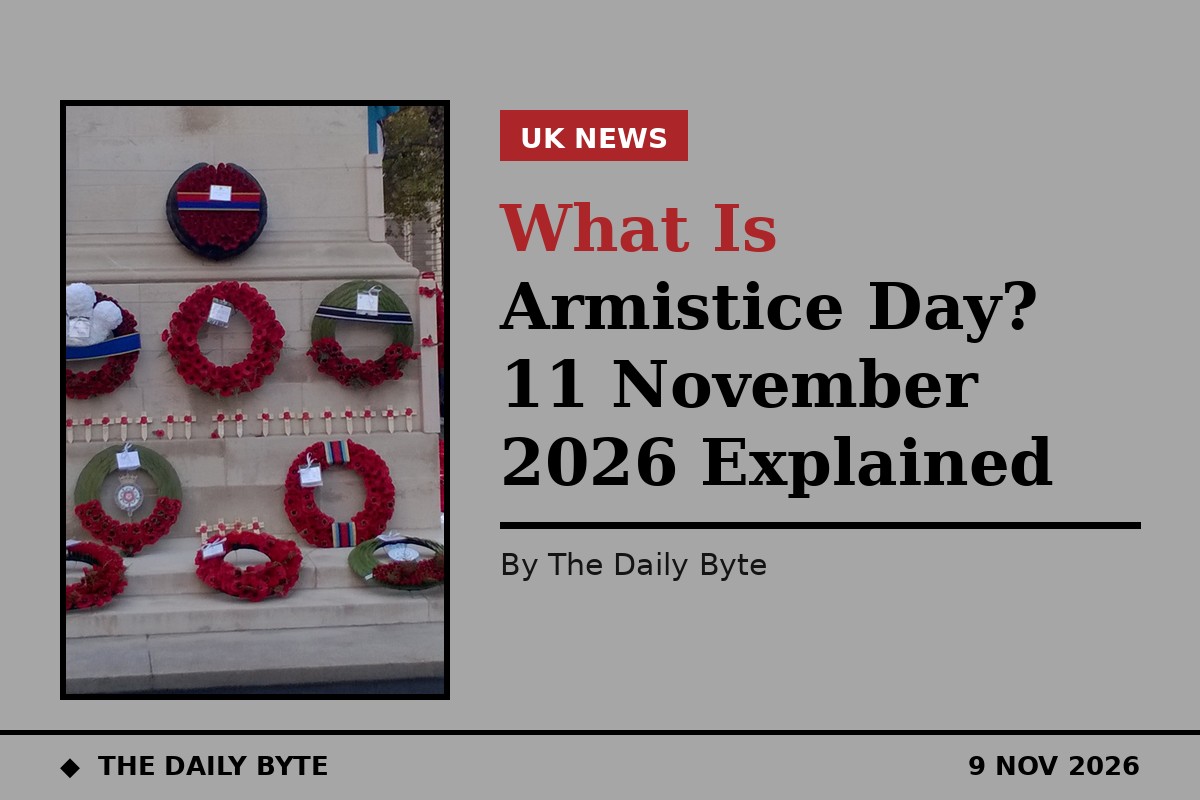
Armistice Day is observed every year on 11 November to mark the armistice that ended the fighting of the First World War. The armistice was signed in the early hours of 11 November 1918 and came into force at 11am that day, the eleventh hour of the eleventh day of the eleventh month. In 2026, Armistice Day falls on Wednesday 11 November, and at 11am the country will again fall silent for two minutes to remember the dead.
It is not the same as Remembrance Sunday, although the two are closely linked. Remembrance Sunday, the day of the big national ceremony at the Cenotaph in London, was held this year on Sunday 8 November 2026. Armistice Day is the fixed date itself, 11 November, and it is marked more quietly, with a two-minute silence at war memorials, schools and workplaces across the country.
When is Armistice Day 2026?
Armistice Day 2026 is on Wednesday 11 November 2026. The date never moves: it is always 11 November, because that is the anniversary of the day the guns fell silent in 1918. The two-minute silence is held at 11am, the exact time the armistice took effect 108 years ago. Remembrance Sunday, by contrast, is always the second Sunday in November, the Sunday nearest to 11 November, which is why it fell on 8 November this year.
The principal national ceremony on 11 November itself is held at the National Memorial Arboretum in Alrewas, Staffordshire, at the Armed Forces Memorial. Local services take place at war memorials in towns and villages throughout the United Kingdom, and many schools, offices, railway stations and workplaces pause for the silence at 11am. Armistice Day is not a public holiday in the United Kingdom.
What happened on 11 November 1918?
The armistice was signed in a railway carriage in the Forest of Compiegne in northern France, where the German delegation met the Allied commander, Marshal Ferdinand Foch. It was signed in the early hours of the morning and came into effect at 11am Paris time. The agreement was a ceasefire, not a peace treaty: it stopped the fighting on the Western Front after more than four years of war, and the formal peace settlement only followed when the Treaty of Versailles was signed the next year.
The fighting did not stop gently. Orders to cease fire took time to reach the front line, and men were still being killed in the hours between the signing and 11am. One estimate puts the number of men killed on 11 November 1918 alone at 2,738. The first news of peace was greeted with relief and celebration in London, Paris and other Allied capitals, but for the families of those who had died, and for the millions living with the consequences of the war, the day quickly took on a more solemn meaning.
Why do we fall silent at 11am?
The two-minute silence began the year after the war ended. In 1919, King George V asked the country to observe two minutes of complete silence at 11am on 11 November, so that, in his words, there could be a brief suspension of all normal activities in memory of the dead. The first official Armistice Day events were held in the grounds of Buckingham Palace on the morning of 11 November 1919, and the silence has been observed every year since.
The silence lasts two minutes, from 11am to 11.02am. At the Cenotaph and at formal ceremonies it is opened and closed by a gun fired by the King’s Troop Royal Horse Artillery on Horse Guards Parade, followed by buglers sounding the Last Post. The timing is the whole point of the day: the eleventh hour of the eleventh day of the eleventh month is when the armistice took effect, and the silence returns the country to that exact moment.
Armistice Day vs Remembrance Sunday: what is the difference?
The two days honour the same dead, but they are not the same observance. Armistice Day is the fixed anniversary, 11 November, marking the end of the First World War. Remembrance Sunday is the national day of services, held on the second Sunday in November, and it is when the National Service of Remembrance takes place at the Cenotaph in Whitehall, with the King, the Prime Minister and the leaders of the other parties laying wreaths, and around 10,000 veterans marching past.
The split dates back to the Second World War. In 1939, the two-minute silence was moved to the Sunday nearest to 11 November so that observing it on a weekday would not disrupt wartime production. After the war, the Sunday observance was kept and became Remembrance Sunday, commemorating the dead of both world wars and every conflict since. Since the 50th anniversary of the end of the Second World War in 1995, it has become usual to hold ceremonies on both days: the big national service on the Sunday, and a quieter silence on 11 November itself.
Originally, Armistice Day commemorated only those killed in the First World War. After 1945 its scope widened, as it did for Remembrance Sunday, to include the dead of the Second World War and later conflicts involving British and Commonwealth forces. The red poppy, inspired by John McCrae’s 1915 poem In Flanders Fields and adopted by the Royal British Legion when it began selling poppies in 1921, is worn for both days.
What happens on Armistice Day in the UK?
At 11am on Wednesday 11 November 2026, a two-minute silence will be observed at the National Memorial Arboretum and at war memorials across the country. Many schools hold their own short services, and employers commonly pause work for the two minutes. The Royal British Legion, which organises the annual Poppy Appeal and is the national custodian of remembrance, provides resources for schools, employers and communities marking the day.
There is no rule about wearing a poppy: the Legion says it is a personal choice. Poppies are sold from late October until Armistice Day or Remembrance Sunday, whichever comes later, and the money raised supports serving personnel, veterans and their families. The poppy itself has been made entirely from paper since 2023, so it can be recycled with household paper after the commemorations.
How other countries mark 11 November
The date is marked very differently around the world. In France, 11 November is a full public holiday, and the President lays a wreath at the Arc de Triomphe in Paris. Belgium also keeps it as a public holiday. In Poland, the same date is National Independence Day, a public holiday marking the restoration of Polish sovereignty in 1918 after 123 years of partition.
In the United States, 11 November was Armistice Day until 1954, when it was renamed Veterans Day to honour all American veterans, living and dead. It remains a federal holiday. Canada calls it Remembrance Day, and Australians observe one minute of silence at 11am, rather than two. In Serbia, 11 November has been a public holiday since 2012, and people wear the Natalie's ramonda flower as a symbol of remembrance. In Kenya, ceremonies are held over the weekend two weeks after Armistice Day, because news of the armistice only reached the region about a fortnight later.
Frequently asked questions
Is Armistice Day a bank holiday in the UK? No. Armistice Day is not a public holiday in the United Kingdom, and neither is Remembrance Sunday. The commemoration is the two-minute silence at 11am, observed wherever people happen to be.
What time is the two-minute silence on Armistice Day? It starts at exactly 11am and lasts until 11.02am, marking the moment the armistice came into force on 11 November 1918.
What is the difference between Armistice Day and Remembrance Day? In the UK they are closely related but distinct. Armistice Day is the fixed date, 11 November. Remembrance Sunday is the Sunday nearest to it, when the national service is held at the Cenotaph. In Canada and other Commonwealth countries, 11 November itself is called Remembrance Day.
Why is it called Armistice Day? An armistice is an agreement to stop fighting. The armistice of 11 November 1918 ended hostilities on the Western Front. It was not the peace treaty, which came later with the Treaty of Versailles in 1919.
Where is the main Armistice Day service held? The principal national ceremony on 11 November is held at the National Memorial Arboretum in Alrewas, Staffordshire. The National Service of Remembrance, with the King and political leaders, is held at the Cenotaph in London on Remembrance Sunday.
Sources: Awareness Days, Armistice Day 2026; Wikipedia, Armistice Day and Remembrance Sunday; Royal British Legion, About Remembrance.