What Is ASEAN? Southeast Asia Bloc Explained
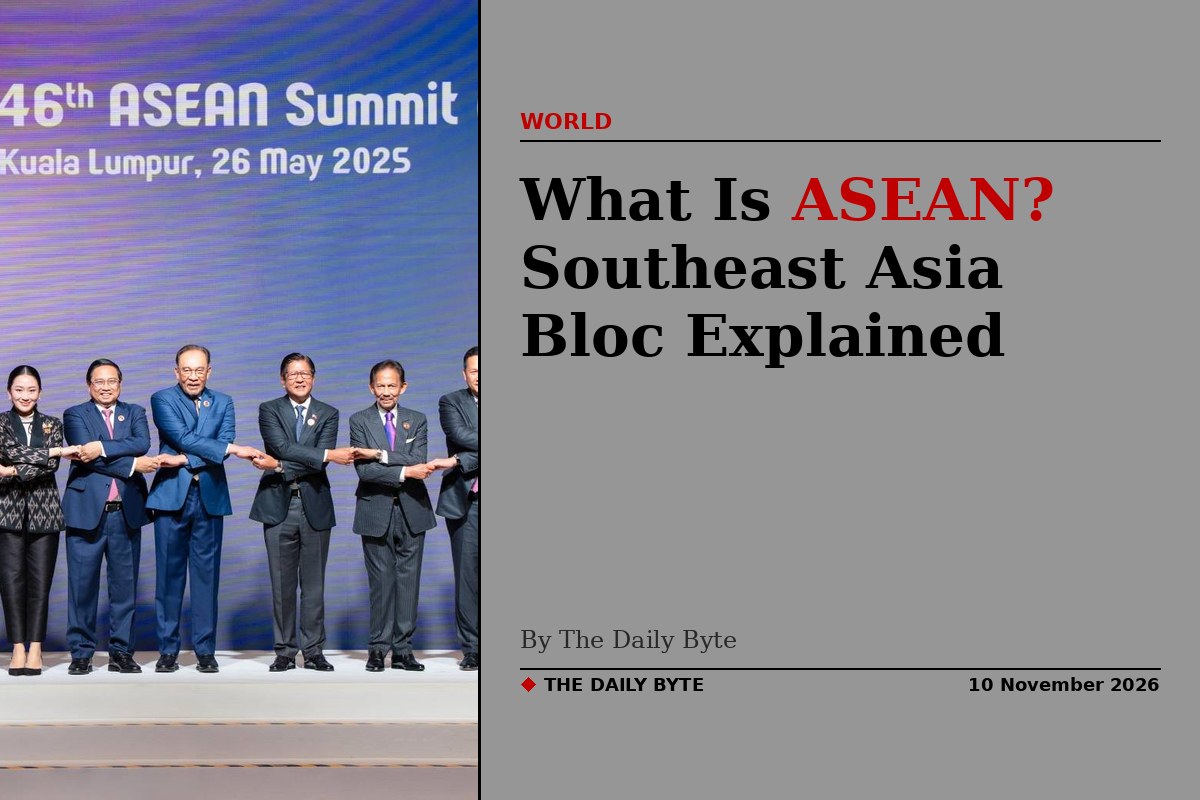
ASEAN is the Association of Southeast Asian Nations, a regional bloc of 11 countries in Southeast Asia that works together on trade, security and shared problems. It was founded on 8 August 1967 in Bangkok, when five countries signed the Bangkok Declaration, and it has grown from a small Cold War-era grouping into one of the world's most important regional organisations. Its motto is "One Vision, One Identity, One Community".
The bloc matters because Southeast Asia sits at the centre of some of the world's busiest shipping lanes and fastest-growing economies. When ASEAN leaders meet, their decisions affect trade, travel, disaster relief and security across a region home to hundreds of millions of people. The Philippines holds ASEAN's rotating chair in 2026, and Manila is hosting the 49th ASEAN Summit and Related Summits from 15 to 17 November 2026.
Which countries are in ASEAN?
ASEAN now has 11 member states. The five founding members were Indonesia, Malaysia, the Philippines, Singapore and Thailand, who signed the Bangkok Declaration on 8 August 1967. Brunei joined in 1984, Vietnam in 1995, Laos and Myanmar in 1997, and Cambodia in 1999. Timor-Leste became the 11th member in October 2025, at the 47th ASEAN Summit in Kuala Lumpur, the bloc's first enlargement since 1999.
The full list is Brunei, Cambodia, Indonesia, Laos, Malaysia, Myanmar, the Philippines, Singapore, Thailand, Vietnam and Timor-Leste. Papua New Guinea holds observer status. English is the bloc's working language, which is one reason ASEAN documents and summits are followed so closely by businesses and governments outside the region.
What does ASEAN actually do?
ASEAN's work is organised around three communities: the Political-Security Community, the Economic Community and the Socio-Cultural Community. The political-security arm covers defence cooperation, counter-terrorism, disaster response and the peaceful settlement of disputes. The economic arm works to cut tariffs and other barriers between members so goods, services, investment and skilled workers can move more easily across the region. The socio-cultural arm covers education, health, the environment and people-to-people links.
In practice, ASEAN runs hundreds of meetings a year, from leaders' summits to ministerial meetings on trade, finance, health and the environment. It also negotiates as a bloc with outside powers. Its dialogue partners include the United States, China, Japan, India, Australia and the European Union, and leaders from those countries are regularly invited to ASEAN summits and related meetings.
ASEAN has also built a wider web of regional forums, including the ASEAN Regional Forum on security, the East Asia Summit and ASEAN Plus Three, which brings in China, Japan and South Korea. For many smaller countries in the region, these forums are the main stage on which they deal with the great powers as a group rather than one by one.
How does ASEAN make decisions?
ASEAN decides by consultation and consensus, a style often called the "ASEAN Way". In plain terms, members talk until they can all agree, and no member is outvoted. The ASEAN Charter, which came into force on 15 December 2008, sets out this rule and gives the bloc a legal personality, a secretariat and a formal structure.
The Charter also sets out the principle of non-interference in the internal affairs of member states, alongside respect for sovereignty, territorial integrity and the peaceful settlement of disputes. The ASEAN Secretariat is based in Jakarta, Indonesia, and is led by a Secretary-General. The chairmanship rotates among members each year, and the chair sets the agenda and hosts the year's summits.
Consensus has strengths and weaknesses. It keeps the bloc together by making sure no member is forced into a decision it opposes, which matters in a group that spans democracies, monarchies and military-led governments. But it can also make ASEAN slow to act, because a single member can block a joint statement or a strong collective response.
What is happening at the ASEAN Summit in Manila?
The Philippines is hosting the 49th ASEAN Summit and Related Summits from 15 to 17 November 2026 at the Philippine International Convention Center in Manila. More than 20 leaders from ASEAN member states and dialogue partners are expected, with discussions covering regional stability, economic integration, energy security and digital transformation. The Philippines holds the chair under the theme "Navigating Our Future, Together".
Preparations have been under way for months, with venues inspected, security tightened across Metro Manila and special arrangements for delegates, including free jeepney rides in parts of the capital. The summit is the centrepiece of the Philippines' chairmanship year, and its outcome will be watched for signs of how the region handles trade tensions, the South China Sea and the crisis in Myanmar.
Why does ASEAN matter to the UK and the wider world?
ASEAN matters well beyond Southeast Asia because the region is a manufacturing hub, a growing consumer market and a crossroads for global trade. Goods moving between East Asia, the Indian Ocean and the Pacific pass through Southeast Asian waters, including the Strait of Malacca, one of the world's busiest shipping channels. When ASEAN economies grow, demand rises for everything from financial services to food and energy.
For the UK, ASEAN is a significant trading partner and a focus of the Government's tilt towards the Indo-Pacific. Britain became a dialogue partner of ASEAN in 2021, the first new dialogue partner in 25 years, and British ministers regularly attend ASEAN meetings. For businesses, ASEAN's work on cutting tariffs and aligning rules can decide whether it is easy or hard to sell into ten or eleven separate markets.
ASEAN also matters strategically. The United States and China both court the bloc, and ASEAN's insistence on staying central to regional diplomacy gives its members a collective voice they would not have alone. When ASEAN speaks with one voice, the world's biggest powers listen; when it cannot agree, that silence is itself a signal.
What are the criticisms of ASEAN?
Critics say ASEAN's consensus rule and its principle of non-interference have limited its ability to respond to crises, above all in Myanmar. After the military takeover in Myanmar in 2021, ASEAN agreed a Five-Point Consensus calling for an end to violence and dialogue between all parties, but the plan has produced little visible progress, and critics argue the bloc has struggled to enforce it.
Others point to slow progress on economic integration. Despite decades of work, doing business across ASEAN can still mean dealing with different rules, standards and paperwork in each country, and the goal of a single market remains unfinished. Supporters reply that ASEAN was never designed to be like the European Union: it is an intergovernmental club of sovereign states, not a body that can overrule its members.
There are also questions about how ASEAN handles the South China Sea, where several members have competing claims with China. ASEAN has negotiated for years over a code of conduct for the sea, but agreement has proved elusive, and some members have preferred to deal with Beijing directly rather than wait for a joint position.
Frequently asked questions about ASEAN
Is ASEAN like the European Union? No. The EU has a single market, a parliament and laws that bind members, while ASEAN is an intergovernmental organisation that works by consensus and does not overrule its members. There is no ASEAN single currency and no ASEAN citizenship.
Where is ASEAN's headquarters? The ASEAN Secretariat is in Jakarta, Indonesia.
Is Timor-Leste a member of ASEAN? Yes. Timor-Leste became the 11th member in October 2025, after being admitted in principle in 2022 and holding observer status.
When was ASEAN founded? On 8 August 1967, when Indonesia, Malaysia, the Philippines, Singapore and Thailand signed the Bangkok Declaration.
Who chairs ASEAN in 2026? The Philippines, which is hosting the 49th ASEAN Summit in Manila from 15 to 17 November 2026.


