What Is AUKUS? Australia Submarine Deal Explained
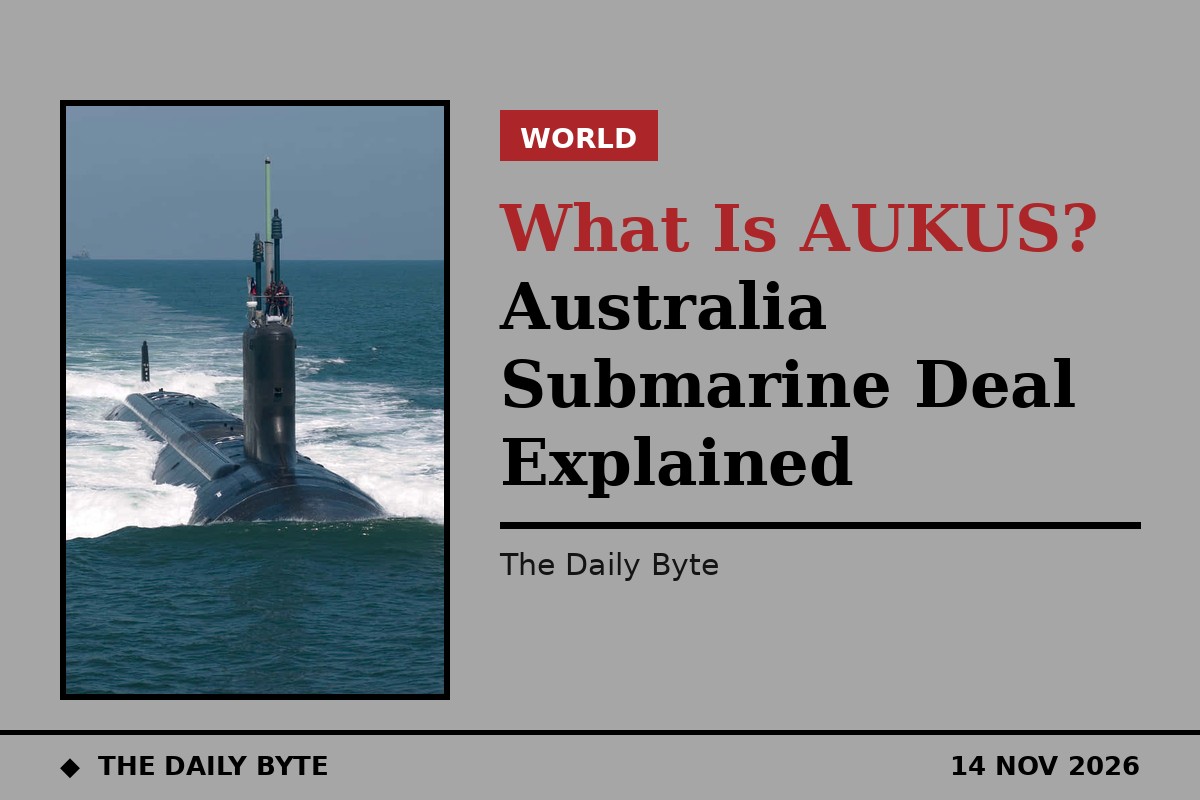
AUKUS is a security partnership between Australia, the United Kingdom and the United States, announced in September 2021, whose best-known element is supplying Australia with nuclear-powered attack submarines. Under the current plan, Australia will receive three second-hand American Virginia-class submarines in 2032, 2035 and 2038, and will then build five new SSN-AUKUS submarines, the first from the early 2040s. Defence Minister Richard Marles said on 28 October 2026 that Australia remains on track for the first delivery in the early 2030s. The United States Studies Centre sets out the revised timeline in full.
What does AUKUS stand for?
The name is an acronym made from the three partners: Australia, the United Kingdom and the United States. The partnership has two parts. Pillar I is the submarine programme. Pillar II is cooperation on advanced defence capabilities, including work on artificial intelligence, cyber, quantum technologies and hypersonic weapons. The submarine deal is the part that attracts most attention because it involves sharing nuclear propulsion technology with a country that has never operated a nuclear-powered submarine, and because of its scale and cost.
How the submarine plan works
The delivery plan, known as the Optimal Pathway, was announced by the three governments in March 2023. It was revised on 30 May 2026, when Marles announced at the Shangri-La Dialogue in Singapore that Australia would take three in-service Block IV Virginia-class submarines instead of a mix that included a newly built boat. He said the change would streamline the programme by reducing the number of submarine types Australia must sustain and train crews for. Marles repeated in October 2026 that the programme is on track.
The Virginia-class boats are the bridge to a new class, SSN-AUKUS, which will be built to a British design in Britain and in Australia. British-built boats are expected to enter service in the late 2030s, with Australian-built boats following in the early 2040s. Before any Australian boat arrives, American and British submarines are due to begin operating from HMAS Stirling near Perth in Western Australia from 2027, under a rotational presence called Submarine Rotational Force-West. Australia is also extending the life of its existing Collins-class diesel-electric submarines so it does not face a gap in capability while it waits.
A Block IV Virginia-class boat displaces around 7,900 tonnes, carries a crew of about 132, and is armed with Tomahawk cruise missiles and Mk-48 torpedoes. Because the three boats Australia will receive are already in service, they will arrive with part of their reactor life used up. The United States Studies Centre estimates they will offer around 23 years of operational availability, compared with 33 years for a newly built boat, and that the third boat, due in 2038, could reach the end of its service life around 2061 rather than around 2071.
What does AUKUS cost?
The Australian government costed the programme at roughly A$268 billion to A$368 billion over three decades when the Optimal Pathway was announced in 2023, and the A$368 billion figure has become the widely cited headline price. The programme also depends on American shipyards, which currently build about 1.2 to 1.3 Virginia-class submarines a year, against an estimated requirement of about 2.33 a year to meet both United States Navy needs and the Australian transfers. That gap is one reason the timetable is watched so closely in Washington, where officials must balance their own navy's needs against the commitment to Australia.
Why is AUKUS controversial?
China has protested against AUKUS since it was announced, arguing that it raises tensions and risks spreading nuclear technology. Australia, Britain and the United States reject that argument. They say the boats will be conventionally armed, will not carry nuclear weapons, and are consistent with non-proliferation rules because the nuclear material stays sealed inside the propulsion system. Inside Australia, critics question whether the timetable and the cost can hold, and whether the boats will arrive at all if American production slips. The government disagrees: Prime Minister Anthony Albanese said in August 2026 that the pact remained full steam ahead, and Marles used his October meeting with United States Defense Secretary Pete Hegseth to reinforce that position.
Frequently asked questions
When will Australia get its first nuclear-powered submarine? The first of three Virginia-class boats is due in 2032, with the other two following in 2035 and 2038, and the first Australian-built SSN-AUKUS boat is expected from the early 2040s.
Will the submarines carry nuclear weapons? No. The boats are nuclear-powered but conventionally armed, carrying cruise missiles and torpedoes rather than nuclear weapons.
What is SSN-AUKUS? It is the new submarine class Australia and Britain will build together, based on a British design with American combat systems, to replace the Virginia-class boats from the 2040s.
Why does Australia want nuclear-powered submarines? Because they can travel further, stay submerged longer and move faster than the diesel-electric Collins-class boats Australia operates today, which matters in a region defined by long distances and open ocean.


