What Is the Australia-Solomon Islands Treaty?
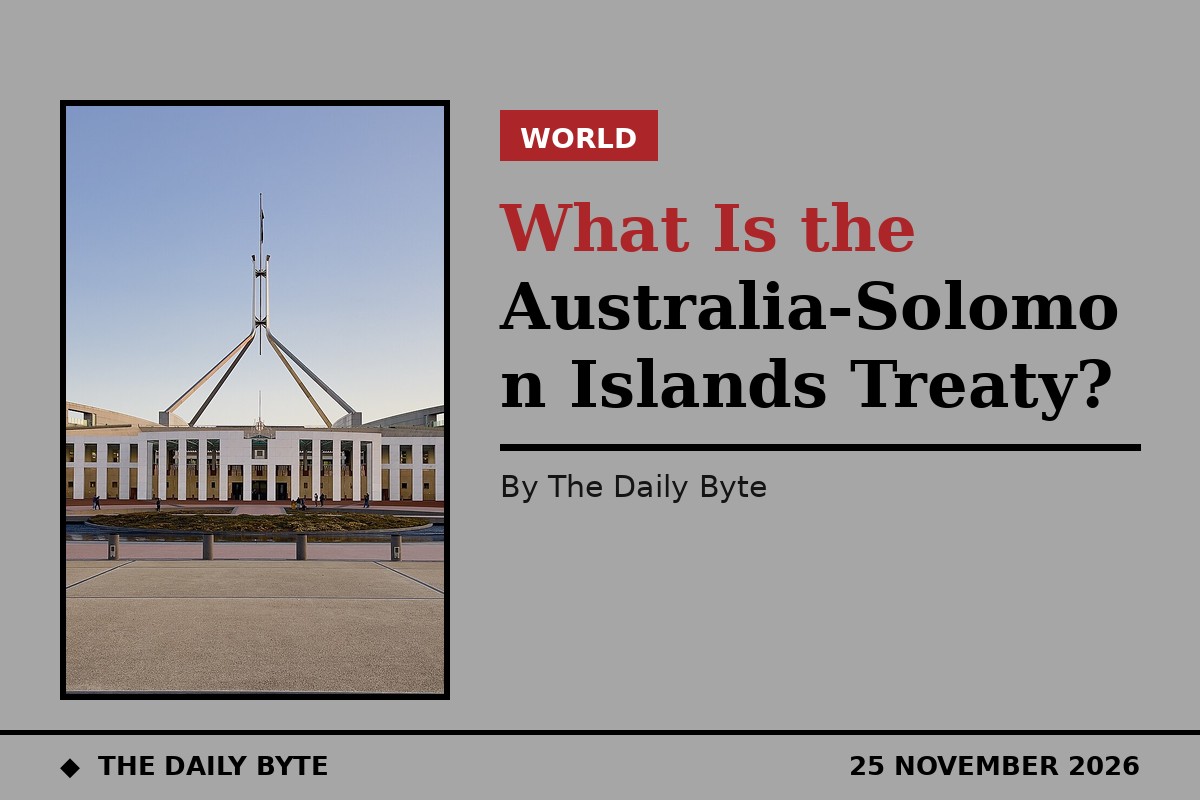
Australia and Solomon Islands signed a wide-ranging treaty in Canberra on Tuesday 25 November 2026, making Australia the Pacific island nation's primary security partner and recording Solomon Islands' decision that no foreign military or security base will ever be established on its soil. The treaty, signed by Australian Prime Minister Anthony Albanese and Solomon Islands Prime Minister Matthew Cooper Wale, pairs security commitments with Australian funding for education, infrastructure, policing and jobs, and it is widely read as a check on China's influence in the South Pacific.
The signing matters because Solomon Islands signed a secretive security pact with China only four years ago, in 2022, a deal that raised fears in Canberra and Washington of a Chinese naval foothold in the region. The new treaty does not name China, but its central promise — no foreign base, and sensitive infrastructure kept free from militarisation and foreign interference — answers that fear directly, while the Australian funding attached to it gives Honiara a concrete reason to choose Canberra as its partner.
What does the treaty actually say?
The joint statement issued by the two prime ministers sets out a treaty that covers security, development and people-to-people ties together, rather than defence alone. Its most important provisions are these: Australia becomes Solomon Islands' primary security partner, described by the leaders as its security partner of choice; Solomon Islands affirms its sovereign decision that there will be no foreign military or security base in the country; and the country's sensitive infrastructure will remain free from militarisation, foreign interference and unauthorised access.
Security: Australia will support the expansion and development of a stronger, modern and self-reliant Royal Solomon Islands Police Force, and will continue to support the development of Solomon Islands' border management system.
No foreign bases: Solomon Islands' sovereign decision is that there will be no foreign military or security base on its territory, and its sensitive infrastructure — including ports, airports, energy and telecommunications, and road and bridge construction — will remain free from militarisation, foreign interference and unauthorised access.
Consultation: Solomon Islands will consult Australia before making deals involving critical infrastructure or security cooperation with countries outside the Pacific Islands Forum regional bloc.
Education and budget: Australia will provide substantial support for the Solomon Islands Government's free education policy, and budget support to help the government invest in its communities. The Associated Press reported the package at 740 million Australian dollars, about 490 million United States dollars, over ten years.
Infrastructure and energy: Australia will increase ongoing investment in sustainable infrastructure, including roads and renewable energy.
Jobs and visas: Australia will support Solomon Islands under an expanded Pacific Australia Labour Mobility approach, opening opportunities in early childhood and aged care, expanding access to new locations and increasing skills training. Solomon Islanders will also benefit from improved visa arrangements, with longer stays, extended validity and visa facilitation inside the country in Honiara.
The treaty also covers culture, sport and the arts, including an expanded football partnership. The leaders said the agreement affirms Solomon Islands' sovereignty and its capacity to determine its own security needs and partnerships, and that it is a partnership built on sovereignty, trust, mutual respect, open dialogue and shared purpose.
Why does the no-base clause matter so much?
Solomon Islands is an archipelago about 2,000 kilometres north-east of Australia, spread across the sea route between the United States and Australia. During the Second World War, the United States commander General Douglas MacArthur directed the Pacific campaign from the region, and the islands have held strategic value ever since because of where they sit, not because of their size.
That geography is why the 2022 China security pact caused such alarm. The pact, whose text was never published, brought Chinese police trainers to the capital, Honiara, and raised the possibility — denied by both Honiara and Beijing — that China might one day seek a naval presence in the country. Australia, which describes itself as Solomon Islands' largest development partner, has spent the years since trying to restore its position as the islands' first-choice security partner. The treaty signed on 25 November is the formal result of that effort.
What happens to the China security pact?
Reports before the signing said Solomon Islands had told Beijing that the China pact would not be renewed when it expires after five years in early 2027, with one report putting the lapse in April 2027. Prime Minister Wale would neither confirm nor deny those reports at the press conference with Mr Albanese at Parliament House in Canberra, saying there is a non-disclosure clause in the treaty with China and that discussions with Beijing are continuing.
That leaves the position deliberately unclear. What is clear is that the new Australian treaty does not apply retroactively to existing arrangements, and that Solomon Islands has now made a public sovereign commitment against any foreign base — a commitment that would be difficult to square with renewing a security pact that other countries feared could lead to one. The China pact's future is now the main unanswered question hanging over the treaty.
The signing in Canberra was the fifth meeting between the two leaders since Mr Wale came to office, according to the Australian Associated Press, and the scale of the occasion underlined its importance: Mr Wale travelled with 15 of his ministers for talks spanning security, infrastructure, education and health. That breadth is the point of the treaty. It is not a narrow defence pact but a whole-of-relationship agreement, and its drafters clearly intended it to be hard to unwind, because the education, jobs and infrastructure commitments give ordinary Solomon Islanders a direct stake in the partnership, not just their government.
What does Australia get out of the deal?
Australia gets certainty about its near neighbourhood. The consultation clause means Canberra will have a say before Honiara signs critical infrastructure or security deals with outside powers, and the no-base commitment removes the scenario Australian governments have feared most since 2022. In return, Australia is committing money and access: funding for free education and other programmes, budget support, infrastructure investment, police and border support, and more places for Solomon Islanders to work in Australia under the labour mobility scheme.
The treaty also reflects a wider Australian approach in the Pacific, in which security partnerships are bundled with development spending, education, health and labour mobility, rather than offered as defence deals alone. The leaders noted that Australia and Solomon Islands share the view that Pacific security is the collective responsibility of Pacific Islands Forum members, and that Solomon Islands will look to forum members for future security cooperation needs.
What happens next?
The two governments will now implement the treaty, starting with the police, border, education and infrastructure support it promises. The most important date ahead is the expiry of the China security pact in early 2027, when it will become clear whether the reports of non-renewal were correct. Until then, the treaty stands as a public statement of direction: Solomon Islands has chosen Australia as its primary security partner, has ruled out a foreign base on its soil, and has accepted Australian funding and consultation arrangements in return. Whether that choice holds will be tested by how the China question is resolved next year.
Sources: Prime Minister of Australia, “Signing of the Australia-Solomon Islands Treaty”, 25 November 2026; CNN, “This nation had a security pact with China. It's just signed a deal with a US ally instead”, 25 November 2026; Associated Press reporting of the signing, 25 November 2026.


