What is the Bab el-Mandeb Strait and why does it matter?
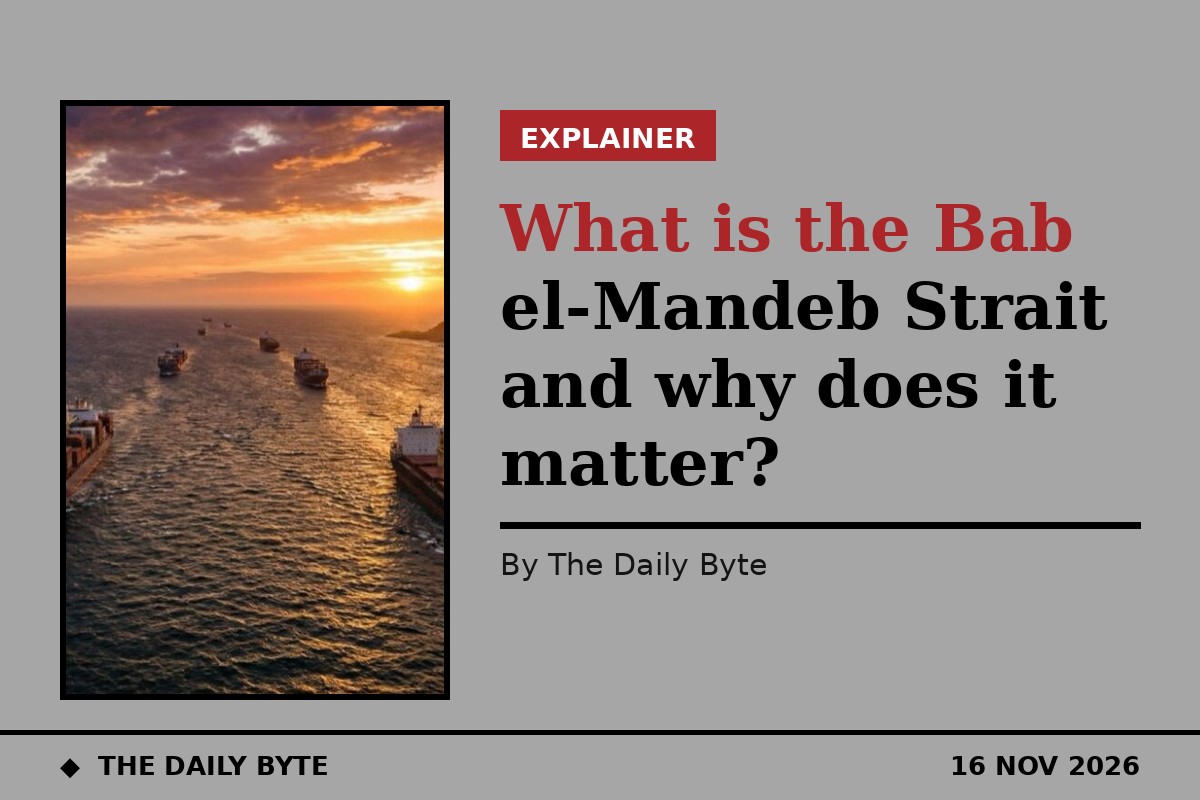
The Bab el-Mandeb Strait is the narrow waterway that connects the Red Sea to the Gulf of Aden, and through it the shortest sea route between Asia and Europe. It matters because about a tenth of the world's seaborne trade and millions of barrels of oil a day pass through it — and on 15 November 2026, Yemeni government forces withdrew from the land overlooking it, leaving the Iran-aligned Houthi movement in control of the ground around one of the world's most important shipping chokepoints.
The strait is not closed. Ships are still passing through it. What changed on 15 November is who holds the shore: the Houthis now control the coastline from which the narrow shipping lanes can be threatened with missiles, drones and small boats, at the same time as Iran is disrupting traffic through the Strait of Hormuz on the other side of the Arabian Peninsula.
Where is the Bab el-Mandeb Strait?
The strait sits between Yemen on the Arabian Peninsula to the north-east and Djibouti and Eritrea on the Horn of Africa to the south-west. Its name comes from Arabic and means "Gate of Tears" or "Gate of Grief", a reference to its treacherous sailing conditions. It is the southern gateway to the Suez Canal: ships travelling between Asia and Europe pass from the Indian Ocean through the Gulf of Aden, through Bab el-Mandeb, up the Red Sea and through the Suez Canal into the Mediterranean.
At its narrowest point the strait is about 29 kilometres (18 miles) wide, according to the US Energy Information Administration (EIA). The island of Perim — also called Mayyun — sits in the middle and divides it into two shipping channels, each only about two nautical miles wide. That narrowness is what makes it a chokepoint.
| Fact | Detail |
|---|---|
| Location | Between Yemen and Djibouti/Eritrea, joining the Red Sea to the Gulf of Aden |
| Width at narrowest point | About 29 km (18 miles), split by Perim Island into two channels |
| Oil flow | About 4.2 million barrels a day of crude and petroleum products in the first half of 2025 (EIA) |
| Share of world trade | Roughly 10 to 15 per cent of global seaborne trade; about $1 trillion of goods a year |
| Alternative route | Around the Cape of Good Hope, adding roughly 10 to 15 days to an Asia–Europe voyage |
What happened there on 15 November 2026?
On Sunday 15 November, Yemen's Southern Armed Forces — the forces fighting for the internationally recognised, Saudi-backed government — announced they were withdrawing from Dhubab Airport and the Bab el-Mandeb area, west of Taiz governorate, and redeploying towards Aden, where the government is based. Reuters reported that the withdrawal leaves the Iran-aligned Houthis in control of the area overlooking the strait.
The withdrawal ended a six-week government counteroffensive launched in October to retake the Red Sea coast. The Houthis had pushed south in September, capturing the port of Mokha and three strategic islands, and the fighting broke a 2022 United Nations-brokered truce. The Houthis already control much of northern Yemen, including the capital Sanaa, and Reuters reported they were about 80 kilometres (50 miles) from Aden.
The government forces described the move as a redeployment to secure Aden and strengthen front lines. A government spokesman, Majid al-Nazili, appealed for outside help to restore control of the strait and the west coast, saying the passage was essential to free navigation and trade.
Why does the strait matter for world trade and oil?
About 10 to 15 per cent of global seaborne trade passes through Bab el-Mandeb each year, worth about $1 trillion in goods, according to reporting by Reuters and the New York Post. The EIA estimated that about 4.2 million barrels a day of crude oil and petroleum products crossed the strait in the first half of 2025, down from 8.7 million a day in 2023 before the Houthi shipping crisis.
When shipping through Bab el-Mandeb becomes unsafe, vessels reroute around the Cape of Good Hope. The EIA estimates that detour adds roughly 15 days to a voyage between the Arabian Sea and Europe, with much higher fuel and insurance costs that eventually reach consumers as higher prices.
Traffic has partly recovered but remains far below its old level. Lloyd's List Intelligence counted 1,363 transits in October 2026 — up 43 per cent on a year earlier, but still 46 per cent below the level before the Houthi shipping crisis — and said there had been no attacks on shipping in the Red Sea since 24 August.
What is the "dual squeeze" with the Strait of Hormuz?
Reuters described the danger as a "dual squeeze". Iran has been disrupting traffic through the Strait of Hormuz, the other great chokepoint on the far side of the Arabian Peninsula, since the war that began in February 2026, and the United States has a naval blockade on Iran's ports. Saudi Arabia's workaround is the East-West pipeline, which carries crude across the kingdom to Yanbu on the Red Sea, avoiding Hormuz altogether.
From Yanbu, tankers either sail north through the Suez Canal or south through Bab el-Mandeb towards Asia. With the Houthis now holding the ground overlooking Bab el-Mandeb, that workaround is exposed too — and the Houthis have already hit Saudi ports, airports and Aramco facilities, including the Yanbu export hub.
Holding the shore is not the same as closing the strait, and no closure has been announced. The waterway remains open to commercial shipping, according to the Joint Maritime Information Center's advisory of 5 November. What has changed is leverage: from Perim Island and the mainland coast the Houthis can now threaten passing vessels with missiles, drones and small boats. They attacked more than 100 commercial vessels from this coast between late 2023 and 2025.
Is the Bab el-Mandeb Strait closed?
No. As of 16 November 2026, no authority has announced a closure and commercial ships are still transiting the strait. The question for shipping companies, insurers and oil markets is whether the Houthis use their new position against vessels, as they have before, or hold it as a bargaining chip. For households in the UK and Europe, the effect is indirect but real: sustained disruption raises shipping and fuel costs, and higher oil prices feed into petrol and diesel prices at home.
Frequently asked questions
What does Bab el-Mandeb mean? It is Arabic for "Gate of Tears", named for the strait's dangerous currents.
Who controls the Bab el-Mandeb Strait now? The waterway itself is an international shipping lane and no one has closed it, but since 15 November 2026 the Houthis control the Yemeni coastline and Perim Island overlooking it, after government forces withdrew to Aden.
How wide is the Bab el-Mandeb Strait? About 29 kilometres (18 miles) at its narrowest point, according to the US Energy Information Administration, with the island of Perim splitting it into two shipping channels each about two nautical miles wide.
What happens if ships cannot use Bab el-Mandeb? They reroute around the Cape of Good Hope, adding roughly 10 to 15 days to an Asia–Europe voyage and raising costs.
Sources: Reuters, via Duke FM; New York Post; US Energy Information Administration.


