What Is Bird Flu? H5N1 Avian Flu Explained
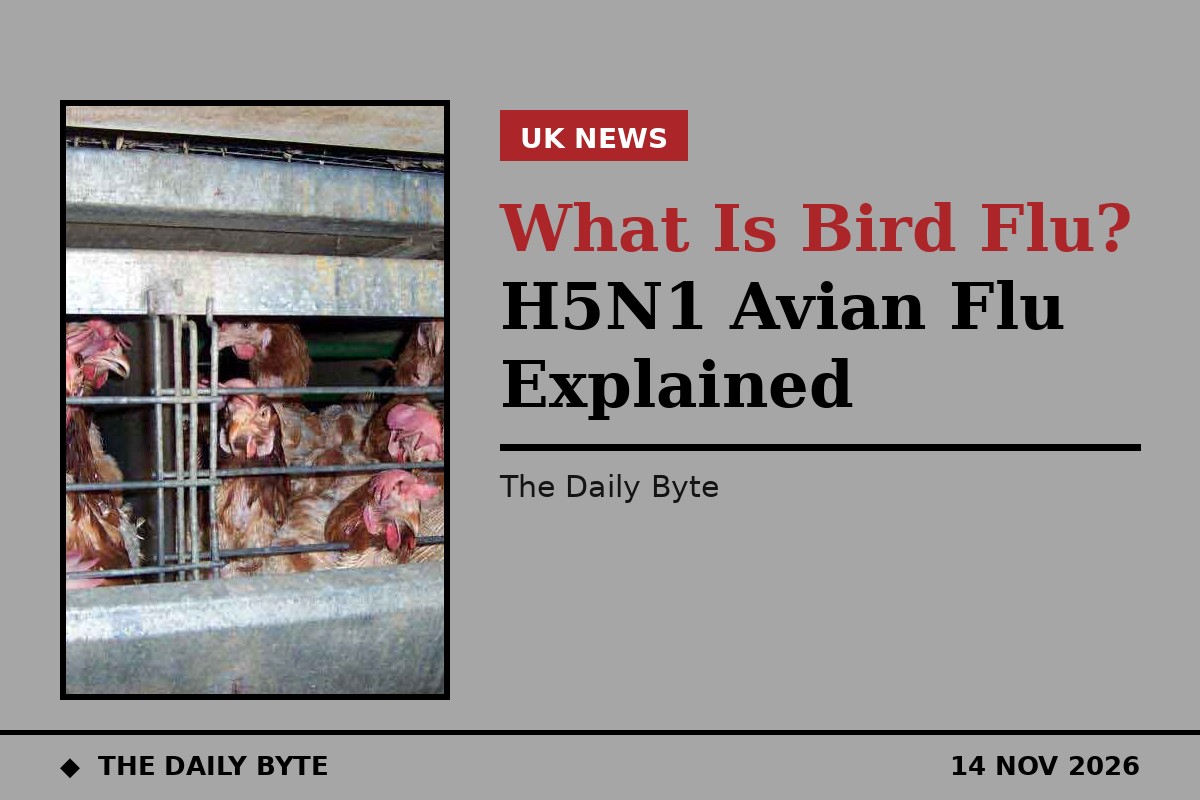
Bird flu, also called avian influenza, is a disease of birds caused by influenza A viruses that usually infect birds. The strain behind the current outbreak is H5N1, a highly pathogenic form of the virus that can kill poultry quickly and spread fast through flocks. It rarely infects people, and the risk to the general public in the UK is very low — but it is a serious animal disease, and that is why England has just ordered poultry keepers across the whole country to keep their birds housed indoors. From 00:01 on Friday 13 November 2026, keepers of 50 or more birds in England must house them, and the same applies to smaller keepers who sell or give away eggs, poultry products or live birds.
The housing order is the sharpest sign yet that this winter's bird flu season is under way. Cases have already been confirmed in commercial poultry in Norfolk and Lincolnshire and in backyard poultry in Orkney, and an England-wide avian influenza prevention zone with mandatory biosecurity measures is in force. This explainer sets out what bird flu is, what H5N1 means, how the virus spreads, whether people can catch it, what the symptoms are, and what the new rules mean for bird keepers and for everyone else.
What causes bird flu?
Bird flu is caused by specific influenza A viruses that usually infect birds. These viruses are different from the ones that cause seasonal flu in people. Like all influenza A viruses, they are classified into subtypes according to two proteins on the virus surface: haemagglutinin, shortened to H, and neuraminidase, shortened to N. Different combinations of these proteins produce subtypes such as H5N1 and H7N9. Five subtypes — H5, H6, H7, H9 and H10 — are known to infect people, and most reported human infections have been caused by H5N1, H5N6, H7N7, H7N9 or H9N2.
Wild water birds such as waterfowl, gulls and shorebirds are the main natural reservoir for bird flu viruses. In wild birds, infection is often mild or causes no symptoms at all, which allows the virus to travel long distances along migration routes. The danger comes when the virus spills over into domestic poultry, where some strains cause severe and fast-moving disease. Viruses are therefore also classified by how severe the disease they cause in poultry is: highly pathogenic avian influenza, known as HPAI, or low pathogenic avian influenza, known as LPAI. HPAI and LPAI viruses can both cause severe disease in people, but it is HPAI H5N1 that is driving the current outbreak in Britain.
Bird flu viruses can also change quickly. As Australia's Centre for Disease Control notes, the more they spread in animals or people, the more chances they have to change — and if a virus changed in a way that made it spread more easily between people, it could cause an outbreak or spread more widely. That is why health and animal health agencies around the world watch H5N1 so closely, even though human infections remain rare.
What is H5N1?
H5N1 is a subtype of avian influenza virus, named for its combination of haemagglutinin type 5 and neuraminidase type 1. It is the subtype behind the global animal outbreak that has been running since 2020, when the H5N1 clade 2.3.4.4b — a genetic subgroup of the virus — began causing illness and high mortality in poultry, wild birds and some mammal species around the world. That clade was detected in Australia for the first time in June 2026.
In poultry, H5N1 in its highly pathogenic form is devastating. Infected birds can die suddenly and in large numbers, and the standard control measure is to humanely cull all poultry on an infected premises and to declare disease control zones around it. That is what has happened at each of the premises confirmed in Britain this season: a 3km protection zone and a 10km surveillance zone are declared around the premises, and all poultry on the premises are humanely culled.
It is important to keep H5N1 in proportion. It is primarily a disease of birds. The UK Health Security Agency advises that bird flu is primarily a disease of birds and that the risk to the general public's health is very low, a position repeated on the government's bird flu guidance pages. The Food Standards Agency has said bird flu poses a very low food safety risk for UK consumers, and properly cooked poultry and poultry products, including eggs, are safe to eat.
How does bird flu spread?
Infected animals shed the virus in secretions, faeces and other body fluids, and into the air. Birds can pick it up from contaminated feed, water, bedding, equipment, clothing and vehicles, or from direct contact with infected birds. Wild birds are the usual route into a kept flock, which is why the current housing order exists: keeping birds indoors removes the contact with wild birds that drives most outbreaks in kept birds.
People can become infected if they touch an infected animal, its body fluids or something contaminated with the virus, and then touch their eyes, nose or mouth, or if they breathe in contaminated dust or air. Infection usually happens after close contact with infected poultry — such as chickens, ducks, turkeys and geese — or contaminated environments. That is why the people at highest risk of exposure are commercial poultry workers, animal disease outbreak responders, vets and vet nurses, wildlife carers and laboratory workers handling bird flu specimens. For the general public, who do not handle sick birds, the risk is very low.
The virus can also infect wild and kept mammals, which is known as influenza of avian origin. It is notifiable in both wild and kept mammals in England, meaning anyone who examines or inspects a mammal and suspects it, or who detects evidence of influenza A virus in a mammal sample, must report it immediately — by calling 03000 200 301 in England — and failing to report it breaks the law.
Can people catch bird flu?
Yes, but rarely. Bird flu rarely spreads to people, and when it does it most often causes a respiratory infection. Infections in people are detected sporadically around the world, and spread between people is very rare — the last documented cases of person-to-person transmission overseas were reported in 2007 for H5N1 and 2016 for H7N9. For the H5N1 clade 2.3.4.4b behind the current global animal outbreak, around 100 human infections have been reported, including more than 70 cases in the United States during 2024 and 2025, most of them mild, with a very small number developing severe disease. Most cases have been linked to exposure to infected poultry or, among dairy workers in the United States only, infected dairy cattle. There has been no reported spread from person to person for this clade.
That record is reassuring, but it is not a reason for complacency. Infections in people are rare but can cause severe disease or death, and severe disease and death are most commonly reported in H5N1, H5N6 and H7N9 infections. Because so few human infections have occurred, and there are so many subtypes, health agencies say it is not yet fully known which groups are at greater risk of severe disease, though they are expected to be similar to those at risk from seasonal flu: babies and children under five, older people, pregnant people, and people with certain chronic conditions or weakened immune systems. Anyone who develops symptoms within 10 days of contact with sick or dead birds or wildlife should call a health professional, say they have been around birds, and follow the advice given.
What are the symptoms of bird flu in people?
Some infected people have no symptoms at all. When symptoms do appear, they can include fever, cough, sore throat, runny nose, conjunctivitis — red, sore eyes — muscle aches and pains, headache, fatigue, and less commonly gastrointestinal symptoms such as nausea, vomiting or diarrhoea. Symptoms can range from mild to severe, and serious complications include pneumonia, acute respiratory distress, brain inflammation and sepsis. Symptoms usually start about three to five days after being infected, but this can range from one to ten days.
Eye redness has been a common feature of recent human cases, particularly among poultry and dairy workers, and people with conjunctivitis may have a swab taken from the eye as well as from the nose or throat. Diagnosis is usually made through laboratory testing of a nose or throat swab, and rapid antigen tests are not recommended when bird flu is suspected because they are less accurate and cannot identify the subtype. Most people with bird flu receive antiviral treatment to prevent severe disease, and people with bird flu are considered infectious from one day before symptoms start until either seven days after symptoms begin or their acute symptoms have gone.
Is bird flu in the UK now?
Yes. The 2026 to 2027 outbreak season is under way, and the UK is no longer free from highly pathogenic avian influenza under World Organisation for Animal Health rules. The first case of the season was confirmed in Scotland on 2 October 2026, and the first in England on 19 October 2026. By 13 November, the confirmed case totals for the season stood at seven H5N1 cases in England, two H5N1 cases and one H5N5 case in Scotland, and none in Wales or Northern Ireland — nine H5N1 cases and one H5N5 case in total. That is far below the 100 cases recorded in the 2025 to 2026 season and the 207 in 2022 to 2023, but the trend is what prompted action: an escalating number of confirmed cases in kept birds, plus findings in wild birds, led the UK Chief Veterinary Officer to act.
The most recent cases show the pattern. Highly pathogenic H5N1 was confirmed in commercial poultry near Dersingham in Norfolk on 9 November, near Market Rasen in Lincolnshire on 11 November, and near Dereham in Norfolk on 12 November. On 13 November it was confirmed in backyard poultry near Stromness in Orkney. At each premises, a 3km protection zone and a 10km surveillance zone were declared, and all poultry on the premises were humanely culled. On the same day, disease control work around a premises near Belford in Northumberland was completed successfully, and its 3km protection zone ended, becoming part of the surrounding 10km surveillance zone.
The risk of HPAI H5 in wild birds in Great Britain is assessed as high, meaning the event occurs very often. The risk of poultry being exposed is assessed as medium where biosecurity is suboptimal or poor, and low where stringent biosecurity is consistently applied at all times. That assessment is the logic behind the housing order: the risk cannot be removed, but it can be cut sharply by keeping birds away from wild birds and by strict hygiene.
| UK bird flu season 2026 to 2027 | Confirmed cases |
|---|---|
| England — HPAI H5N1 | 7 |
| Scotland — HPAI H5N1 | 2 |
| Scotland — HPAI H5N5 | 1 |
| Wales | 0 |
| Northern Ireland | 0 |
| First case of the season | Scotland, 2 October 2026; England, 19 October 2026 |
| Risk to the general public | Very low (UK Health Security Agency) |
What is the poultry housing order in England?
An avian influenza prevention zone, or AIPZ, covering England and Scotland was declared from 11 November 2026, making strict biosecurity a legal requirement for all bird keepers. On 13 November, the zone in England was updated to include mandatory housing measures, in force from 00:01 that day. The UK Chief Veterinary Officer, Christine Middlemiss, ordered the national housing order after the increased risk and escalating number of confirmations of highly pathogenic avian influenza in kept birds and findings in wild birds.
The rules are straightforward. If you keep 50 or more birds, you must house them — this applies to all types of birds. If you keep fewer than 50 birds and they are for your own use only, for example you do not sell or give away their eggs or meat, you do not have to house them. But if you keep fewer than 50 birds and you do sell or give away their eggs, poultry products or live birds, you must house them, because those birds count as poultry. Keepers of ducks, geese and swans, ostriches and rheas, or poultry kept for restocking game, may be eligible for an exemption from housing on welfare grounds, using a bird keeper statement agreed with their vet. Poultry and most captive birds cannot be vaccinated against bird flu in England; only zoo birds can be vaccinated, and only if they meet eligibility criteria and get authorisation from the Animal and Plant Health Agency.
All bird keepers in England, whether they have pet birds, commercial flocks or just a few birds in a backyard flock, must also follow the mandatory biosecurity measures in the prevention zone. The government has published guidance on housing birds safely, and keepers can check what zone they are in on the bird flu disease zone map on GOV.UK. Anyone who finds dead wild birds should not touch or move them, and should report them through the official channels; the Animal and Plant Health Agency can be called on 03000 200 301 in England.
Is it safe to eat chicken and eggs?
Yes. The Food Standards Agency has said bird flu poses a very low food safety risk for UK consumers, and properly cooked poultry and poultry products, including eggs, are safe to eat. The virus is not a food safety concern when meat and eggs are properly handled, prepared and cooked. The same advice applies abroad: only eat thoroughly cooked animal products, do not consume raw or unpasteurised milk, and stay away from sick or dead animals, poultry farms, backyard chicken enclosures and live animal markets when travelling. Garden bird feeding can continue, but always wash your hands with soap and water afterwards, and keep feeders and water baths clean to stop disease spreading between wild birds.
Frequently asked questions
What is bird flu? Bird flu, or avian influenza, is a disease caused by influenza A viruses that usually infect birds. The current outbreak is mainly H5N1, a highly pathogenic strain that is deadly to poultry but rarely infects people.
Can humans get bird flu? Rarely, usually after close contact with infected poultry or contaminated environments. Symptoms are often mild and flu-like, sometimes with sore, red eyes, but severe illness is possible. Person-to-person spread is very rare, and there has been no reported spread between people for the H5N1 clade 2.3.4.4b.
Do I have to keep my chickens indoors in England? If you keep 50 or more birds, yes, from 00:01 on 13 November 2026. If you keep fewer than 50 birds only for your own use, you do not. If you sell or give away eggs, poultry products or live birds, you must house them even with fewer than 50 birds.
Can I still eat chicken and eggs? Yes. The Food Standards Agency says properly cooked poultry and eggs are safe to eat, and bird flu poses a very low food safety risk for UK consumers.
What should I do if I find a dead wild bird? Do not touch or move it. Report it through the GOV.UK guidance on reporting dead wild birds, and wash your hands thoroughly with soap and water if you touch wild bird droppings or feathers. GOV.UK: Bird flu latest situation in England | GOV.UK: National housing order declared | Australian Centre for Disease Control: Bird flu