What Is Bitcoin? Explained Simply
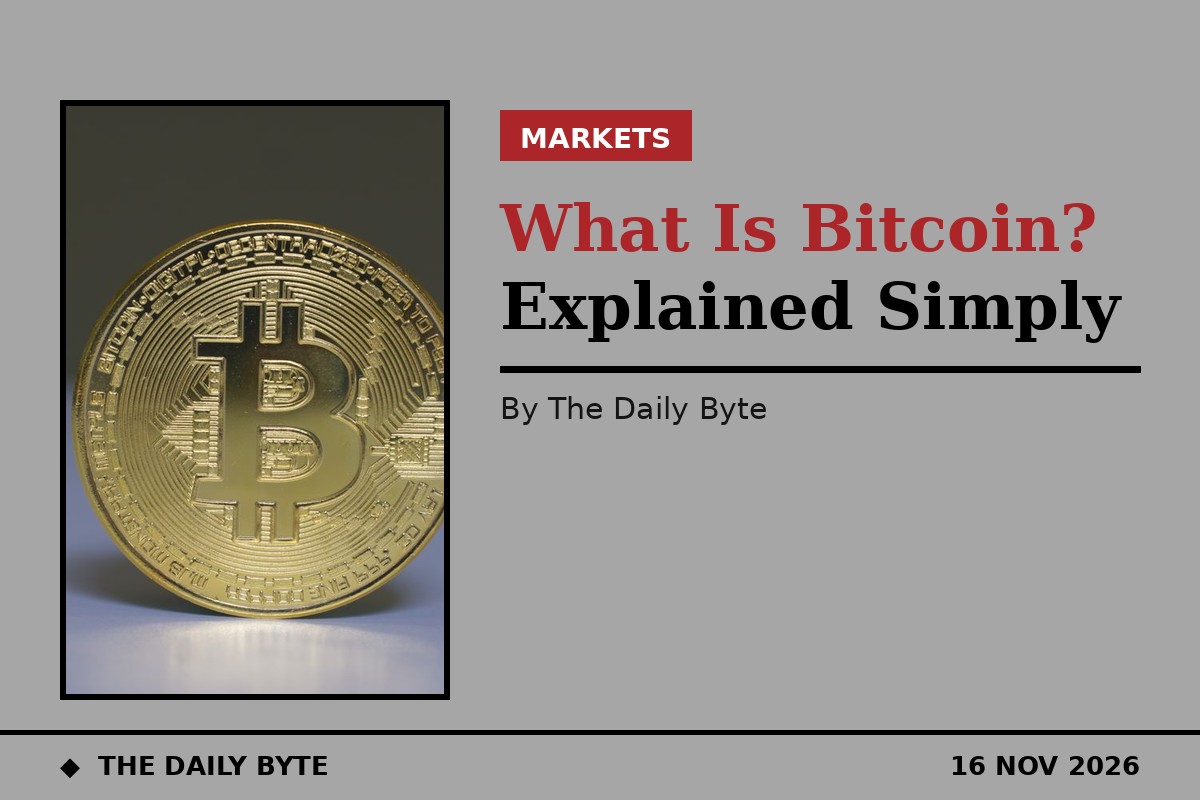
Bitcoin is a decentralised digital currency that lets people send value to each other over the internet without going through a bank. It is the first and best-known cryptocurrency, and it runs on a public record called a blockchain, which is maintained by thousands of computers around the world rather than by any central authority.
Bitcoin made headlines again on Sunday 15 November 2026, when it climbed back above 65,000 US dollars after sliding below 62,000 dollars overnight, its lowest level since mid-July. It was still trading about 23 percent below its high of 84,856 dollars on 21 October, after a sharp ten-day sell-off. This explainer sets out what Bitcoin is, how it works, why its price moves so violently, and what the risks are.
Who created Bitcoin?
Bitcoin was created by a person or group using the pseudonym Satoshi Nakamoto. On 31 October 2008, during the global financial crisis, Nakamoto published a nine-page paper titled "Bitcoin: A Peer-to-Peer Electronic Cash System" on an online cryptography mailing list. The paper proposed a form of electronic cash that could be sent directly from one person to another without going through a financial institution.
The first Bitcoin block, known as the genesis block, was mined on 3 January 2009. It contained the headline from that day's Times newspaper, "Chancellor on brink of second bailout for banks", a reference to the banking crisis that was unfolding at the time. Nakamoto stopped communicating publicly a little over two years later, and the true identity behind the name has never been established.
Bitcoin was the first cryptocurrency, and its design became the template for thousands of later digital currencies. None of them has matched Bitcoin's size: it remains the largest cryptocurrency by market value, accounting for about 59.6 percent of the total crypto market on 15 November 2026, according to CoinGecko data reported that day.
How does Bitcoin work?
Bitcoin works on a blockchain, a shared public ledger that records every transaction. When someone sends Bitcoin, the transaction is broadcast to a network of computers, known as nodes, which check that the sender has the funds to spend and that the same coins have not already been spent elsewhere. This solves the "double-spend" problem that had defeated earlier attempts at digital money.
Transactions are grouped into blocks, and blocks are linked together in order, forming a chain. New blocks are added by miners, computers that compete to solve a cryptographic puzzle in a process called proof of work. The winning miner adds the block and is rewarded with newly created Bitcoin. Because changing an old transaction would mean redoing the work for every block after it, the record is very hard to alter once it is written.
To use Bitcoin, a person needs a wallet, which is software or a device that holds the private keys needed to authorise spending. A private key is like a password: whoever holds it controls the coins. Lose the key, and the Bitcoin is effectively gone. Transactions are pseudonymous rather than anonymous. Wallet addresses are strings of letters and numbers, not names, but every transaction is visible on the public ledger, and an address can sometimes be linked to a person.
What is the 21 million limit?
Only 21 million Bitcoin will ever exist. That limit is written into the software, and it is one of the features that distinguishes Bitcoin from ordinary currencies, which central banks can print in larger quantities. New Bitcoin is created as a reward for mining, but the reward is cut in half roughly every four years, in an event called a halving. The most recent halving took place in April 2024.
Bitcoin is divisible to eight decimal places. The smallest unit is called a satoshi, after Satoshi Nakamoto, and one satoshi is 0.00000001 Bitcoin. That means a person does not need to buy a whole Bitcoin: at a price of 65,000 dollars, a hundred dollars buys a small fraction of one coin.
The fixed supply is often given as the reason Bitcoin is described as "digital gold" by its supporters, who argue that scarcity protects it against inflation. Critics point out that scarcity alone does not give something value, and that Bitcoin's price depends entirely on what other people are willing to pay for it.
What is Bitcoin worth now?
Bitcoin fell sharply in the first half of November 2026. It was still trading above 73,000 dollars on 11 November, then lost more than 15 percent in four days. On Coinbase, it fell to 61,946.17 dollars in the one-minute candle that opened at 8.45pm US Eastern Time on 14 November, its lowest since mid-July. It then recovered, regaining 65,000 dollars during the 9pm Eastern hour on Saturday, and Coinbase quoted 65,330.50 dollars at 7.12am Eastern on Sunday 15 November, about 5.5 percent above the overnight low.
Other venues told a similar story, with small differences that reflect the fact that there is no single official Bitcoin price. Bybit's contract printed a low of 61,899.20 dollars, and Bitcoin traded at 65,071 dollars at 23.27 UTC on 15 November. The weekend range on that venue ran from about 61,899 to 66,132 dollars. Prices vary between exchanges because each one has its own order book.
The fall capped a sixth consecutive weekly loss. Bitcoin was about 12.4 percent below the previous Sunday's close of 74,740 dollars, and it was roughly 48 percent below its record high of about 126,000 dollars set in October 2025. The total value of all crypto assets fell by about 571 billion dollars between 4 and 14 November, from 2.69 trillion to 2.12 trillion dollars, a drop of 21.2 percent.
Why has Bitcoin fallen so sharply?
The steadiest pressure has come from US spot Bitcoin exchange-traded funds, known as ETFs. These are funds that let investors hold Bitcoin through an ordinary brokerage account, and they had recorded about 1.91 billion dollars of net outflows over seven straight trading sessions from 5 to 13 November, according to figures compiled by Farside Investors. When ETF investors sell, the funds sell Bitcoin, which pushes the price down.
Forced selling of leveraged bets made the fall worse. CoinGlass recorded about 808 million dollars of Bitcoin futures liquidations in the 24 hours to Sunday 15 November, roughly three quarters of them long positions, meaning traders who had bet on the price rising. When prices fall far enough, exchanges automatically close those bets, which adds more selling.
Wider market worries also played a part. The US Bureau of Labor Statistics reported that consumer prices rose 0.4 percent in October, with core inflation at 0.3 percent, and traders began to expect another rise in interest rates from the Federal Reserve, whose next policy meeting is scheduled for 8 to 9 December. Weakness in technology shares added to the mood, and the Crypto Fear and Greed Index, a measure of market sentiment, read 10 on 15 November, deep in "extreme fear" territory.
How do people buy and store Bitcoin?
Most people buy Bitcoin through a cryptocurrency exchange or, in the United States and some other countries, through a spot Bitcoin ETF held in a brokerage account. Exchanges let users buy Bitcoin with ordinary currency and hold it in a wallet provided by the exchange, although that means trusting the exchange with the coins.
People who want to hold their own Bitcoin use a personal wallet. A software wallet runs on a phone or computer, while a hardware wallet is a separate device that keeps the private keys offline. Hardware wallets are generally considered safer against hacking, but they can be lost or damaged, and the owner is responsible for keeping a backup of the keys.
Bitcoin trades 24 hours a day, seven days a week, including weekends. That is why the sharpest moves in November 2026 happened on a Saturday night and a Sunday morning, when stock markets were closed and trading in Bitcoin was thinner. Weekend sessions can be more volatile because fewer buyers and sellers are active.
Is Bitcoin money or an investment?
Bitcoin was designed as electronic cash, a way to pay for things without a bank. In practice, it is rarely used for everyday purchases. Its price moves so much that few shops price goods in Bitcoin, and a payment that takes minutes to confirm is slower than a card tap. Supporters argue it works better as a store of value, like digital gold, or as a way to send money across borders without going through the banking system.
Its best-known use as an investment is as a speculative asset: people buy it because they expect the price to rise. US spot Bitcoin ETFs, launched in 2024, made that easier by letting ordinary investors hold Bitcoin through a brokerage account, and those funds have become one of the main drivers of the price. In November 2026, their selling was one of the main drivers of the fall.
Bitcoin is also used in countries with unstable currencies or strict controls on moving money, where people value a form of money that no government can freeze or print. That use is real, but it is a small part of total trading, most of which is speculation.
What are the risks?
The biggest risk is volatility. Bitcoin has fallen by more than 20 percent in a matter of days on several occasions, and it has lost more than half its value in past downturns. A fall of about 27 percent from its 21 October high of 84,856 dollars to its 14 November low of about 61,946 dollars took less than a month. Anyone who bought near the high would have lost more than a quarter of their money.
Other risks include hacking of exchanges, loss of private keys, fraud, and changes in regulation. Governments have taken very different approaches: some have welcomed Bitcoin, others have restricted it, and rules can change quickly. Bitcoin has no central bank or government standing behind it, and there is no compensation scheme if an exchange fails.
There is also an environmental cost. Proof-of-work mining uses large amounts of electricity, and critics argue that the energy use is hard to justify. Supporters say miners increasingly use surplus or renewable energy, but the debate continues, and it is one of the reasons some investors and institutions stay away.
Frequently asked questions
What is Bitcoin in simple terms? It is a digital currency that exists only online, is not controlled by any bank or government, and is recorded on a public ledger called a blockchain.
Who owns Bitcoin? Nobody owns the Bitcoin network. It is run by thousands of independent computers, and individual coins are owned by whoever holds the private keys to them.
How many Bitcoin are there? There will never be more than 21 million. New coins are created as mining rewards, and the reward halves roughly every four years.
Can Bitcoin go to zero? Its price depends entirely on what buyers are willing to pay, so a total collapse is possible in theory, though it has survived many sharp falls since 2009 and remains the largest cryptocurrency.
Is Bitcoin legal in the UK? Owning and trading Bitcoin is legal in the UK, and crypto assets are regulated by the Financial Conduct Authority, but Bitcoin itself is not legal tender and there is no government guarantee behind it.
This article is general information only. It is not financial advice, and it is not a recommendation to buy or sell Bitcoin or any other asset. Sources: Satoshi Nakamoto, "Bitcoin: A Peer-to-Peer Electronic Cash System", 31 October 2008; Qazinform, "Bitcoin rebounds above 65,000 dollars after sliding to lowest level since July", 15 November 2026; Farside Investors ETF flow data, November 2026; CoinGecko market data, 15 November 2026.